


The regulated online gambling market in the US is scrambling to keep up with predictive markets like Kalshi and Polymarket.
Are online gambling heavyweights DraftKings (Nasdaq: DKNG), FanDuel (NYSE: FLUT) in trouble?
In the realm of U.S. sports betting, prediction markets were once seen as an unregulated nuisance, with few giving the likes of Polymarket and Kalshi a chance of surviving the rigors and compliance challenges they faced to sustain a legitimate operational status.
Fast forward to today, and prediction markets are no longer playing second fiddle to state-licensed sportsbooks; they’ve ripped up the playbook completely.
Polymarket has even begun offering the chance for traders to wager on its own legal standing with a tongue-in-cheek event contract market, “Will sports prediction markets be banned in any U.S. state in 2025?”
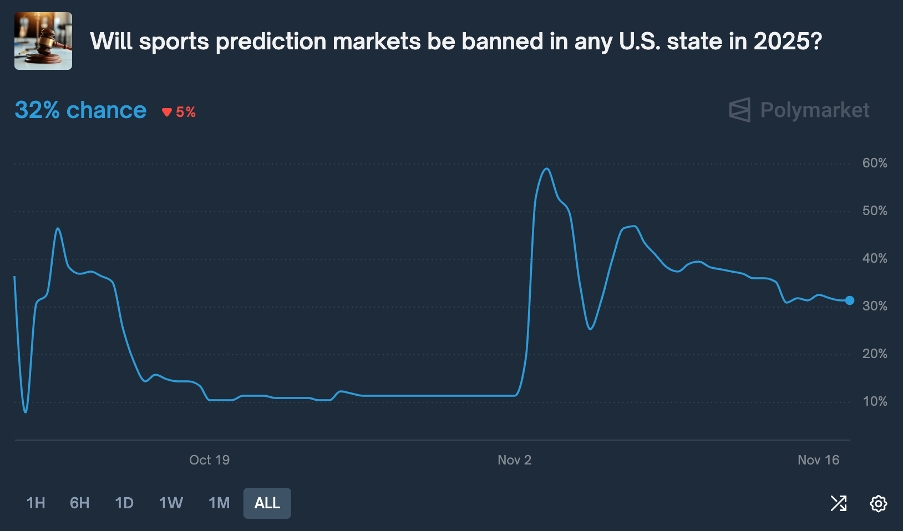
While currently trading at 32%, it’s perhaps a genuine reflection of just how far prediction markets have evolved since their early notoriety, largely due to their political event contract offerings.
Having already successfully launched a campaign to lure sports bettors away from mainstream sportsbooks, as DraftKings and FanDuel shares continue to tumble, is it too late for the previous darlings of Wall Street to bounce back?
Sportsbooks betting on a long-shot turnaround
It’s fair to say Wall Street could see the tide turning for Polymarket and Kalshi earlier this year, which perhaps is what sparked FanDuel to partner up with CME Group to launch its own FanDuel Predicts back in August.
DraftKings, on the other hand, was sluggish to respond, much to the dismay of its stakeholders, having only acquired Railbird Technologies, a CFTC-regulated platform, as of last month.
Nevertheless, DraftKings and FanDuel, the once-unchallenged behemoths of U.S. betting, have each seen their share prices free-fall since Kalshi announced their explosive NFL trading volume during Week 1 of the season. Both companies are down more than 30% since the start of the NFL season.
That being said, there is a belief on Wall Street that if the gaming giants can get their products to market sooner rather than later, they have a fighting chance of conquering the billion-dollar battleground of prediction markets. Sentiments shared by FanDuel’s parent company, Flutter, which has publicly declared it intends to unseat the likes of Kalshi as the U.S.’s leading predictions platform.
Legal wranglings yet to dent event trader confidence
Undeniably, there is a definite upside for both sportsbooks’ diversification, as with its CFTC approval in hand, it unlocks two of the highest-value state markets in California and Texas. Both of which are currently out of bounds to its sportsbook verticals due to the prohibition of sports betting — a much-needed incentive for existing investors to keep the faith.
Top 5 States where sports betting Is prohibited & adults eligible for sports contracts
| U.S. State | Total Population | Residents Over 18 |
| California | 39.4 million | 31.0 million |
| Texas | 31.2 million | 23.6 million |
| Georgia | 11.1 million | 8.6 million |
| Minnesota | 5.7 million | 4.4 million |
| Alabama | 5.1 million | 4.0 million |
However, with sizable investments in the pioneers of prediction markets already pouring in, it’s clear there is institutional support for the disruptors too.
Yet, despite all the hype and hyperbole on Wall Street, prediction market sports event contracts still face a barrage of objections from state regulatory bodies, with countless cease-and-desist letters and ongoing court cases across the country, meaning their universal legality is not a foregone conclusion.
However, one thing is for sure, the momentum behind prediction markets does not appear to be slowing, and with all parties throwing caution to the wind to enter the fold, should the likes of DraftKings and FanDuel eventually get up to speed, they could still dominate a sector ripe for explosive growth.