

MGM withdrew from a multi-billion-dollar application in New York to focus on other aspects of the business.
The news out of New York this week has both investors and analysts scratching their heads after MGM Resorts International (NYSE: MGM) announced it was withdrawing its application for a commercial casino license in Yonkers, New York.
In deciding to halt a proposed $2.3 billion expansion of Empire City Casino, backers were left questioning the future of MGM’s strategic direction within New York’s rapidly evolving gaming landscape.
MGM argued the decision stemmed from what they deemed as an excessive degree of competition from the cluster of rival casinos in close proximity to the project, while also citing that the reduction of its original license term, down from 30 years to just 15 years, was also a decisive factor.
Combined, MGM claimed that the planned modifications in Yonkers were no longer aligned with its initial long-term investment strategy or its original real estate agreement with VICI Properties.
Despite the expansion setback, MGM was quick to reassure stakeholders that the company remains dedicated to operating Empire City Casino in its current video lottery terminal format.
MGM closes one door, but opens another for its rivals
It’s no secret that MGM has always viewed New York’s gaming market as a prospective growth market, however, the decision to pull out of its Yonkers expansion this week possibly indicates a tapering of these aspirations.
Nevertheless, with MGM now stepping back, other operators look set to move in to capitalize on the opportunity. The first to benefit was Bally’s Corporation (NYSE: BALY), whose stock rose 5.8% on the news, fueled by renewed investor optimism about its $4 billion ‘Bally’s Bronx’ Complex.
Meanwhile, MGM’s bowing out of its planned expansion also added renewed impetus for the two other remaining approved casino projects involving Hard Rock International and Resorts World New York City, which both have large-scale planned developments in nearby Queens, New York.
Remaining Approved New York Casino Developments
| Project | Location | Developer | Investment | Highlights |
| Metropolitan Park (Queens, NY) | Adjacent to Citi Field, Flushing Meadows–Corona Park | Hard Rock International and Mets owner Steve Cohen | $8 billion | A Hard Rock casino, 2,000 hotel rooms, and a 7,000-seat arena |
| Resorts World New York City (Queens, NY) | Aqueduct Racetrack, South Ozone Park | Genting Group | $5.5 billion | 6,000 slot machines, 800 table games, 2,000 hotel rooms |
| Bally’s Bronx (Bronx, NY) | Ferry Point, former Trump Golf Links | Bally’s Corporation | $4 billion | 500,000 square feet of gaming space, 3,500 gaming machines, and a 500-room hotel |
MGM’s calculated retreat sends mixed signals to investors
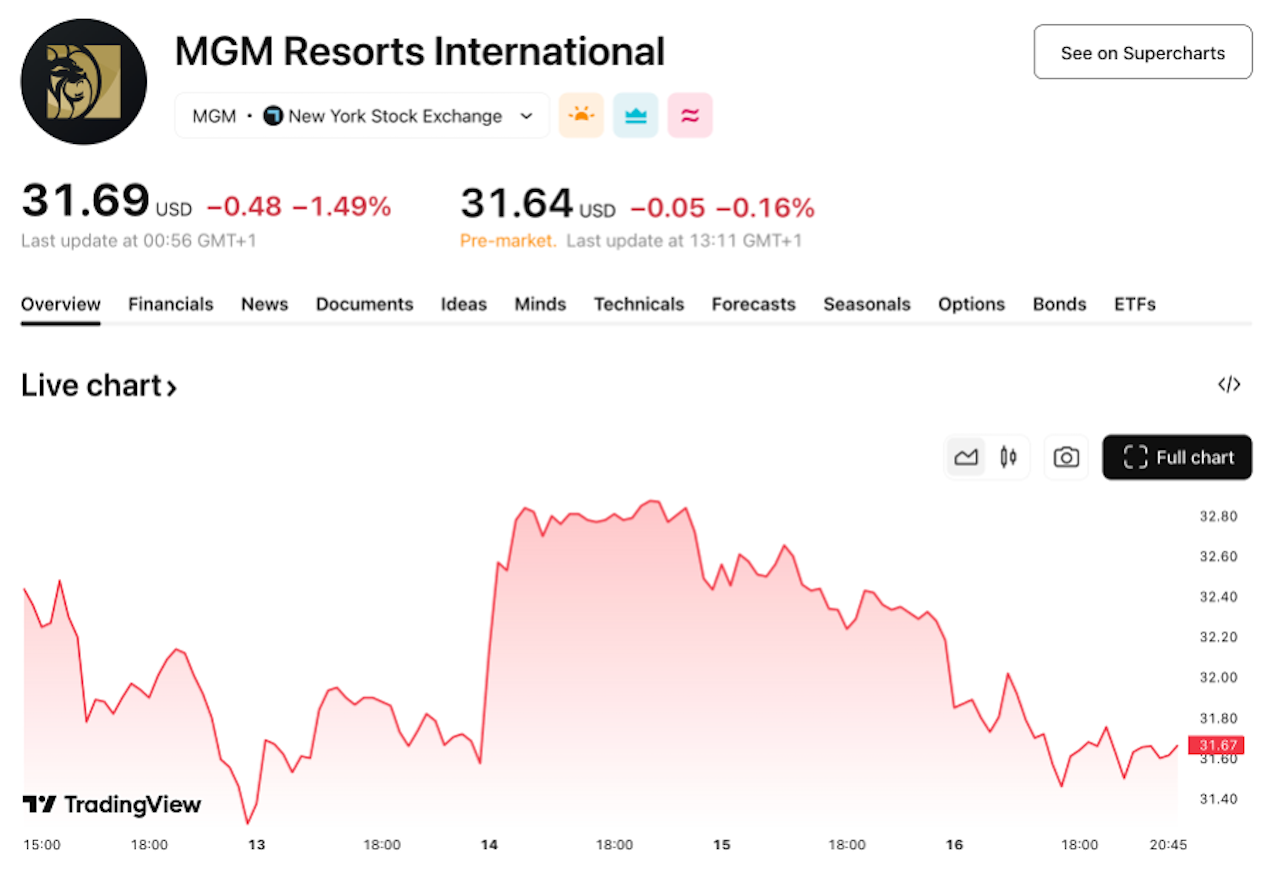
Following the news, MGM’s stock began falling from Tuesday’s high of 32.97 to 31.58, a drop of 4.2%, which was not surprising given the scale of the announcement.
Of course, it’s not inconceivable that MGM’s rescinded Yonkers development may mirror a broader mission statement to strengthen other areas of the business away from its dominant in-person casino revenues.
This might explain its high-profile campaign to rebrand BetMGM in August, purported to help siphon online gamers and sports betting customers away from rivals DraftKings (NASDAQ: DKNG) and FanDuel (NYSE: FLUT), while building on its own existing online player base.
For MGM’s investors, the strategic abandonment of its development plans could be considered an overtly cautious response to the intensifying competition in the Empire State. Yet, at the same time, its commitment to maintaining its existing Empire City Casino operations should reassure stakeholders that it doesn’t plan to surrender its lucrative foothold in the New York market just yet.