

Blockchain systems are organized into layers, each serving a unique role in making the entire ecosystem functional and efficient. These layers are called Layer 0, Layer 1, Layer 2, and Layer 3. Together, they ensure security, scalability, and usability for blockchain technology.
Layer 3 focuses on user interaction, providing applications like wallets, games, and marketplaces that make blockchain accessible to everyone. Layer 3 relies on Layers 1 and 2 for security and efficiency, offering a seamless user experience. In order to understand Layer 3 chains, we must first understand the role of other layers.
Layer 0: The foundations
Layer 0, often called the “infrastructure layer” or “network layer,” is the foundation of blockchain technology. It ensures the security, scalability, and stability of the platforms and applications built on top of it.
A primary role of Layer 0 is to facilitate cross-chain interoperability. By enabling seamless communication and data sharing between blockchains, it removes the isolation that would otherwise limit their utility.
This interconnectedness allows blockchains to collaborate, enhancing dApps by leveraging each other’s strengths. Layer 0 includes the essential tools and connections to build Layer 1 blockchains.
Layer 0 examples
Cosmos
Cosmos is a toolkit and network for launching custom blockchains that can talk to each other. Teams build with the Cosmos SDK and link through IBC, which moves tokens and messages across many chains. In 2025 the stack kept advancing: the Hub’s Interchain Security lets Hub validators secure consumer chains, and ibc-go shipped new versions to improve performance. Think of Cosmos as shared roads and rules that many Layer 1s use while keeping their own features and tooling across projects.
Avalanche
Avalanche can act like Layer 0 because it lets you spin up dedicated blockchains called Subnets while keeping them connected.
The core network hosts the EVM C-Chain, and Subnets choose their own rules. Recent upgrades simplified cross-chain messaging: in 2024 the Durango upgrade brought Avalanche Warp Messaging to the EVM and enabled Teleporter, so Subnets and the C-Chain communicate natively. For you, that means apps can scale across many chains yet still feel like one network to users and developers.Internet Computer
The Internet Computer is a base layer where smart contracts run fully on-chain and can call other blockchains directly. Through Chain Fusion, ICP can sign and send transactions to Bitcoin and Ethereum, and in June 2025 it added Solana support. Developers also use chain-key tokens like ckBTC to move BTC value on ICP without centralized bridges. For beginners, that means apps can mix features from multiple chains while staying on-chain, with one platform handling compute, storage, and cross-chain calls securely.
Layer 1: The Mainnet
Layer 1 (L1) blockchains are the main networks. They process transactions, secure the network, and record everything on the blockchain to keep it safe and trustworthy.
Bitcoin was the first Layer 1 blockchain, introducing the ‘decentralized digital currency’ concept. Ethereum advanced the concept with smart contracts and self-executing programs that enable developers to build decentralized applications (dApps) without intermediaries.
Each Layer 1 (L1) blockchain operates independently and uses its native token to process and reimburse transaction fees, often called gas fees. These networks serve as the “source of truth,” maintaining an immutable record of transactions.
While every Layer 1 network has unique features, they all aim to provide a secure, scalable infrastructure for running blockchain-based apps (like games or digital payments). Excluding Bitcoin, the majority of Layer 1 chains validate transactions based on proof of stake.
However, as usage increased, Layer 1 blockchains faced challenges like slower transaction speeds and higher fees. These limitations spurred the development of additional layers, including Layer 2 and Layer 3 solutions, to enhance scalability and efficiency.
Layer 1: examples
Bitcoin
Bitcoin is the original Layer 1 blockchain that records transactions securely without a central operator. In 2025, demand from spot ETFs and institutions keeps rising, and developers debate upgrades that could add programmability like OP_CAT or OP_CTV. You do not need to track every proposal to see why Bitcoin matters. It settles value globally and often leads market cycles. And mining firms are diversifying into AI data centers, which can change costs and revenues while supporting the network’s security overall.
Ethereum
Ethereum is a Layer 1 smart contract network where developers launch apps like exchanges, games, and stablecoins. After March’s Dencun upgrade reduced Layer 2 data costs, 2025 brought Pectra, which improved wallets and rollup data handling. And developers target the Fusaka upgrade for December 2025 to raise blob capacity, letting rollups process more traffic. You use Ethereum through apps while the base chain provides security and settlement.
That design helps Ethereum remain the main hub for on-chain apps and tokens.
Algorand
Algorand is a Layer 1 blockchain using pure proof of stake to reach fast finality and low fees. You can build tokens and apps with its AVM smart contracts, and state proofs enable trustless bridges.
In 2025, the Foundation joined the Blockchain Association and launched an Aid Trust Portal to track humanitarian payments. And Algorand published a 2025 plus roadmap focused on real world use and easier developer tools for users.
That mix targets clear use cases rather than speculation.
Layer 2: Scalability and features
Layer 2 blockchains are built on top of Layer 1 networks to address high transaction fees, slow speeds, and scalability.
These sub-blockchains use the infrastructure of Layer 1 to enhance performance while reducing costs. However, Layer 2 blockchains depend on their base networks; they cannot function if the Layer 1 blockchain is down.
Layer 2 (L2) networks help make blockchains faster and cheaper by handling some transactions outside the main blockchain. They then send the final results back to the main blockchain for verification.
Additionally, Layer 2 solutions vary in design. Some are built by changing the original blockchain (operating as forks), while others are new systems added on top (independent upgrades).
While Layer 2 makes blockchains more efficient, it can sometimes compromise the network’s security and decentralization because these newer solutions may not have been thoroughly tested yet.
Writer’s note: Layer 2 solutions include Rollups (Optimistic Rollups like Optimism and zkRollups like zkSync), Sidechains (e.g., Polygon), and State Channels (e.g., the Lightning Network). Below, we’ll define some of these in detail:
Layer 2 chain types
Optimistic rollups
Optimistic rollups are a Layer-2 solution that helps blockchains process more transactions at lower costs. They work by bundling multiple transactions into one “rollup” and processing them off the main blockchain.
These rollups assume transactions are valid unless proven otherwise, allowing for reduced congestion on the main blockchain. If errors are found, proof can be submitted to correct them, maintaining security through dispute mechanisms.
Zero-Knowledge rollups (ZK-Rollups)
ZK-Rollups are Layer-2 solutions that enhance blockchain efficiency by processing transactions off-chain. They generate proof to validate transactions without revealing all details, which is then sent to the main blockchain (Layer 1) for verification.
This method keeps blockchains scalable, efficient, and private, using mathematical guarantees for accuracy instead of trust to ensure fast and secure transactions.
Sidechains
Sidechains are separate (or independent) blockchains that work alongside a main blockchain to improve scalability. They allow users to transfer assets back and forth between the two chains.
Sidechains handle their transactions and don’t depend on the main blockchain for security, making them faster and more flexible. However, they rely on their validators to ensure safety, which means their security is independent of the main chain.
Validium
Validium is a Layer-2 solution that enhances blockchain scalability by moving transaction data off-chain while retaining proofs on the main chain. Unlike rollups, it stores data externally but uses cryptographic proofs for transaction validity.
This method improves scalability and reduces costs, though it sacrifices some decentralization. It’s often the practical choice for applications with high transaction volumes.
Layer 2 examples
Optimism
Optimism scales Ethereum with optimistic rollups and the open-source OP Stack. In 2024 it enabled permissionless fault proofs, bringing OP Mainnet to “Stage 1” decentralization and paving the way for more secure withdrawals. The OP Stack also powers the Superchain (which we’ll discuss below), a family of L2s like Base and World Chain that share standards and upgrades. You get cheaper, faster transactions without leaving Ethereum’s security. Builders benefit.
Linea
Linea is a Consensys-built zkEVM Layer 2 that’s compatible with existing Ethereum apps and tools. Transactions are proven with zero-knowledge proofs, lowering fees while keeping Ethereum’s security. ETH pays gas.
In 2025 Linea launched the LINEA token with buy-and-burn mechanics tied to L2 fees, no investor allocation, and a Binance listing on September 10. You get fast, low-cost transfers plus a growing ecosystem. For builders.
The Liquid Network
The Liquid Network is a Bitcoin sidechain for faster, confidential settlement. It pegs BTC to LBTC via a two-way peg run by federation functionaries, with one-minute blocks and two-block finality. Confidential Transactions hide amounts and asset types. DynaFed lets the federation expand. In 2025 the federation reported 81 members. USDT also exists on Liquid, making exchange and OTC transfers quick and private. For institutions too.
StarkEX
StarkEX is StarkWare’s SaaS Layer 2 engine that uses STARK proofs to batch transactions. Apps can choose Rollup mode (data on Ethereum) or Validium mode (data held off-chain by a committee), trading higher throughput for different trust assumptions. It has powered large apps like Sorare, and several exchanges. In 2025 some deployments wound down while others persisted, reflecting varied needs across projects.
Layer 3: The application layer
Layer 3 is where decentralized applications (DApps) operate. These apps operate on blockchain networks, enabling users to perform tasks such as sending cryptocurrencies, trading, or borrowing money without relying on central authorities.
Built on top of Layer 2 solutions, Layer 3 (L3) enhances scalability and performance, offering solutions to reduce network congestion and computational bottlenecks. It also allows the creation of customized networks that are often required depending on the industry the chain will be used for, centralized or decentralized.
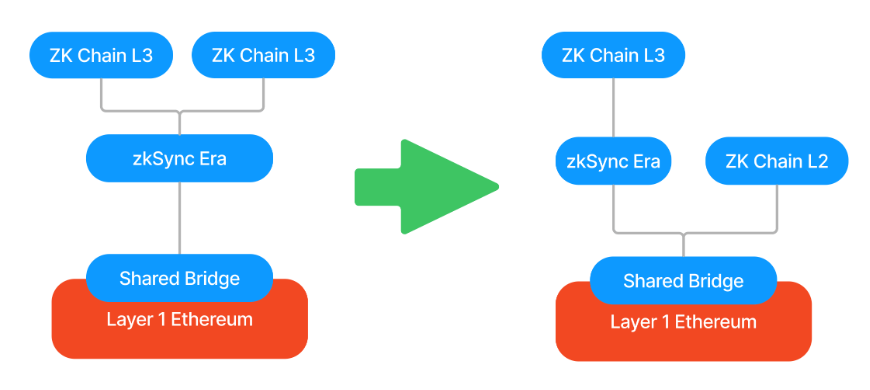
While Layer 2 focuses on improving the performance of a single blockchain, Layer 3 expands the blockchain ecosystem’s capabilities by connecting multiple blockchains and facilitating seamless communication between them. This allows DApps to operate with greater efficiency, security, and flexibility.
Layer 3 enhances the functionality of blockchains by making them faster and more user-friendly. It gives developers more tools to create apps that fit specific needs, helping these blockchains run smoothly and work better with other blockchains.
One idea proposes that Layer 3 could support privacy-focused applications, enhance cross-chain interoperability, and offer tailored solutions for various industries, such as finance, gaming, e-commerce, logistics, and healthcare.
It may host confidential smart contracts, facilitate asset transfers between blockchains, and cater to specific use cases like supply chain management and healthcare.
Layer 3 examples
Arbitrum Orbit
Arbitrum Orbit lets teams launch their own chains that settle to Arbitrum rollups. You pick settings like the gas token, governance, and data availability, then inherit Arbitrum’s security and EVM tools. Orbit chains get new features such as Stylus for WebAssembly smart contracts and improved compression, plus permissionless validation introduced through BoLD in 2025, helping decentralization for builders and users.
zkSync Hyperchains
zkSync Hyperchains are custom zero-knowledge chains built with the ZKsync Stack. They interconnect through a shared bridge so users and liquidity move easily, while proofs settle on Ethereum.
Developers can tailor fees, data availability, and privacy.
Recent updates highlight the Elastic Network vision and enterprise offerings like Prividium, plus tooling that makes launching L2 or L3 chains simpler for teams wanting security via ZK proofs.
Orbs
Orbs is a Layer 3 network that adds an extra execution layer to smart contracts. It runs validator nodes that execute off-chain logic, then settle results back on-chain, enabling features like dTWAP, dLIMIT, Liquidity Hub, and Perpetual Hub on multiple DEXs.
In 2025, the project advanced its V4 infrastructure and published further transparency updates for its trading protocols and operations.Optimism’s Superchain
Optimism’s Superchain is a network of chains built with the OP Stack. These chains share security assumptions, governance, upgrades, and an interoperability layer, so users and apps can move across them with less friction. Well-known members include Base and World Chain. In September 2025, the Collective prepared Upgrade 16a, a maintenance release that refines interop code and keeps the Superchain on a unified path forward.
The benefits of Layer 3 chains
Layer 3 blockchains offer great benefits to the blockchain ecosystem:
- Layer 3 solutions enhance scalability through specialized blockchains that improve throughput and reduce congestion for DApps.
- They enable seamless communication and asset transfers between different blockchains.
- Layer 3 allows the development of tailored blockchains for specific industries, such as gaming, supply chain, and logistics, offering flexibility beyond Layer 1 and Layer 2.
- These solutions can add extra security to protect user data and transactions, especially for apps focused on privacy.
Conclusion
Layer 3 blockchains are currently in development and are likely to evolve into customized chains tailored to meet specific industry requirements. With their potential to deliver faster transaction speeds, reduced fees, and a more streamlined user experience, Layer 3 solutions are expected to drive broader engagement with blockchain technology.
This advancement could play a significant role in boosting the adoption of decentralized platforms and innovations such as DeFi 2.0 coins, which are designed to offer more sustainable, efficient, and user-friendly financial services on the blockchain.
Although discussions around Layer 4 have begun, there is still no clear consensus on its definition or scope making Layer 3 the current frontier of blockchain development.