


Crypto arbitrage refers to the process or strategy of capitalizing on price discrepancies across various crypto platforms for risk-adjusted profits. Although the core arbitrage remains consistent, 2025 comes with new tools and tighter margins. It also brings fresh strategies that shape the entire outlook of the process.
In this article, we explore the meaning of crypto arbitrage, including the types of arbitrage that dominate, as well as some notable pros, cons, and risks.
What is Crypto Arbitrage?
Crypto arbitrage still means buying a coin where it’s cheap and dumping it where it’s a touch pricier. The profit hides in the spread. Yet spreads are razor‑thin now because market‑makers, high‑frequency desks, and on‑chain oracles keep prices almost level across venues. Speed beats brains. Bots wired into exchange APIs scan thousands of pairs every second, fire orders, and flatten positions before you blink.
There are three core paths: a straight cross‑exchange lift, a triangular hop inside one platform, or a flash‑loan loop that borrows, flips, and repays in a single block. Each path runs on code, capital, and low latency. You need cash parked on multiple venues, servers sitting meters from exchange engines, and tight risk checks.
So when we say crypto arbitrage, we’re talking about an infrastructure race. The question “is crypto arbitrage profitable” hinges less on spotting mispricing and more on whether your stack outruns everyone else. Without that toolkit, spreads vanish before you even see them.
Understanding crypto arbitrage
Arbitrage involves buying a cryptocurrency for a low price in one place and selling it in another where it trades higher, thereby pocketing the price difference. In crypto, that often looks like cross‑exchange crypto arbitrage—snapping up BTC on Bybit, then offloading on Coinbase a second later.
It can also be triangular crypto arbitrage, where you loop three pairs inside one venue—say ETH/USDC → USDC/SOL → SOL/ETH—ending with more ETH than you started. Because spreads are slim, you must subtract trading fees, network withdrawals, and slippage before counting any gain. A solid crypto arbitrage trading guide always starts with that maths, not the trade itself.
Potential profit in crypto arbitrage
Back in 2017 you could skim two‑ or three‑percent gaps for hours. Today, low‑risk crypto arbitrage strategies rarely show more than a few basis points.
Market makers stream quotes across 50‑plus venues, while on‑chain oracles broadcast real‑time prices into DeFi pools. Even retail bots ping every pair, so opportunities compress fast. Fees climbed too: most exchanges added tiered taker costs and stricter withdrawal limits.
Nevertheless, if there is a steep price differentials across different exchanges, it may be quite profitable. The profit will depend on the amount of capital that has been allocated for the trade and its ability to capitalize on the opportunity before the price stabilizes.
Importance of speed and automation in arbitrage
Milliseconds decide winners. A modern desk pipes price data straight into RAM, runs co‑located servers near exchange engines, and relies on coded strategies.
Crypto arbitrage bots auto‑subscribe to order‑book websockets, compute edge size, and send orders without human approval. Many traders even plug a crypto arbitrage profit calculator into the bot to block trades that net under 0.05%.
The swap must be executed in matter of seconds (often less than 30 seconds) in order to take advantage of the arbitrage.
Types of crypto arbitrage
Crypto arbitrage isn’t one tactic; it’s a bundle of crypto arbitrage strategies that attack price gaps from different angles. As you’ll see below, while each path calls for its own stack multi‑wallet funding, fee‑aware bots, or block‑level scripting every path chases the same goal: grab basis points before spreads snap shut.
Cross‑exchange
Cross‑exchange arbitrage ships a coin from Exchange A to Exchange B when B’s ask runs higher. You pre‑fund both sides so you can sell instantly and back‑haul later. Fees, withdrawal lags, and on‑chain gas cut margins, so you lean on high‑throughput APIs and multi‑exchange bots. It’s the classic cross‑exchange crypto arbitrage play, still alive but hyper‑competitive in 2025; spreads hover near zero.
Triangular
Triangular arbitrage hunts pricing gaps among three pairs inside one exchange. Example: BTC/ETH, ETH/USDC, USDC/BTC— a triangular arbitrage example crypto desks still run. Start with BTC, pivot through ETH and USDC, and end with more BTC. All hops stay on one book, eliminating withdrawals. Maker‑taker fees remain, so exact timing and a fee‑aware bot are vital in low spreads.
Flash‑loan
Flash‑loan arbitrage uses DeFi protocols that let you borrow vast sums with no collateral if you repay within the block. Borrow, swap where the price is low, sell where it’s high, clear the loan, keep the residue. Profit can be juicy, but smart‑contract risk, gas spikes, and sandwich bots can vaporize the edge in brutal on‑chain races.
DeFi vs CeFi
DeFi pools quote prices from automated market makers (AMMs), while CeFi books reflect centralized order flow. Arbitrage arises when Uniswap lags Binance after a sudden rally. You might buy on the pool, dump on the exchange, or reverse. DeFi gives 24‑hour access and flash loans; CeFi offers deeper liquidity but stricter KYC. Many desks build hybrid bots for seamless routing.
Is crypto arbitrage still profitable in 2025?
Yes, but only if you’re well‑equipped. Edges still exist, yet they vanish within seconds unless you combine deep capital with co‑located servers, fee‑aware bots, and instant settlement routes.
The same dynamic drives flash‑loan loops and cross‑exchange hopsprofits flow to stacks that fuse real‑time data, self‑optimizing code, and strict fee‑control. Without that toolkit, spreads seldom outpace taker fees, gas, or withdrawal delays, turning “risk‑free” trades into losses.
Crypto arbitrage in tokenized assets: Gold
Gold is among the commodities that were tokenized. The two leading digital assets of gold are Tether Gold (XAUt) and Pax Gold (PAXG). The digital gold is available on both decentralized and centralized exchanges.
In our example, we will focus on Kraken and Uniswap. At the time of this writing, these are the current prices.
Kraken PAXG price

Uniswap PAXG price
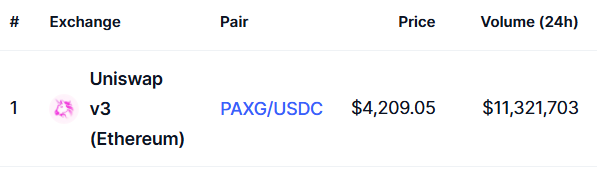
On Kraken, PAXG is trading at $4,231.75, and on Uniswap, it is trading at $4,209.05. If one can buy PAXG on Uniswap at a price lower than the value of PAXG on Kraken, the difference may be the profit.
It is still considered a minor difference, and the prices can stabilize at any time. There may be occasions (although not many) where the price difference is more profound. Additionally, there may be scenarios where it is cheaper to buy PAXG on Kraken and sell it on Uniswap for a higher price.
It is only an example. Crypto arbitrage is for experienced traders who also understand the risks.
Crypto arbitrage trading step-by-step guide
Build knowledge & experience
- Learn how order books, AMMs, and fee tiers shape spreads, then study case reports from desks like Wintermute.
- Keep a journal of your simulated trades to spot botched fills, fat‑finger slips, and hidden costs.
Set up your infrastructure
- Pre‑fund wallets on at least three CEXes and two DEXes so you never wait on a blockchain confirmation.
- Spin up a VPS near the exchanges, plug in APIs, and test a crypto arbitrage profit calculator against historical data.
Choose your arbitrage strategy
- Decide early: cross‑exchange for simplicity, triangular for fee savings, DeFi flash‑loan loops for leverage.
- Stick to one playbook until you log 100 back‑tests that clear fees and slippage.
Monitor markets & identify opportunities
- Stream tick data into a dashboard that fires alerts when a spread tops your threshold in basis points.
- And pull price feeds from CoinGecko or similar so bots see the same numbers you do.
Execute with automation
- Trigger bots to place simultaneous buy‑sell legs; never rely on manual clicks.
- Keep retry logic tight—if a leg fails, auto‑unwind in seconds to cap losses.
Manage risk and fees
- Track every withdrawal timer, KYC daily limit, and fee schedule in a live sheet. But cap exposure per trade so one stalled transfer doesn’t freeze your entire stack.
Pros and cons of Crypto Arbitrage
Pros
- Profit without taking price direction bets
- Positions close in seconds, slashing market risk
- Scales smoothly once bots and servers are live
- Works in any market mood—bull, bear, or flat
- Multiple strategy paths diversify revenue flow
- 24/7 automation frees you from manual clicks
Cons:
- Tiny spreads shrink returns fast
- Exchange + gas fees erase thin edges
- Large pre‑funding ties up capital
- KYC holds and custodial freezes stall funds
- Latency races favor better‑wired rivals
- Smart‑contract or counterparty blow‑ups nuke balances
Risks associated with crypto arbitrage
Arbitrage feels like free money until hidden frictions bite. In 2025 the edge often sits under 0.05%, so one extra second, a gas spike, or a compliance hold flips green to red. You’re battling spread decay while juggling networks, regulators, and your own code.
The faster your stack, the sharper the risk that a micro‑delay erases profit. Because you trade across exchanges, chains, and borders, every leg inherits fresh points of failure.
Let’s break down the biggest issues associated with these strategies:
A. Latency
Servers meters from a matching engine still lose races when jitter spikes. One dropped packet delays an order, the spread slams shut, and your hedge leg fills at a worse price. Co‑location fees rise yearly, yet residential connections can’t keep up. Time your routes, benchmark round-trip speed daily, and adjust throttle position sizes when network health degrades to avoid unexpected losses.
B. Fees
Every exchange or swap has its costs. Withdrawal fees, gas costs, and overnight funding if you use leverage. When spreads show 0.04%, a 0.1 % taker fee flips green to red instantly.
Maintain a live sheet of costs per venue, negotiate VIP tiers, and route through maker orders or on-chain liquidity where fee rebates or gas-discount tokens exist to preserve net profit margins.
C. Regulatory risk
Rulebooks rarely warn you before changing. A new travel‑rule deadline, a ban on privacy coins, or tighter withdrawal checks can freeze assets mid‑loop. Regional arbitrage adds currency‑control paperwork and tax surprises. Track each venue’s compliance blog, keep KYC documents updated, and hold a legal buffer account so you can settle trades even when one exchange locks deposits without warning overnight.
D. Platform risk
Centralized venues can halt withdrawals or suffer hacks; DeFi pools can be drained via smart‑contract exploits. Either event leaves you long on one side and unable to hedge. Spread capital across multiple platforms, use cold storage for idle funds, and limit on‑exchange balances to what your bot needs for the next few hours of trading during volatile market shocks, too.
E. Bot misfires
Automation can backfire. Bad parameters, stale price feeds, or coding bugs dump positions at a loss or buy illiquid tokens. Implement circuit breakers, dry‑run upgrades in sandbox mode, and keep human override hotkeys nearby. Regularly audit logs and push unit tests before each deployment to catch glitches.
Conclusion: Crypto arbitrage rewards professionals, not casual users
Crypto arbitrage can still generate profit but only for traders with professional‑grade infrastructure and a high tolerance for risk.
You need substantial capital spread across several exchanges, servers placed close to matching engines, live fee tracking embedded in every quote, and automation that closes positions immediately when conditions change.
Skip any component and the narrow spreads rarely cover costs, creating churn and tax headaches. Beginners should treat arbitrage as a learning exercise rather than a revenue source. Begin with paper trades, build fee‑aware calculators, and understand how custody, compliance, and latency interact.
Scale only after repeated tests show consistent net gains. The opportunity persists, yet its entry requirements now resemble a corporate technology budget.