

Investing in the S&P 500 index is one of the best ways to gain exposure to the US stock market. The gauge, which tracks the performance of 500 large-cap stocks, including Apple, Nvidia, and Microsoft, covers approximately 80% of the total market capitalization of US public companies. It’s also one of the most-watched stock market indices in the world, providing an indication of the overall health of the US economy.
The S&P 500 has a history of impressive growth. The index has a total return of 297% over the past decade, which is not to be sniffed at. However, you can’t directly invest in the S&P 500 index. It would also be hard to invest in 500 individual companies to replicate its performance. Fortunately, you can get all the benefits by investing in index funds and exchange traded funds (ETFs) that track the index.
In this guide, we’ll show you exactly how to invest in the S&P 500, using various S&P 500 index funds and ETFs.
Why invest in the S&P 500?
Founded in 1975, the S&P 500 is the granddaddy of US market-cap-weighted indexes. To be included in the index, a company must be based in the US and have a market cap of at least $18 billion.
The allure of the S&P 500 is multifaceted. First, as the index includes companies across a broad range of industries and sectors, it offers diversification, a key risk-mitigation strategy for all investors. Spreading your investment across hundreds of companies will reduce risk compared to putting your money into just a few stocks. Being exposed to the combined performance of 500 large-cap US companies through an index fund or ETF provides significant diversification, reducing risk compared to picking individual stocks.
Second, the S&P 500 has a history of decent growth. Also, S&P 500 index funds or ETFs that track the index have a solid track record of good returns over the long term, often outperforming individual stocks.
Finally, index funds and ETFs that track the S&P 500 typically come with low fees, keeping more of your hard-earned returns in your pocket.
Using such index funds or ETFs is one of the simplest ways to invest in the stock market and these financial instruments typically have lower expense ratios than actively managed funds, helping investors to keep more of their investment gains. S&P 500 index funds and ETFs are widely available through various brokerage accounts, for example, eToro, making them accessible to many investors.
Historical performance of the S&P 500
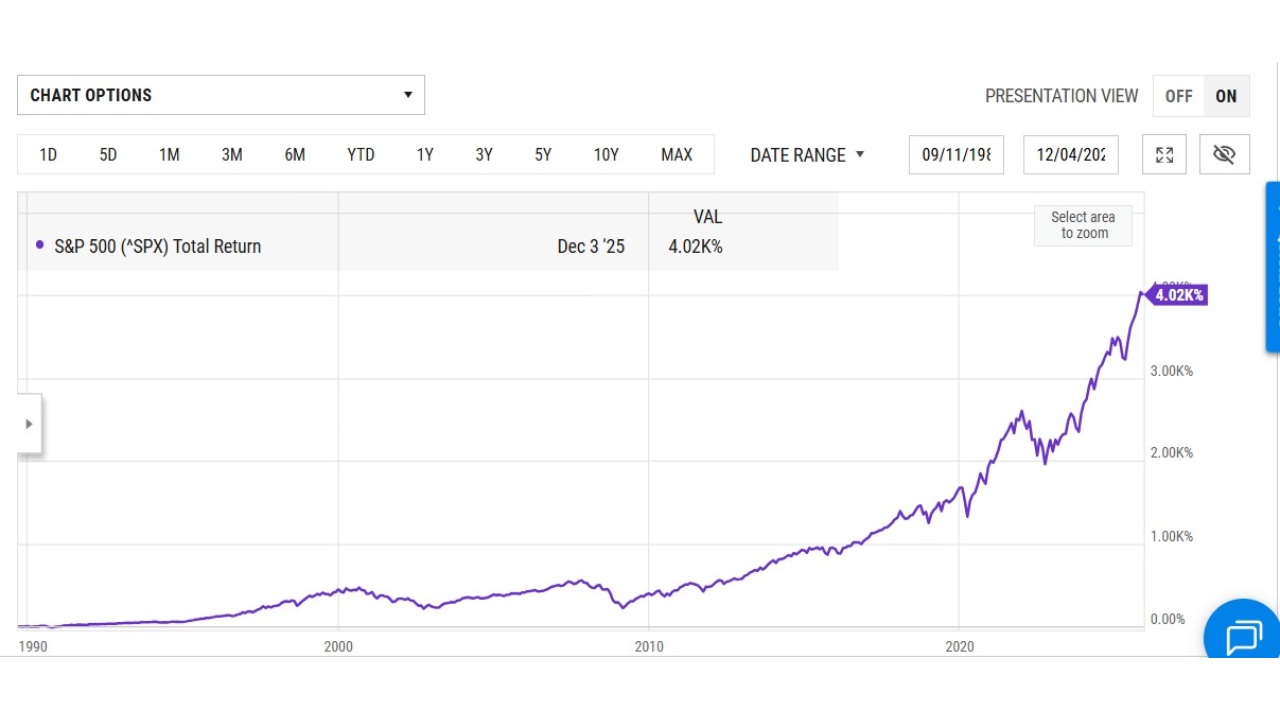
The S&P 500 has posted an average annualized return of approximately 10.5% over the past 50 years, including dividend reinvestments. Though the trend for the index has been up, it has still experienced significant volatility over the years, with both major ups and downs.
During the bursting of the dot-com bubble of the late 1990s and the financial crisis of 2008, the index saw sharp declines. This year has seen a significant jump of more than 16%.
Despite these fluctuations, the S&P 500 has generally trended upward over the long term, demonstrating its potential for growth over time. Being invested in the index for the long term can also serve as a hedge against volatility.
The following chart shows the index’s total return gain since 1990:
What is the 10-year average annualized return of the S&P?
The index has an annualized return of 12% over the past decade. An investment of $100 in the S&P 500 Index a decade ago would be worth more than $391 today.
2 ways to invest in the S&P 500 in 2025: Index funds and ETFs
For investors looking to replicate the performance of the S&P 500 in their portfolio, ETFs and index funds are viable options.
Investing through an S&P 500 index fund
An S&P 500 index fund is a form of passive investment that tracks this US stock market benchmark. The financial institution that manages the index fund will invest in the shares of the companies that make up the index. This also means that the assets within the index are fixed and determined by its composition and weightings.
The benefits of S&P 500 index funds include diversification of investments, as the index encompasses companies from various sectors. It’s a good choice for investors with a long-term perspective who can remain unfazed by the rises and falls in the index’s value. S&P 500 index funds are available through brokerage firms and asset management companies.
Investing via an S&P 500 ETF
Investing in the benchmark US stock index via an ETF means buying an ETF from an investment platform or app. The ETF manager buys stock in every member of the index and compiles a basket of stocks using the same weightings as the index. Then it lists this ETF on an exchange. The investor’s money will rise or fall with the S&P 500.
Popular choices include the SPDR S&P 500 ETF Trust (SPY), Vanguard 500 Index Fund ETF Shares (VOO), and iShares Core S&P 500 ETF (IVV). You can track the ETF’s value and returns through your brokerage account or financial websites.
Investing in the S&P 500 with an index fund: a 6-step guide
Step 1: Understand your goals
Start by understanding how the S&P 500 works and how it aligns with your financial objectives. This knowledge will guide your investment strategy. If you’re looking to add diversification to your portfolio, an index fund that tracks the S&P 500 index is a great place to start.
Step 2: Choose an investment account
Select an account like a brokerage, IRA, or 401(k) to hold your S&P 500 investments. Not all brokers have access to S&P 500 index funds, though most do.
Step 3: Research various index funds
There are numerous index funds available that track the S&P 500 Index, but they vary significantly, primarily in their expense ratios. While past performance doesn’t guarantee future success, it makes sense to look at index funds that have a solid track record.
The expense ratios of each index fund can significantly impact its performance. A good expense ratio for a mutual fund is less than 1%. For example, while there are index funds with no expense ratios, some actively managed funds have expense ratios of 0.52% or higher. This means that, with an investment of $1,000, the annual expenses could amount to $52 per year.
Many brokers provide research on index funds. Many offer a fund search tool that allows you to filter by fund type (such as index funds), market capitalization (e.g., S&P 500), and other criteria. Take a look at each fund’s profile, which shows the funds’ objectives, investment strategy, expense ratio and performance history. Many platforms also provide ratings on various index funds that include analyst reports.
Step 4: Choose your S&P 500 index fund
Pay attention to these popular index funds
Popular funds that track the S&P 500 include the Fidelity 500 Index Fund (FXAI), the Vanguard 500 Index Fund Admiral Shares (VFIA) and the Fidelity Flex 500 Index Fund (FDFIX).
The Fidelity 500 Index Fund has a low 0.015% expense ratio and requires no minimum investment, making it easily accessible to all investors. So far this year, it has returned 16.74%. It normally invests at least 80% of assets in common stocks included in the S&P 500 Index and has 507 holdings, making it quite diverse.
The Vanguard 500 Index Fund Admiral Shares has an ultralow expense ratio of 0.04%, but it requires a minimum investment of $3,000. It currently holds 504 stocks. So far this year, its performance is a return of 10.73%.
The Fidelity Flex 500 Index Fund has an expense ratio of 0.00%. It currently holds 511 stocks. There’s no minimum investment requirement, and its return so far this year is 16.62%.
Step 5: Make your trades
Once you’ve chosen your approach, use your investment account to buy shares of S&P 500 index funds. It’s important to think long-term when purchasing S&P 500 index funds, as many of them outperform individual stocks over a period of time.
Step 6: Monitor and rebalance
Regularly review your investments to ensure they remain aligned with your goals. The S&P 500 is broad, so diversification is key. Rebalance your portfolio as needed to maintain your desired asset allocation.
Investing in the S&P 500 with an ETF: 6 easy steps
Exposure to the S&P 500 through an ETF is very similar to investing in the S&P 500 with an index fund. You’re looking for ETFs that track the S&P 500 Index, have a low expense ratio, and a proven record of success. Follow these five steps:
Step 1: Understand your investment goals
Focus on why you’re buying an ETF that tracks the S&P 500. Are you looking for a long-term investing strategy that doesn’t require a lot of management on your part? Does your portfolio need additional diversification beyond what you already own? The key is an ETF that tracks the S&P 500 Index, which may fit many investment profiles.
Step 2: Choose your brokerage
If you’re at the beginning of your investing career, make sure the broker you choose offers plenty of educational opportunities, low fees and the ability to trade an assortment of ETFs.
Step 4: Choose your ETF
Though the ETFs that track the S&P 500 may have similar track records, it’s important to understand that your own performance may depend on an ETF’s fees, how much you’re able to invest, and other factors. This step is the most crucial. Beginners often start with index ETFs, like those tracking the S&P 500, as they offer broad market exposure.
Pay attention to three popular S&P 500 Index ETFs:
The SPDR S&P 500 ETF Trust (SPY). Launched in 1993, it is the oldest ETF in the US with $703 billion in assets under management (AUM). It has 503 holdings, an expense ratio of 0.0945%.
The Vanguard’s S&P 500 ETF (VOO) features an expense ratio of only 0.03%. It has $799 billion in AUM. Vanguard is a pioneer in ETFs and closely tracks the S&P 500 Index. The one downside is that it trades at more than $628 per share, so unless your broker allows you to buy partial shares, it can be expensive to invest in.
The iShares Core S&P 500 ETF (IVV) US-based ETF has more than $732 billion in AUM. Its expense ratio is 0.03%. It has 503 holdings and is priced at more than $507 per share.
Step 5: Make your trades
ETFs can be bought whenever the markets are open, so it’s a relatively easy process. Depending on your broker, your choice may come down to what is offered and whether there are any promotions featuring an S&P 500 Index ETF.
Step 6: Monitor your portfolio
Index ETFs are not designed for frequent trading, but it still makes sense to monitor your ETFs and rebalance your portfolio accordingly. While these ETFs provide broad diversification in large-cap US companies, it may make sense to make sure you have exposure to mid-cap and small-cap stocks, as well as international stocks.
Investing in an S&P 500 index fund or S&P 500 ETF: which is better?
This isn’t a simple answer because many S&P 500 index funds and S&P 500 ETFs have more similarities than differences, including low fees. In some cases, ETFs, because they are traded in real time, provide more flexibility, but the initial investment can be more expensive. S&P Index funds are only traded once a day, but can be purchased for as little as $1.
The fees on both index funds and ETFs are low, particularly when compared to those of actively managed funds. Many ETFs track an index, which helps keep fees low. Since the fund changes based only on changes to the index – a passive approach – there are few labor costs associated with index funds. Ultimately, the best decision for you may come down to the individual fund or ETF.
Pros and cons of investing in the S&P 500
Index funds and index ETFs are investments that track a specific stock market index, such as the S&P 500. By investing in an index fund or an ETF that tracks an index, you’re essentially buying a piece of every company in that index. This offers a diversified approach to investing, as it spreads your risk across multiple companies. There are pros and cons of investing in the S&P 500.
The benefits of investing in an S&P 500 index fund or ETF
- Long-term returns: Over time, the S&P 500 has consistently shown growth, making it a reliable investment option.
- Hands-off approach: Index funds and ETFs require minimal management, making them ideal for investors who prefer a passive investment strategy.
- Diversification: By investing in an index fund or ETF that tracks the S&P 500, you automatically gain exposure to hundreds of profitable large-cap companies, reducing your risk.
The drawbacks of investing in an S&P 500 index fund or ETF
- You lose individual stock control: If you want to pick and choose specific companies, an index fund or ETF that tracks an index may not be the best choice.
- No exposure to mid-cap and small-cap stocks and international stocks. This may mean your portfolio will lack diversification, unless you also broaden your portfolio.
Ultimately, the decision to invest in an S&P 500 index fund or ETF depends on your individual investment goals and risk tolerance. If you’re looking for a low-maintenance, diversified investment strategy with long-term potential, an index fund or ETF could be great options.
How much does it cost to invest in the S&P 500?
There are ways to invest in the S&P 500 for as little as $1, as some S&P 500 index funds require no minimum investment, though some require as much as $3,000 to begin investing. S&P 500 Index ETFs vary widely in price, though some of the most popular ones cost at least $500 a share.
The cost of investing in an S&P 500 index fund
You can begin investing in an S&P 500 index fund for as little as $1, or pay as much as $3,000 to begin your investment.
The cost of investing in an S&P 500 ETF
The minimum cost of investing in an S&P 500 ETF is the cost of one share of the ETF, which varies from under $100 to above $500 a share.
The price of investing in individual stocks within the S&P 500
There’s a huge range of prices for the individual stocks within the S&P 500, from slightly more than $8 a share for packaging maker Amcor to more than $7,600 a share for homebuilder NVR.
FAQs on investing in the S&P 500
How should a beginner invest in the S&P 500?
How does the S&P 500 index influence the economy?
Can I invest in the S&P 500 index from outside the US?
What if I invested $100 a month in S&P 500?
Can you invest directly in the S&P 500?
What is a good time to invest in the S&P 500 index?
What’s the best performing S&P 500 stock so far this year?
References
- S&P 500’s growth
- Fidelity 500 Index Fund
- Fidelity Flex 500 Index Fund
- Vanguard 500 Index Fund Admiral Shares
- SPDR S&P 500 ETF Trust
- Vanguard S&P 500 ETF
- iShares Core S&P 500 ETF