

Short selling refers to borrowing shares and then selling them at a higher price with the objective of purchasing them later at lower prices, thereby making profits out of this difference.
At first, the short selling definition might seem baffling and complex, but after reading this article, you’ll find yourself well-versed in the intricacies of short selling stock. You will soon know the short selling process, bridged through simple, straightforward explanations.
What does short selling mean?
Unlike traditional investing strategies, where the aim is to buy low and sell high (otherwise known as ‘going long’), short selling (going short) flips this approach on its head. The aim is to sell high and buy back low.
The short selling meaning, often simply termed as ‘shorting,’ can be quite perplexing for those new to investing. This strategy is predicated on the belief that the stock’s price will decline, allowing the short seller to profit from the difference after returning the shares to the lender.
It’s a tactic that’s commonly used by those who speculate that a stock’s price is inflated or likely to fall. Hedge funds are especially known to engage in short selling in order to hedge against the possibility that the stocks they own will go down.
How does short selling stocks work?
Firstly, short sellers must locate a stock that they can sell after borrowing. The main objective is buying back the stock at a lower price than when it was sold, in order to give it back to its lender and keep the rest as a profit or pay out the difference as loss, after deducting all fees charged on the loan plus brokerage commission.
Here are several key steps involved in the short selling process:
- You have to find a share that you think will decrease.
- Borrowing shares of that stock from a broker.
- Sell them on the open market.
- Wait for a price decline.
- Buyback the shares.
- Return shares to the lender.
- Profit/Loss incurred.
Let us consider an example so that you may understand how a profit or loss depends on what happens when a short seller goes short.
Let’s say you want to sell shares in ShortyMcShort Co because you believe that they are going down soon. The current market price of ShortyMcShort’s stock is $100.
Initiating the short sale
Alexandro borrowed 100 shares of ShortyMcShort Co from his broker and sold them at the market price of $100 per share.
He received USD 10,000 for this transaction (USD 100 x 100 shares).
Scenario A – Profitable Outcome
- After a month, the cost of one share was reduced to $80 in relation to ShortyMcShort Inc.
- Consequently, Alex closed his short position by purchasing 100 stocks at $80 each, which cost him $8,000.
- He then returned the shares to the brokerage and earned a profit amounting to $2,000 ($10,000 minus $8,000).
Scenario B – Loss-making outcome
- Contrary to Alex’s expectations, the price of ShortyMcShort Inc. rose to $120 per share.
- Therefore he decided to cut his losses by buying back 100 shares for cash at a value of $120 per unit resulting in an expense worth $12,000.
- After returning back those shares to his brokers’ office, he made a loss totaling – $2,000 from his initial sale ($10,000) – repurchase price ($12,000).
Mobile Apps for shorting stocks
The advent of mobile trading apps has significantly simplified and automated the process of short selling for retail investors. Now, with just a few clicks on their smartphones, you can engage in short selling as easily as buying stocks, with these apps handling the complexities of borrowing and selling shares seamlessly in the background.
This technological advancement has made short selling more accessible to a wider audience, though the inherent risks and complexities of this strategy still remain.
What is naked short selling?
It involves selling stock that the investor has not borrowed and does not own. This is unlike traditional short selling, where the investor borrows the stock before selling it.
Don’t worry, you needn’t turn up the central heating to do naked short selling!
In a naked short sale, the critical difference lies in the fact that in naked short selling, the seller has not secured the stock to be sold.
This practice can lead to situations where there are more shares sold short than actually exist in the market, a scenario that became especially infamous during the GameStop trading frenzy of 2021 (more on that shortly).
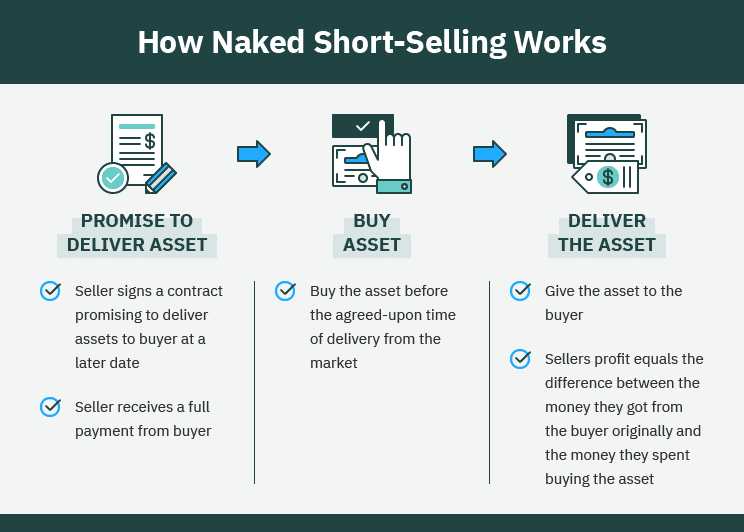
Naked short selling is heavily regulated and, in many jurisdictions, is either restricted or outright banned due to the risks it poses to market integrity.
For instance, the US Securities and Exchange Commission (SEC) imposes strict rules against this practice. The rationale behind these regulations is to prevent market manipulation and maintain fair trading conditions.
Who are typical short sellers?
These days pretty much anybody can be shorting a stock whenever they please, but the demographic of short sellers is heavily skewed towards professional traders and institutions because of the extra risks involved.
These entities often use short selling as a strategy within their broader investment portfolio, either to hedge against market downturns or to take advantage of overpriced stocks.
The field also includes renowned professional short sellers and firms, such as Muddy Waters, known for their expertise in identifying and capitalizing on overvalued stocks and sometimes fraudulent businesses.
Short selling metrics
Understanding the key measurements of short selling is very important for anyone who intends to invest in capital markets as these measures will give you an inside look into short-selling activity.
Short interest
This is the total number of shares sold short in a particular stock but not covered or closed yet. This is best understood in relation to the overall float of the company because different companies issue different numbers of shares.
Short percentage of float
This is a percentage of the number of shares sold short out of the total number of outstanding shares. A higher figure typically implies negative market sentiment towards such stocks.
Short interest ratio (SIR)
The SIR, otherwise known as the “days to cover” ratio, quantifies how many days it will take for all outstanding shorts positions to be covered based on an average daily volume of shares traded. A relatively high ratio indicates that short sellers would need more time to close their positions.
Price trends and volume
While not exclusive to short selling, tracking price trends and trading volumes can provide context to the short-selling metrics. Sudden spikes in volume or sharp price movements might reflect short-selling activities.
Ideal conditions for short selling
There are two distinct scenarios that are often considered most conducive to the short selling process.
1. Short selling overvalued stocks at high prices
This approach involves identifying stocks that are perceived to be overvalued at their current high price levels. Investors who employ this strategy believe that the stock’s price does not accurately reflect the company’s fundamental value and is due for a correction.
This perception of overvaluation might stem from factors like speculative hype, over-enthusiastic investor sentiment, or financial discrepancies in the company’s reports.
2. Short selling a stock on downward momentum
Some investors prefer to short sell stocks that have already started falling in price. This strategy banks on the momentum of the price fall, anticipating that the initial decline is a precursor to a more significant drop. Such downward movements might be triggered by adverse news, disappointing earnings reports, or broader market downturns.
In both scenarios, short sellers rely on careful analysis and timing. They must assess not only why a stock might be overvalued or why it has started to fall but also when the market will reflect these assessments in the stock price.
Famous examples of short selling
Historical examples provide insightful lessons on short selling, such as George Soros’ bet against the British Pound and hedge funds’ shorting of GameStop and AMC, among others. In addition, other notable examples can be highlighted to illustrate the diverse nature of short selling strategies.
George Soros shorting the British pound:
The example that comes to mind when many people hear the words ‘going short’ is George Soros, whose actions were aimed at betting against the UK’s national currency during 1992’s Black Wednesday.
He projected that either devaluation or withdrawal from ERM was inevitable for the pound sterling. Thus, his fund went heavily into a short sell position on the pound, which reportedly netted him a $1 billion profit when the currency did depreciate.
Hedge funds shorting GameStop and AMC:
Some hedge funds took large positions against companies like GameStop and AMC, seeing them as overpriced. However, a sudden surge in purchases by retail investors in early 2021, who mostly communicated through social media platforms, pushed up the prices of these stocks, now known as meme stocks.
Thereby, they caused massive losses to the short sellers. The event displayed how powerful retail investment can be when done collectively, and how unpredictable the outcome of short selling is. This event gave rise to the meme-stock category, which are heavily-shorted and little-known stocks being popularized by social media chat rooms.
Short selling regulations
Short-selling restrictions are in place to ensure fairness and market stability, although they vary across countries. In the US, shorting activity is overseen by the Securities and Exchange Commission (SEC), while in the UK, it’s the Financial Conduct Authority (FCA).
Naked shorting, where shares are sold without borrowing them first, is heavily restricted or prohibited in many jurisdictions due to its potential to exacerbate market volatility.
To enhance market transparency, some regions require investors to disclose substantial short positions. These regulations seek a balance between recognizing short selling as a legitimate investment strategy and preventing issues like market manipulation.
Risks of short selling
The major risk associated with short selling is the possibility of a “short squeeze” occurring when stock prices unexpectedly rise, forcing lots of sellers who had initially enjoyed low prices, to suddenly need to buy them back from the market at higher prices so as to cover their shorts.
This could drive further losses for those involved if such a prolonged upswing were sudden in what is often referred to as a short covering rally.
There is no limit to the losses that may arise from short selling since there’s no cap on how high a stock’s price can rise. This is as opposed to the purchase of stocks where the loss is limited to the initial investment, which in a worst-case scenario drops to zero.
Short selling involves borrowing shares, which can result in margin calls when prices move against you. Additionally, interest accrues on borrowed stock, thus adding to cost.
Lastly, changes in regulations can change short-selling strategies, and some stocks may have low trading liquidity, making it difficult for shorts to cover without impacting price substantially.
Most investors avoid short selling because of the inherent risks. It is really a strategy for experienced investors who understand and can manage these risks.
Ethical considerations of short selling
Critics claim that during times of turbulence, short sellers are responsible for steepening the market declines or that they could disseminate misleading information about firms so as to benefit from falling share prices.
However, supporters regard this practice as a natural method of correcting overpriced equities and hence a more efficient and quicker return to equilibrium within the markets. They argue that short sellers can reveal frauds as well as financial weaknesses in companies, thereby promoting market transparency. This ethical dichotomy makes short selling a controversial aspect of stock market trading.
Pros and cons of short selling
Pros
- Can present the opportunity to make money in bearish markets
- Can serve as a hedge in diversified portfolios
- Helps to correct overvalued stocks
Cons
- Requires detailed knowledge of market dynamics due to high risks and complexity
- Strict, changing regulations are applicable
Conclusion
Short selling is an aggressive trading strategy that entails selling borrowed shares with the intention of repurchasing them at lower prices. It is a method that can be used by any investor who uses mobile applications for trading.
However, it also poses a great risk to the investor going short via the possibility of incurring unlimited losses, and the strategy raises moral objections from some market participants.
FAQs
What is short selling for beginners?
Is it a good idea to short-sell?
Who are the biggest short sellers?
Can you legally short a stock?
References
- How Soros Broke the British Pound (The Economics Review)
- This Hedge Fund made 35% on Its Twitter Bet (Financial News)