


UK investors are increasingly turning to online stockbrokers, which have made stock trading more accessible and affordable than ever before.
Several factors have contributed to this trend, including technological advancements that have resulted in intuitive platforms and mobile apps, making it easier to trade on the go. Additionally, low minimum deposits and the ability to buy fractional shares have also played a role.
We have analysed several online stock brokers in the UK based on the range of stocks they offer, their investment fees, minimum initial deposits and other factors. We found that these 10 trading platforms below have the most to offer UK stock investors.
The best online stock brokers in the UK ranked
These 10 stock brokers available in the UK stand out with low-cost fees, intuitive interfaces, plenty of options and educational opportunities:
- eToro: Renowned for its social trading features, eToro allows you to copy the trades of experienced investors. The platform offers a user-friendly interface and more than 6,000 stocks from 20 different exchanges.
- XTB: The Poland-based broker offers a user-friendly platform and a wide range of tradable assets, including over 6,000 stocks. It allows both contracts for difference (CFDs) and actual stocks to trade.
- Pepperstone: Known for competitive pricing, ample trading instruments, and fast execution speeds, the Melbourne-based broker offers more than 1,000 stocks, plus other CFD instruments, including forex.
- Admiral Markets: The London-based company offers both CFD trading on forex, crypto, ETFs, indices, stocks, commodities and bonds and single-share trading on stocks and ETFs and a range of platforms.
- FP Markets: The Sydney-based online broker offers raw spreads and a variety of account types to suit different trading styles, and CFD trading for forex, stocks, indices, commodities and cryptocurrencies.
- Trade Nation: The London-based platform is known for its educational support, making it ideal for beginner and intermediate traders seeking personalised guidance.
- Saxo Bank: Known for its robust platform suite, Saxo caters to both beginners and experienced traders. It offers a wide range of investment products and tools, including 23,500 stocks.
- Trading 212: Known for its low fees, the stockbroker provides a simple platform for beginners. It offers both share investing and CFD trading and was the first UK broker to allow commission-free trading.
- Freetrade: The commission-free platform that focuses on simplicity and transparency is ideal for those starting their investment journey. It lists more than 6,200 stocks, as well as ETFs, trusts, and UK Treasury bills.
- IG: The London-based company offers CFD trading in crypto, forex, indices, and commodities, as well as direct stock and ETF investing. It provides advanced charting tools and educational resources.
Your capital is at risk.
- Show Full Guide
An in-depth look at the top-ranked UK online stock brokers
Discover the top-rated platforms for UK stock traders. Our rankings are based on a variety of factors, ensuring you find the ideal platform for your trading needs.
1. eToro: Intuitive interface, a good option for UK-based novice traders
eToro is a good option for beginners because of its easy-to-use interface and commission-free investing. eToro can be used for direct share buying, apart from trading contracts for difference (CFDs) on shares. Its stock ownership has some limitations, as eToro retains control of your shares.
When adding the dividends the stocks pay to your account, it only grants you voting rights on US shares, and these rights are not transferable to another broker. Two of the negatives for beginning investors is eToro requires a minimum deposit and that it has an inactivity fee.
Opening an account with eToro is easy. The platform delivers more than 7,000 financial instruments to trade, including direct shares, plus CFD trading of stocks, forex, commodities, indices and crypto.
Find out more about this broker from our eToro review.
Pros
- Copy trading feature
- Free demo account
- Easy to sign up with the platform
Cons
- Inactivity fee
- Limitations on share ownership
Disclaimer: Your capital is at risk.
2. XTB: Expanding beyond CFD trades to direct share investing
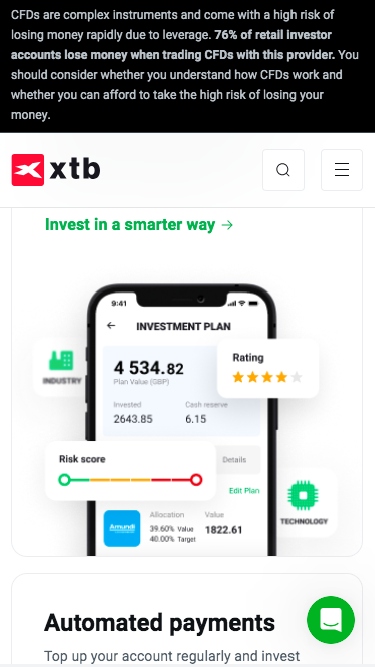
XTB, once known purely for CFD trading for stocks, indices, ETFs, commodities, forex and cryptocurrencies, began allowing direct share buying and direct ETF purchases without commission in 2023.
While the platform is known as a boon for day traders due to its ability to quickly execute trades, it also has a lot to offer for beginner investors who primarily trade stocks or ETFs.
Investors can trade in fractional shares, a good way to buy into quality stocks that are a little pricey. Traders, provided they have fewer than £100,000 in monthly trades, don’t pay commission on ETFs and shares.
Its knowledge centre includes a news feed, including upcoming dividend announcements, to hep you spot good dividend stocks, a calendar of economic news and a market sentiment indicator, as well as more than 1,000 articles and videos. Our XTB review will give you more details on the trading conditions at this stockbroker.
Pros
- High interest rate on univested deposits
- Copy trader option
- No minimum deposit required
Cons
- Inactivity fee
75% of retail investor accounts lose money when trading CFDs with this provider.
3. Pepperstone: Plenty of technical analysis for share CFD trading
Pepperstone does not allow non-leveraged, traditional stock trading. Since the only share trading it offers is through CFDs, it is probably best suited for experienced traders. The company is known more for its forex trading than its share trading, but offers more than 1,000 shares in CFD trading.
Some of the advantages of Pepperstone include no minimum deposit to open an account, no inactivity fee, and the EDGE Standard account does not charge a commission on trades. It’s important to understand, though, that when buying or selling stocks through CFD, you are speculating on the price movements of shares without actually owning the underlying assets.
Pepperstone’s platforms include MT4, MT5, cTrader, TradingView, and the Pepperstone Trading Platform, most of which deliver advanced technical analysis and charting. Despite the wide range of trading platforms, setting up an account with the broker remains relatively easy.
What is also handy for beginner stock investors is that Pepperstone offers copy trading, which lets users emulate the trades and strategies of experienced traders. Make sure to read our Pepperstone review for more details on the broker’s features and services.
Pros
- Free demo account
- No inactivity fee
- No minimum deposit required
Cons
- No direct share buying
- Educational resources are lacking
4. Admiral Markets: Growing beyond CFD offerings into shares

Admiral Markets, once known primarily for its forex and CFD trading, has expanded its offerings to include direct share and ETF buying. The online broker offers more than 3,000 UK, European and US stocks for CFD trading and more than 300 ETFs for CFD trading.
It also allows for the direct purchase of more than 4,500 stocks. It also offers fractional trading, so you can buy partial ownership of a stock or an ETF for as little as €1, and also an auto-investing option.
Admiral Markets doesn’t charge a commission on direct share buying and its fees for forex and CFD trading are around average for the industry.
The company gets strong marks for its educational services, as it offers webinars, articles, tutorials, guides, a glossary of terms, e-books and online courses. To learn more about Admiral Markets, see our review of this UK online broker.
Pros
- Good mix of CFD, non-CFD trading
- Fractional shares
- Good educational services
Cons
- High minimum deposit
- Inactivity fee
5. FP Markets: Stockbroker with plenty of CFD share trade possibilities
FP Markets is designed for more advanced traders, and its products are limited to forex and CFDs, including CFDs on more than 10,000 stocks. Investors can also trade CFDs on bonds, commodities and indices.
To do CFD share trading, you can use the company’s IRESS platform, which offers more than 10,000 stock CFDs through its standard, platinum, and premier accounts, or sign up for its MetaTrader 4 or MetaTrader 5 platforms, which offer more than 1,000 stock CFDs.
One of the nice features of FP markets is that it offers a demo trading account with US$100,000 in virtual money, giving new investors a way to understand the markets better.
It also has social trading features that allow you to mimic the moves of successful, experienced traders. It doesn’t have as many educational features as some competitors, however. Our FP Markets review gives you more insight into this broker’s advantages and drawbacks.
Pros
- Demo trading account
- Copy trading options
- Wide choice of stocks to trade
Cons
- Lack direct share buying
- High minimum account balance
- Not regulated by the FCA
6. Trade Nation: UK stock broker offering low-cost CFD share trading
The platform limits share dealing to CFD stock trading, but it still has a lot to offer as a trading platform for stocks. There’s no minimum deposit required to start an account, no inactivity fee, and no commission on trades, and the spreads on its CFD trades are low compared to some of Trade Nation’s competitors.
It also allows you to, without signing up, to practise on a demo trading platform with up to $10,000 in virtual funds.
Trade Nation has solid technical analysis through its advanced trading platforms of TN Trader, as well TradingView and MetaTrader 4. Some of the platforms’ other advantages for stock trading are its amount of educational materials as well as its copy trader program, TradeCopier, which allows you to automatically copy the trades of elite investors, but it is only available in MetaTrader 4.
Trading is limited to CFD trading for forex, shares, indices, commodities, and cryptocurrencies, so you can’t own stock shares directly, and CFD trading isn’t a great option for novice traders. That’s one negative for Trade Nation. Another is that its customer service has a phone number, a chatbot, and email, but no live chat.
Pros
- Good technical analysis
- Demo trader program
- Copy trader option
Cons
- No live chat
- No non-CFD share dealing
- Copy trading is limited in scope
7. Saxo Bank: Stock broker with plenty of educational resources for new traders
Saxo Bank, founded in 1992, offers more than 23,000 stocks across more than 50 global markets. It offers three platforms suitable for stock trading in the UK: SaxoInvestor, SaxoTraderGo and SaxoTraderPro.
SaxoInvestor is designed for novice stock traders, focusing on the direct buying and selling of stocks, ETFs, mutual funds, and bonds. The commission is between 0.03% and 0.08% of the trade value. For US stocks, the minimum fee is $1, and for UK stocks, it’s £3. There’s also a 0.25% currency conversion fee.
SaxoTraderGo is a user-friendly, mid-level platform offering various analysis tools, such as stock comparisons, news, and expert research, making it appealing for those starting with UK stocks for beginners.
Saxo Bank’s platforms get solid marks for its easy-to-use interface and customer service, with help available by phone, email or online chat. Saxo also has a nice, relatively safe way for investors to make money: stock lending.
Pros
- Easy-to-use interface, great for beginners
- Offers stock lending as a way to make income from shareholdings
- Decent market analysis tools
Cons
- High commissions on trades
- Some high-end features require subscriptions
8. Trading 212: Hub for passive income investment and diverse trading
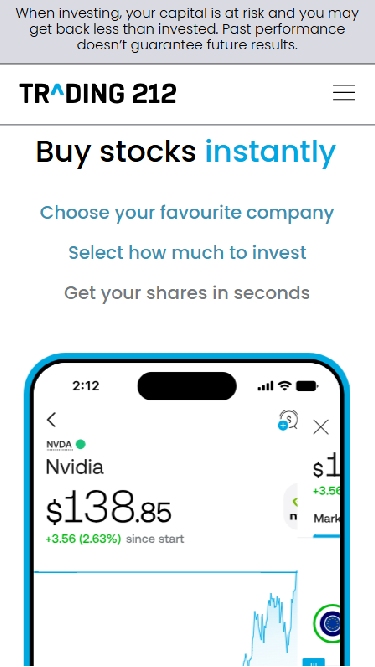
Trading 212 stands out for passive investors, looking for set-it and forget-it style investing and is used by more than 5 million funded accounts. It offers more than 13,000 stocks.
Some of its key features include share lending, which allows you to earn interest on your stocks by lending them to other investors, as well as paying interest on uninvested funds in your account, with the rate currently 4.05% in the UK.
Some of the other factors that make Trading 212 beneficial to those investing in stocks include no commissions or custody fees and a user-friendly interface. Your choices for an account include an Invest Account, which delivers commission-free investing in stocks and ETFs or its CFD Account, useful for more advanced traders.
It has a feature called automatic investing, which permits investors to schedule deposits and invest in a ready-made balanced ETF portfolio or one of their own choosing.
There’s no minimum deposit required, and it takes only €1 to trade in stocks or ETFs. It also allows investors to buy fractional shares. The company also has a savings plan, called AutoInvest which permits you to build a diversified portfolio and customise it to your needs.
Pros
- Has a share lending option
- Pays interest on uninvested cash
- Stocks and shares ISA available
Cons
- High forex conversion fees
- No trading on options or bonds
9. Freetrade: Great low-cost UK stock broker for beginners

Freetrade is a UK fintech that offers basic, standard and plus plans. The basic plan charges no commission for trades and allows trading in more than 6,500 global stocks and ETFs, and has just added a stocks and shares ISA.
It also allows you to buy fractional shares of US stocks and pays 1% on up to £1,000 in uninvested cash. The standard and plus plans charge £4.99 and £9.99 a month, but offer more technical analysis, lower fees on currency conversion and pay more interest on uninvested funds.
Many investors who are not likely to get involved in complicated trading like Freetrade for its low costs, transparency and ease of use. It has more than 1.6 million users.
At the beginning of 2025, the financial services group IG Group bought Freetrade to broaden its own investment options.
Pros
- No-commission trading
- Fractional trading in US shares
- Low barrier to trading
Cons
- Some ISA plans have a monthly fee
- Limited number of investments
- Not much in the way of technical analysis
10. IG: Solid platform for frequent share dealing
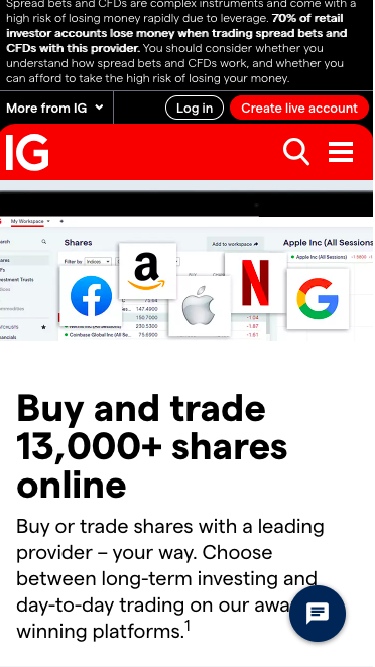
IG offers more than 15,000 global financial instruments to trade, including more than 13,000 shares, funds and investment trusts. It allows direct share, ETFs and CFD share trading, as well as forex, crypto, commodities and indices.
Share investing in the UK happens via three routes. Clients can set up a stocks and shares ISA, a general investment account, or a SIPP account, which stands for self-invested personal pension. In all of these accounts, you can trade shares or set up a pre-designed IG Smart Portfolio of curated shares.
IG offers commission-free share trading on all stocks and ETFs traded within a UK GBP GIA, ISA, and SIPP account; however, a currency conversion fee of 0.7% applies for international share purchases. There may also be other fees, such as administration charges. IG also pays currently 3.75% on uninvested cash in the UK.
IG charges a custody fee of £24 per quarter, but that goes away if you trade more than three times in quarter. The custody fee also doesn’t apply if you have more than £15,000 in an IG Smart Portfolio account.
Pros
- Easy-to-use interface
- Plenty of financial instruments to trade
- More than 17,000 global shares available to trade
Cons
- Custody fee
- High trading fees
How these UK online stock brokers stack up
| Platform | Minimum deposit | Price to trade shares, ETFs | Inactivity fee | FCA protection | Trustpilot score |
| eToro UK | $50 after first deposit | No commission on stocks or ETFs (currency conversion fee applies) | $10 per month after one year of inactivity | Yes | 4.2 out of 5 stars (29,854 reviews) |
| XTB | None | No commission on stocks or ETFs (up to $100,000 in trades a month) | €10 a month after 12 months of inactivity | Yes | N/A |
| Pepperstone | £0 | Commission free (the price is built into the spreads) | None | Yes | 4.3 out of 5 stars (1,194 reviews) |
| Admiral Markets | equivalent of €100 | Typical spreads of 0.8% | €10 a month after 24 months of inactivity | Yes | 4.0 out of 5 (2,079 reviews) |
| FP Markets | AUD $100 | Commission free on standard account (the price is built into the spreads) | None | No | 4.8 out of 5 (9,728 reviews) |
| Trade Nation | None | Commission free (the price is built into the spreads) | None | Yes | 4.4 out of 5 (1,498 reviews) |
| Saxo Bank | None. (Start trading with £1) | Between 0.03% and 0.08% (depending on the account) | None | Yes | 3.5 out of 5 (7,827 reviews) |
| Trading 212 | £1 | Commission free on stock or ETF trades | None | Yes | 4.6 out of 5 stars (73,774 reviews) |
| Freetrade | None | Commission free basic account (Monthly fee on other accounts) | None | Yes | 4.3 out of 5 (6,919 reviews) |
| IG | No minimum on bank transfers £250 for PayPal or credit cards | £8 on UK stocksOr £3 (conditions apply) | £12 for accounts that have been inactive for 24 months | Yes | 3.9 out of 5 stars (8,494 reviews) |
Your capital is at risk.
Choosing the right stock broker for UK-based investors
The best online stock brokers in the UK offer an array of trading options, customised portfolios, market research, low fees, and access to beginner-friendly and advanced trading strategies. When selecting a stock trading app, consider the following:
- User Friendliness: The app should be intuitive and easy to navigate, with clear features and straightforward processes.
- Market Coverage: Ensure the app supports the markets and assets you want to trade, such as UK stocks, US stocks, forex, commodities, and indices.
- Trading Tools: Choose an app with tools that suit your trading style, whether you’re a beginner or an experienced trader.
- Fees and Costs: Compare fees from different brokers to minimise costs and maximise profits.
- Customer Service: Look for an app with reliable customer support, including live chat or phone assistance.
- Investing options: Some of the best apps offer a wide range of assets, including:
- Company Shares: Trade individual stocks, including both UK and US companies. In many cases, fractional shares are also available.
- Forex: Buy and sell international currencies.
- Commodities: Trade assets like gold, oil, wheat, and copper.
- Indices: Invest in market benchmarks like the FTSE 100.
Some brokers offer direct share investing while others only offer derivatives, such as CFDs. While they both involve putting money in the stock market, they have two distinct approaches.
Traditional stock trading involves direct ownership of assets, so when you buy shares, you become a part-owner in the company, complete with voting rights attached to your shares. Meanwhile, CFDs (Contracts for Difference) allow you to speculate on price movements of assets like the top UK hydrogen stocks without owning them outright, offering flexibility but also involving higher risk due to leverage.
CFD trading happens via a derivative instrument that allows you to speculate on price movements without owning the underlying asset. They are usually used for short-term trading profit . You agree to exchange the difference in the price of a financial instrument at the beginning and end of the contract with your broker.
In many cases, CFDs often allow you to trade with leverage, meaning you can control a larger position with a smaller initial investment. This can amplify both gains and losses. If you are interested in CFD trading on stocks or other instruments, check out our compilation of the top brokers in the UK that offer this service.
Several of the best futures brokers also offer both types of trading, allowing you to try your hands at both ways of earning money in the stock market.
Other ways of investing in stocks
Mutual funds pool money from multiple investors. These funds, managed by professional experts, invest in a diversified portfolio of stocks, bonds, or other assets. This diversification helps spread risk, so a poor performing investment doesn’t significantly impact the overall fund. Investors benefit from the fund manager’s expertise while gaining access to a wider range of opportunities with a smaller investment. Units can be easily bought and sold, but fees are involved to cover management and transaction costs.
While mutual funds are geared toward long-term stock market exposure, those seeking more active short-term strategies—like trading currencies—may explore options offered by forex brokers serving UK clients for more flexibility and dynamic market opportunities.
Exchange-traded funds (ETFs) offer a cost-effective way to invest in a diversified portfolio of stocks, bonds, or both. Unlike mutual funds, ETFs trade on stock exchanges, providing more flexibility and often lower fees.
ETFs can focus on specific sectors, asset classes, or investment strategies, making it easier to tailor your portfolio. They can also help mitigate market risk by offering exposure to a variety of assets.
Passively managed ETFs typically track an index and have lower fees than actively managed ones. While active management can potentially outperform, it also carries higher costs and may not always justify the expense.
If you are considering investing in ETFs, we have complied a list of the best ETF brokers in the UK as well to make it easier for investors to find a platform that suits their investment goals.
Fractional shares involve buying or selling a portion of a single stock, rather than purchasing a whole share. It’s like owning a slice of a pie, rather than the entire pie. Buying fractional shares is useful when the price of a stock is high, and you don’t have enough money to buy a whole share. It allows you to buy a smaller amount of a stock and still benefit from gains. The trading platforms in the UK that offer fractional shares are popular with beginner investors that have less funds available to spend.
An UK stocks and shares ISA is a tax-free savings or investment account for UK residents. You can contribute up to £20,000 annually (for the tax year ending April 5, 2026).
ISAs offer tax-free returns on a variety of investments, including stocks, investment funds, and bonds. The top online stock brokers in the UK cater to stock and shares ISA investors. We’ve also written a guide about the best stock and shares ISAs available currently in the UK.

How We Rate Brokers
We manually review the brokers on our list. Below are the key metrics we check before listing online brokers on the website. For further details, you can also take a look at our online brokers rating guide, featured on ValueWalk.