



Futures trading has been gaining significant traction in the UK financial market, leading to a proliferation of futures brokers. Equities are trading at high valuations, and futures contracts help investors diversify their portfolio away from stocks and into commodities such as gold, oil, currencies, and even cryptocurrencies.
In this guide, we feature a list of the best futures brokers in the UK. It’s important to understand that some of these brokers offer futures trading only through contracts for difference (CFDs,) while others give you access to traditional futures contracts that trade on exchanges. Take a look at our picks below:
The top UK futures trading platforms at a glance
First, here’s an overview of the top brokers for futures trading in the UK at the moment:
- eToro: Best known for its social trading, eToro is an Financial Conduct Authority (FCA)-regulated broker, based in Israel, which makes it easy to trade a wealth of CFD futures. May offer direct futures in the UK later.
- XTB: The best CFD futures broker in the UK for beginners with zero commission. Based in Poland, it features an intuitive platform.
- Pepperstone: An Australia-based CFD futures broker that is compatible with MT4/MT5 trading platforms and offers competitive spread costs.
- FP Markets: A top CFD futures brokerage based in Australia that offers spreads as low as 0.0 pips through its Raw ECN accounts.
- Admiral Markets: CFD futures brokerage offers competitive spreads, negative balance protection, and extensive educational resources. The broker is part of the Estonia-based Admirals Group.
- Trade Nation: The UK-based CFD futures broker provides copy trading, extensive market analysis tools, low-cost fixed spreads and no minimum deposit requirement.
- Vantage Markets, based in Australia, offers a diverse range of trading assets, innovative social trading features, and various account options.
- Saxo Bank: The Danish investment bank and futures broker provides investment products and services for professionals and advanced traders. It offers a wide range of instruments, including real futures.
- TradeStation: The FCA-regulated US broker is renowned for its sophisticated trading interfaces, a broad range of features, and analytical tools. It has been involved in futures trading since its inception.
eToro disclaimer: 46% of CFD retail accounts lose money. Your capital is at risk.
Reviewing these top-ranked UK futures brokers
Now, let’s take a deeper look at these UK futures trading platforms and how they compare to each other, to help you find the one that suits your needs the best.
1. eToro: Best futures brokerage overall in the UK
eToro, a multi-asset provider offering more than 9,000 financial instruments to its clients, now offers both direct futures trading and futures trading through CFDs in the UK – the former only to select clients. The Israel-based broker is best known for its copy trading feature and large social network of traders who interact, discuss ideas, and share their strategies on its social feed.
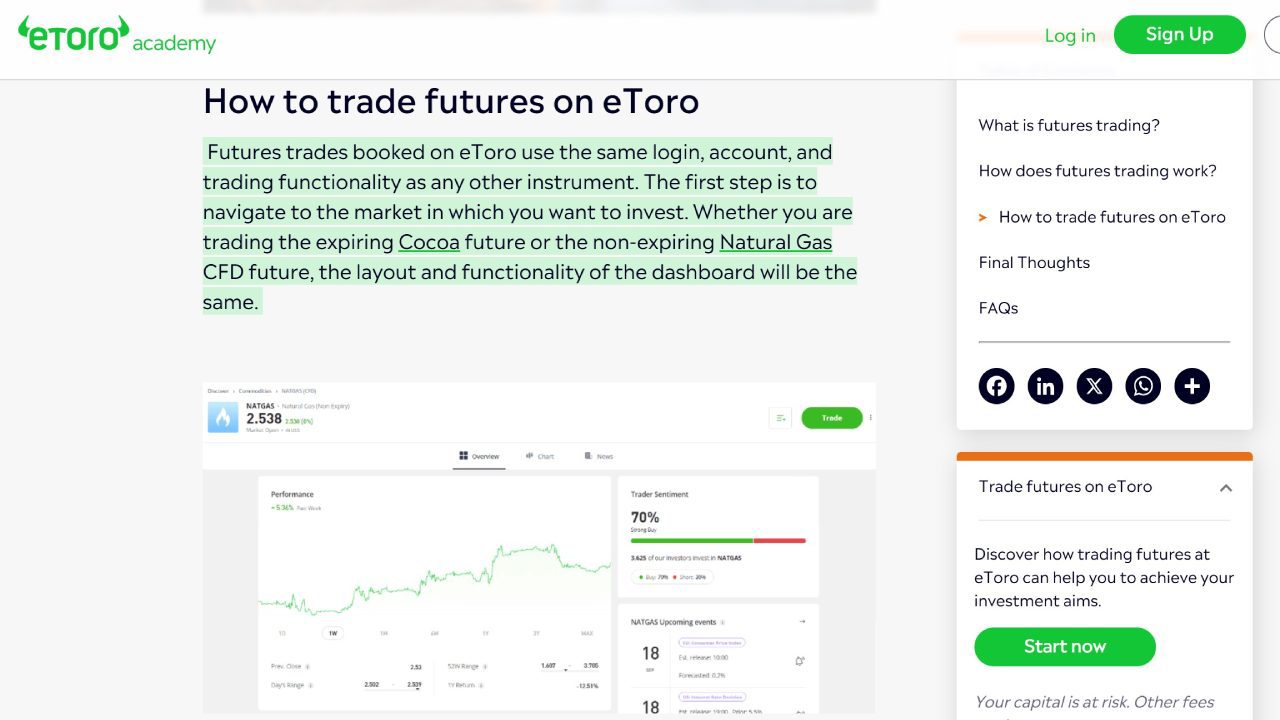
It began offering actual futures contracts to new clients in Spain earlier in 2025, and now the UK also has this service, offered through the CME Group. The direct futures trading eToro offers are spot-quoted futures (SQFs), a newer version of the traditional exchange-traded futures powered by the Chicago Mercantile Exchange (CME).
On eToro’s dashboard, it’s possible to buy CFD futures that cover sectors ranging from commodities to indices, from Orange Juice expiring futures to non-expiring futures that track the S&P 500 index. Crypto futures, like CFDs and other derivative instruments based on crypto assets, are banned in the UK.
All of the futures and CFD futures traded on eToro involve cash settlement. There is no risk of buying a futures contract, which involves delivering or receiving the underlying physical item on the settlement date.
The broker provides a free demo account with $100,000 in virtual funds, and a wide range of educational resources, including videos, webinars, news, and analysis. It also offers numerous instruments to invest in, including currencies, commodities, indices, stocks, and cryptocurrencies. It also features assets for direct investing, such as shares and ETFs, but not futures contracts in the UK at this time.
Take a look at our eToro review for a full rundown of its features, advantages, and drawbacks.
| Trading platforms | WebTrader |
| Number of futures contracts | more than 50 |
| Min deposit | $50 first-time deposit, $10 thereafter |
| Pricing system | Spread-based trading |
| Fee for buying crude oil futures | Starts from 0.05 pips per spread |
| Top features | Great site for social trading. Good educational materials. Free demo account with $100,000 in virtual funds |
Pros
- Fast order execution
- One of the best platforms for social trading
- Free demo account with $100,000 in virtual currency
- Regulated by the FCA in the UK
Cons
- No third-party trading platforms
- Limited customer support
46% of retail investor accounts lose money when trading CFDs with this provider. You should consider whether you can afford to take the high risk of losing your money.
2. XTB: Top UK futures broker for account types and platforms
XTB is one of the top futures brokers to use in the UK. This global brokerage provides access to a range of markets, including forex, commodities, indices, and futures contracts via CFDs. It also offers more than 7,500 direct shares and ETFs for investing. It doesn’t offer direct futures contracts, though.

As one of the leading futures brokers, XTB delivers fast and reliable trading through platforms such as xStation 5 and MT4, via desktop or mobile. With competitive spreads, low trading costs, and negative balance protection, XTB is ideal for traders seeking robust risk management. It’s a secure brokerage, regulated by the Financial Conduct Authority (FCA).
The platform also features comprehensive educational resources, including webinars and tutorials, making it user-friendly for both beginners and professionals.
XTB offers multiple account types, with leverage up to 30:1, which is the legal limit in the UK. Notably, XTB does not have a minimum deposit, making it an effective choice for beginner investors with a smaller trading budget.
XTB does, however, charge an inactivity fee of €10 a month if you don’t make any trades for 12 consecutive months. To learn more about this broker, see our comprehensive XTB review.
| Trading platforms | xStation 5, xStation mobile, MT4 |
| Number of futures contracts | 6 CFD futures |
| Min deposit | £0 |
| Pricing system | Spread-based trading |
| Fee for buying crude oil futures | Starts from 0.03 pips per spread |
| Top features | Multiple account types. Supports different trading platforms. Offers more than 2,000 futures contracts No minimum deposit |
Pros
- Fast order execution
- Multiple trading platforms are supported
- No minimum deposit requirement
- Comprehensive educational resources
Cons
- Inactivity fee of €10 a month after a year of inactivity
- Limited number of tradable assets
70% of retail investor accounts lose money when trading CFDs with this provider.
3. Pepperstone: Futures broker charging no commission on some account types
Pepperstone offers a broad range of trading instruments, including futures, forex, commodities, indices, and share CFDs. In total, more than 1,200 CFD instruments can be traded on Pepperstone. Since its founding 15 years ago, has established itself as a reliable broker with competitive pricing, fast execution, and a client-centric approach.
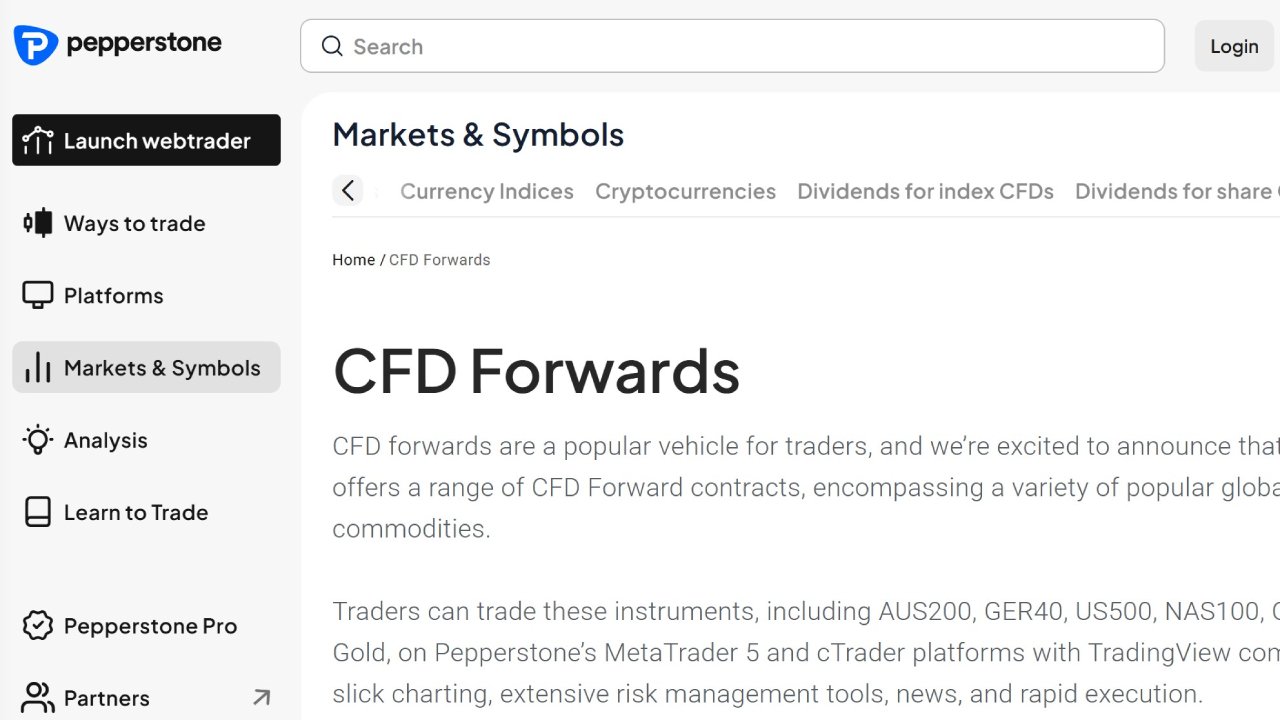
It’s important to note that, like XTB, Pepperstone doesn’t allow direct futures trading, but a type of CFD trading, which in this case, Pepperstone calls CFD forwards. These future-like CFD instruments are similar to futures contracts but traded over-the-counter with Pepperstone, rather than the underlying futures contract being traded on an exchange.
Traders can choose between Razor and Standard accounts. No commissions are charged on Standard accounts, but a markup is applied to raw spreads. The Razor accounts, on the other hand, charge tight spreads and a commission-based structure ideal for active traders.
The platform offers access to the widely used MetaTrader 4 and MetaTrader 5, as well as cTrader, for more advanced trading strategies. Pepperstone also supports trading automation through EAs (Expert Advisors) and offers an active trader program with benefits for high-volume traders.
The broker is regulated by the FCA. Our Pepperstone review has even more detail on its features and services.
| Trading Platforms | MT4, MT5, & cTrader |
| Number of futures contracts | It offers 20 index CFD forwards, 14 commodity CFD forwards, three metals CFD forwards, and four energy CFD forwards. |
| Min deposit | No minimum deposit (recommended $200 for Razor account) |
| Pricing system | Spread-based and commission-based trading costs |
| Fee for buying crude oil futures | Starts from 0.03 pips per spread |
| Top features | Razor account with raw ECN spreads, MT4, MT5, and cTrader platforms available. No deposit or withdrawal fees. Regulated by the FCA |
Pros
- Fast order execution
- Low spreads on major markets
- No inactivity fees
- Regulated by the FCA
Cons
- Slow live chat
- Limited product offerings
CFDs are complex instruments and come with a high risk of losing money rapidly due to leverage. 72% of retail investor accounts lose money when trading spread bets and CFDs with this provider.
4. FP Markets: Best futures broker for low spreads starting at 0.0 pips
The Australian broker offers a comprehensive range of 10,000 CFD trading instruments, including futures, forex, commodities, indices, crypto, bonds, ETFs, and shares.
FP Markets provides access to major global indices such as the S&P 500 and NASDAQ 100 via futures CFDs, and you can trade futures CFDs on various commodities, including metals like gold, oil, and silver. It also offers futures CFDs on bonds, such as the US 10-year Treasuries (US10YR) and UK Long Gilt Futures.
Founded 20 years ago in Australia, this globally recognized broker offers a stable trading environment, competitive pricing, and advanced technology. As you can also see in our review of the broker, it also offers a range of educational resources, including webinars, articles, and daily market insights, helping traders stay informed.
Users can choose between various account types, including Standard and Raw ECN, which cater to different trading needs. FP Markets’ key feature is its spread-based pricing for Raw ECN accounts, which can go as low as 0.0 pips.
For the Standard accounts, the spread starts at 1.0 pips. Traders can access popular platforms such as MetaTrader 4 and MetaTrader 5, along with TradingView and WebTrader, for more advanced trading strategies.
| Trading platforms | MT4, MT5, cTrader, TradingView and WebTrader |
| Number of futures contracts | About 10 futures CFD instruments |
| Min deposit | $100 |
| Pricing system | Spread-based and commission-based trading costs |
| Fee for buying crude oil futures | Starts from 0.03 pips per spread |
| Top features | Raw ECN accounts offer competitive spreads. Access to more than 10,000 trading instruments. Advanced trading platforms. Educational resources for all experience levels |
Pros
- Spread goes as low as 0.0 pips on the Raw ECN accounts
- Regulated by ASIC and CySEC
- Multi-account manager (MAM/PAMM) for professional traders
- Provides educational resources
Cons
- No crypto futures for UK clients
- Not regulated by the FCA in the UK
72.5% of retail CFD accounts lose money.
5. Admiral Markets: Regulated futures broker with negative balance protection
Admiral Markets is a globally recognized broker based in London. It offers more than 8,000 financial assets across six asset classes, including numerous CFD trades on forex, futures, and more than 3,000 equities, 370 ETFs, 43 indices, as well as bonds and commodities.
It also allows you to invest in more than 4,500 shares and ETFs. Any CFD product Admiral offers can be traded through different futures markets.
The platform provides a 30-day free demo account and 24/7 multilingual customer support. The platform caters to both beginners and experienced traders, offering various account types, including Trade.MT5 and Zero.MT5. These accounts provide flexible spreads and competitive commission-based pricing for futures trading.
Its accounts provide flexible spreads and competitive commission-based pricing for futures trading. It also has advanced trading tools such as the MetaTrader Supreme Edition, which enhances the MetaTrader 4 and MetaTrader 5 platforms with additional indicators, analytics, and trading automation options.
Regulated by the FCA, Admiral Markets ensures a secure trading environment with negative balance protection and offers various funding methods without deposit fees. Learn more about this UK broker from our Admiral Markets review.
| Trading platforms | MT4, MT5, & MetaTrader Supreme Edition |
| Number of futures contracts | More than 30 futures CFD instruments, including 11 commodity contracts |
| Min deposit | $100 (Trade.MT5 account) / $1,000 (Zero.MT5 account) |
| Pricing system | Spread-based and commission-based trading costs |
| Fee for buying crude oil futures | Starting from 0.03 pips spread |
| Top features | Advanced MetaTrader Supreme Edition tools. Competitive spreads and ECN-style accounts. Negative balance protection. Extensive educational resources |
Pros
- Regulated by the FCA and other global authorities
- Low spreads and commission-based accounts
- Negative balance protection
- Advanced tools for MetaTrader platforms
Cons
- Inactivity fee of €10 a month after two years of no trades
- Higher spreads on some less liquid instruments
74% of retail investor accounts lose money when trading CFDs with this provider.
6. Trade Nation: UK futures broker with fixed spreads, a wealth of trading tools
This FCA-regulated forex and CFD broker allows you to trade more than 1,000 assets on its proprietary platform TN Trader as well as MT4 on your smartphone or desktop while staying on top of the market with real-time news, analysis, and twice-daily reports.
Spreads at Trade Nation are low and remain consistent. Trade Nation offers various account types, including the Standard Account, which is its most popular option and incurs no commission.
The RAW Account charges a commission of $3.50 per lot per side, while the TN Trader Account features low, fixed spreads but is only available on the proprietary platform, offering cost predictability for those who need it for their strategy.
On its TradeCopier app, you can find top traders and copy the moves of successful traders. When it comes to tools available at Trade Nation, you can enjoy real-time news, signal centre, and risk management tools. Meanwhile, charts are powered by ChartIQ on its web and mobile.
To educate its users, Trade Nation has an Insight Hub and provides tutorials and market information that impacts the way you trade including holidays, expiries, and projections.
| Trading platforms | TN Trader & MT4 |
| Number of futures contracts | Three bond futures contracts |
| Min deposit | $0 |
| Pricing system | Spread-based trading costs |
| Fee for buying crude oil futures | Spread |
| Top features | Tight spreads Good customer support Free deposit and withdrawal Educational resources Negative balance protection |
Pros
- Regulated by FCA, ASIC, SCB, and FSA
- Great research and trading tools
- Free deposit and withdrawal
- Smart News feature
Cons
- Needs safer login
- Limited educational offering
- Range of markets limited on MT4
73.1% of retail investor accounts lose money when trading CFDs with this provider.
7. Vantage Markets: Futures broker with low trading costs and fast execution
The Australia-based broker, established in 2009, offers the trading of more than 1,000 CFD products, including forex, commodities, precious metals, bonds, indices, ETFs, and shares.
Vantage Markets offers a trusted trading ecosystem for users to trade by opening a live or demo account. Different account types on Vantage Markets include Cent, STP, Raw ECN, Pro ECN, and Swap-Free.
Meanwhile, tools available at Vantage include a free forex VPS, an economic calendar, a pro-economic calendar, sentiment indicators, an AI-based market buzz provider, and trading calculators, along with custom charts, indicators, and bespoke order types.
An interesting feature of Vantage is social trading, available through its V-Social app, compatible with both iOS and Android devices. The free-to-download app enables traders to chat with other traders, ask questions, trade, and auto-copy the top-performing investors, or get paid for sharing trading tips, all on the same platform and on the go.
It’s also pretty easy to open an account at FCA-regulated Vantage, and there are no deposit fees. It also has a free demo account with $100,000 in virtual funds. When it comes to educational resources, the platform covers a wide range of topics through its articles, webinars, and videos.
| Trading platforms | MT4, MT5, ProTrader & TradingView |
| Number of futures contracts | About 10 CFD futures |
| Min deposit | $50 |
| Pricing system | Spread-based trading costs |
| Fee for buying crude oil futures | 0.1 pips spread |
| Top features | Low trading costs Fast execution24-hour support Free Forex Insights Negative balance protection |
Pros
- SmartTrader tools for MetaTrader
- Social copy-trading app
- Low non-trading fees
- Demo account with $100,000 in virtual funds
Cons
- Only CFD support
- High min. deposit for the Pro ECN account
68.4% of retail investor accounts lose money when trading CFDs and with this provider.
8. Saxo Bank: Best futures broker for professional traders, broad asset range
As one of the top direct futures brokers, Saxo is known for its user-friendly platform on both desktop and mobile devices, asset-specific analysis tools, responsive charting, and advanced strategy backtesting.
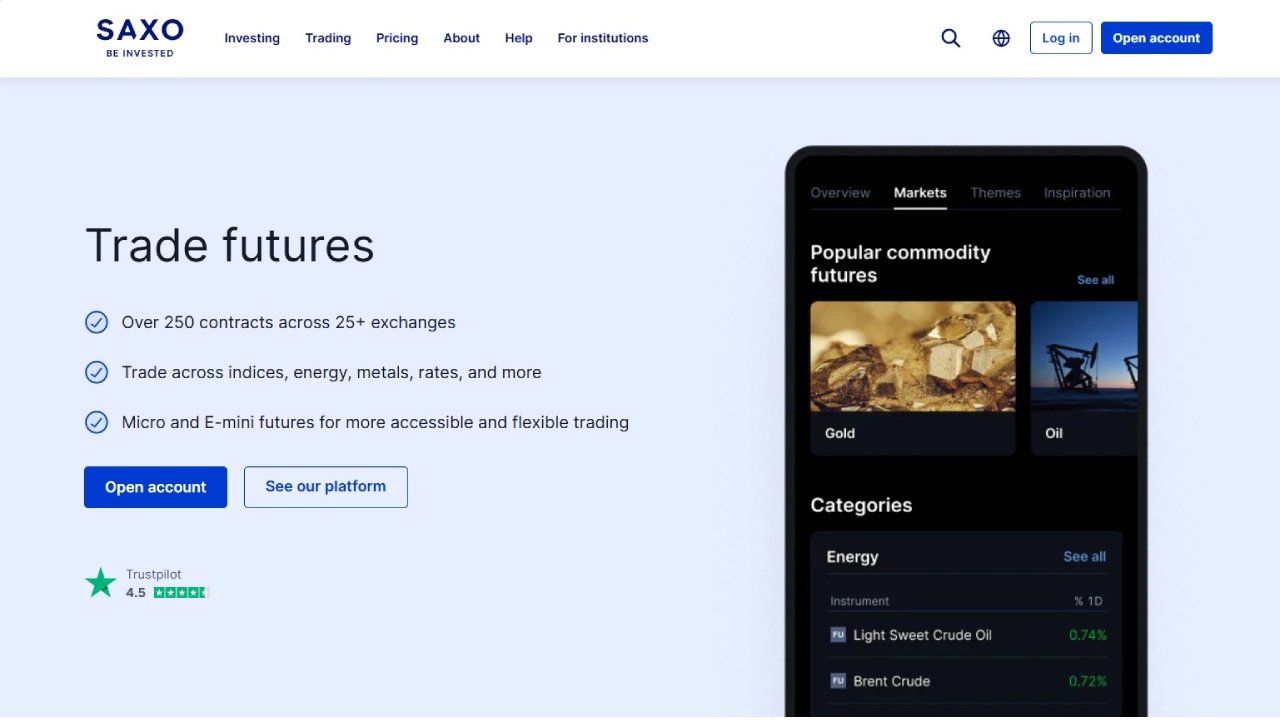
Saxo’s trading platform, SaxoTrader, which combines the features of the former SaxoTrader GO and SaxoTrader PRO platforms, is designed with the end-user in mind, offering significant upgrades over the industry standard.
The platform is fully licensed and regulated in 15 jurisdictions across Europe, Asia, and the Middle East. It has a wide range of equity, metals, bonds, currencies, and even interest rates for traders. It also has 85 technical indicators.
Saxo offers competitive trading fees, with commissions varying based on the contract and the tier of pricing. It also features a three-tiered pricing structure (Classic, Platinum, and VIP), which is based on your trading volume. The more you trade, the lower the available commissions.
When it comes to advanced research and analysis tools, Saxo offers the Futures Spread Trading feature that allows you to simultaneously place orders to buy and sell multiple contracts. Then there’s the Depth Trader feature, which allows you to more effectively manage your trades by viewing all the pending buy and sell orders. Meanwhile, with the Time and Sales feature, you can monitor real-time futures prices and trade directly from the exchange.
| Trading platforms | SaxoTrader |
| Number of futures contracts | 250+ futures from 25 global exchanges |
| Min deposit | £0 for a Classic account, £200,000 for Platinum tier, and £1,000,000 for VIP tier |
| Pricing system | Tier-based |
| Fee for buying crude oil futures | $3 per contract |
| Top features | Mobile app, Demo account Extensive educational features FCA regulation Thousands of trading instruments |
Pros
- Low commissions
- Robust trading platform
- Broad product portfolio
Cons
- >High options and futures fees
- Lacks live chat
62% of retail investor accounts lose money when trading CFDs with Saxo Bank.
9. TradeStation: Renowned for advanced futures trading interfaces and tools
TradeStation is a leading futures broker and delivers a trading platform loaded with customizable charting, advanced trading tools, and a premium real-time watchlist for a professional trading experience. Besides its web platform, you can also use its reliable and user-friendly mobile app to trade on the go.
It allows direct futures trading as well as futures options and micro futures. None of the three options involves a commission, but micro futures cost as little as $0.25 per contract per side, futures options cost as little as $0.85 per contract per side, and standard futures cost as little as $0.50 per contract per side.
The broker does not have CFD trading, but it has expanded its futures offerings to include forex, commodities, indexes, crypto, and even interest rates. One negative aspect is that a $10 inactivity fee applies if traders fail to maintain a $5,000 average end-of-month equity balance or have not placed at least 10 trades during the previous 90-day period.
It also offers various account types, including individual, IRA, joint, institutional, custodial, and entity accounts, which you can select based on your trading needs and experience level.
TradeStation offers a comprehensive suite of research and educational tools featuring a demo account, detailed fundamental data, high-quality news, a detailed FAQ section, and educational videos and articles. However, deposit and withdrawal functions are somewhat limited, with only bank transfers supported.
| Trading platforms | Proprietary Platform |
| Number of futures contracts | Over 250 futures and futures option products |
| Min deposit | £0 |
| Pricing system | Based on type of account |
| Fee for buying crude oil futures | $1.50 per contract |
| Top features | Advanced trading platform Account options High margin rates |
Pros
- Low trading fees
- Active trader community
- High-quality trading platform
Cons
- No CFD trading
- Inactivity fee
Trading in financial products involves risk. You could lose more than your initial investment.
How does futures trading work?
Let’s look at the definition of futures contracts, the various forms of futures trading, what assets are typically offered as futures, where futures trading takes place and the role of brokers.
What is a futures contract?
It’s an agreement to purchase or sell a certain security, commodity or other asset at an agreed-upon price at a predetermined future date. This means that the buyer is obligated to buy, or the seller is required to sell the underlying asset at the predetermined price, irrespective of the prevailing market price on the expiration date.
This is a derivative financial product because the value of futures depends on the value of an underlying asset, such as oil, in the case of crude oil futures.
There are two distinct types available through brokerages: traditional futures contracts (we sometimes refer to these in this article as direct futures) that are traded on exchanges, and futures CFDs (contracts for difference) that allow traders to speculate on the prices of futures contracts without the obligation ever to buy or sell the underlying asset.
Note that futures, like all derivatives, are advanced trading instruments and are best suited to more experienced traders who understand how they work and the risks involved.
What assets can I trade futures on?
Numerous varieties of futures contracts are available for trading, including:
Stock index futures on underlying assets like the S&P 500 Index, the Nasdaq, or the UK’s benchmark FTSE 100.
Commodity futures are available on commodities such as corn, wheat, crude oil, like Brent or WTI crude, natural gas, orange juice, coffee etc.
Precious metals and metals futures for gold, silver or platinum, and copper
Currency futures: These include forex pairs such as EUR/USD, GBP/USD, GBP/EUR USD/JPY
Cryptocurrencies: For example, Bitcoin and Ether futures (some are listed even on the prestigious Chicago Mercantile Exchange (CME), not only on crypto exchanges)
Note: The UK’s Financial Conduct Authority banned crypto derivatives for retail clients from January 2021. That includes crypto futures.
Other futures: There are futures available on interest rates or volatility. The CME, for instance, tracks futures traders’ bets on possible Federal Reserve interest rate changes.
Where and how to trade futures?
We’ll cover the established and newer futures exchanges and the role of brokers as intermediaries.
Where to trade direct futures
The launch of the FMX Futures Exchange in 2024 means there’s now competition for CME Group, which runs the four major futures exchanges, the CME, CBOT, NYMEX and COMEX. That competition also likely means innovations in futures contract design and pricing.
You will need a futures broker to access the futures exchange. They act as an intermediary between traders and the futures exchanges, facilitating the execution of trades, providing market analysis, offering risk management advice, and ensuring regulatory compliance.
Where to trade futures CFDs
To buy futures CFDs, you need to open an account with a regulated online broker that offers CFD trading on futures instruments. Then, you need to access their trading platform to select the desired futures contract and place your order to buy or sell based on your market prediction.
One of the best attributes of CFD trading is that you can take advantage of rising as well as falling markets by opening a long or a short position.
The role of futures brokers
To trade futures, you need a broker that acts as an intermediary between traders and the futures market.
The primary role of brokers involves linking buyers and sellers of futures contracts with a range of services at their disposal, including access to market data and trade execution. And in exchange for their services, brokers charge a commission.
In addition, futures brokers facilitate price discovery and provide liquidity, which plays a crucial role in the futures market.
Beyond making it easier for traders to buy and sell futures contracts, these platforms help users navigate the complex futures market. They offer extensive educational materials offering research, market insights, trading tools, and guidance.
The difference between futures CFDs and traditional futures
As we have seen, futures trading varies depending on whether it is traditional futures traded on an exchange or CFDs.
Futures CFDs prioritise flexibility and accessibility, while direct futures emphasize standardization, lower costs, and reduced risk. The choice between these instruments depends on individual trading preferences, risk tolerance, and investment goals.
What goes into a traditional futures trade
- They are standardized on exchanges by the amount, quality, and asset delivery.
- They are contracts that obligate the buyer to purchase a stock, index, or commodity on a fixed date and at a pre-agreed-upon price.
- Futures contracts are transparent and highly liquid.
- Futures contracts are tradable on platforms such as the Chicago Mercantile Exchange (CME) and individuals trade them through their brokerage accounts.
- Futures contracts can be settled through the delivery of assets or a cash settlement. In delivery, the physical product changes hands on the expiry of the agreement. However, in cash settlement, individuals receive a sum equal to the difference between the agreed price and the market value at expiration, without any actual transfer of goods taking place.
- Traders must provide margin – a percentage of the contract value – as a deposit when entering into a futures contract. Margins may be adjusted regularly based on price changes, known as mark-to-market.
What goes into a futures CFD trade
- CFD futures involve an agreement between a trader and a broker to exchange the difference in price of a predetermined asset between the start of the agreement and the point at which the agreement is closed.
- CFD traders never actually own the underlying asset but receive returns or incur losses based on the price change of the asset.
- A CFD trader may choose between taking a long or short position, though only one can be selected per contract.
- As asset prices change in real time, so too, does the value of the CFD. This creates the possibility of a gain or a loss along any point of the contract, depending on the position taken and how the asset price moves.
While leverage is capped at 1:30 for retail clients in the UK, it can magnify both profits and losses. That’s why strong risk management tools and regulatory compliance are essential for safe and strategic futures CFD trading.
Note: Both futures and CFDs carry significant risks and are best suited for experienced traders. Always do your due diligence to determine which types of instruments align with your financial goals and risk tolerance.
Why trade futures?
One major advantage of futures markets is portfolio diversification. With equity markets reaching high valuations in recent years, many investors are turning to futures to expand beyond traditional stock exposure.
Futures allow you to tap into commodities like gold and oil, trade in currencies, and even gain exposure to cryptocurrencies—helping to balance risk across asset classes.
They’re also valuable tools for hedging. For instance, if you expect oil prices to fall, you can short oil futures. Conversely, if you believe gold prices will rise, you can take a long position.
The pros and cons of futures trading
The following is a summary of the primary advantages and risks associated with trading futures. These apply to both direct futures trading and futures CFD trading, with the exception of the expiration risks, which only apply to direct futures trading:
Pros
- Leverage. This gives investors the ability to control large amounts of assets with less initial investment.
- Liquidity. Futures trading takes place on specialized exchanges with plenty of buyers and sellers. This makes it easier to enter and exit a position quickly.
- Diversification. Futures allow investors to buy different asset classes to increase their diversification. It also reduces risk by allowing investors to hedge investments.
Cons
- Leverage risk. Buying on leverage can amplify losses for investors.
- Complexity. Buying futures takes a degree of experience and patience many retail investors don’t have
- Expiration risks. These create challenges and risks for investors who want to maintain or roll over their positions, as they may face price distortions, volatility, or liquidity issues as the contracts approach their expirations.
How we ranked the top UK futures trading platforms
Choosing the right broker that suits your trading needs, level of experience, and goals is the most important decision, as it can have a significant impact on your futures trading success. To assist you in this process, we outline the factors we have considered when making our selections.
Regulation
It’s crucial that futures brokers in the UK are regulated by a reputable authority, such as the Financial Conduct Authority (FCA). This ensures the broker is operating securely and that user funds are safe.
A broker boasting a lengthy history of success and a solid reputation within the industry can offer increased stability and security for your investments.
Order types
When it comes to futures trading in the UK, there are many order types, each having a specific purpose. While market, limit, stop, and stop limit orders are offered by most basic platforms, a good platform will also allow you to place trailing stop orders and have the ability to place conditional orders.
Execution speeds
Markets move fast, especially in trading futures UK, so it’s essential that a broker offers high execution speeds. This also helps in reducing slippage, ensuring you get the desired price.
Fees and commissions
The low commission makes for an attractive broker; however, it’s important to ensure that this advantage isn’t offset by spreads, trade fees, withdrawal fees, inactivity fees, or any hidden charges.
Minimum deposit
While some brokers have zero deposit requirements, others may need you to deposit a minimum amount of cash just to open an account. In fact, in some cases, it can even go as high as £1,000.
Account features
When evaluating futures trading platforms, or more generally CFD brokers, specific account features can significantly enhance your trading experience.
Futures trading brokers with a demo account enable you to test the platform and confirm all the necessary elements that benefit your trading activity.
A broker with a mobile app tends to offer the most modern and extra trading features. Moreover, it allows for a more streamlined trading experience.
For a beginner, educational resources can be immensely helpful in improving proficiency. A good futures platform has extensive educational tools, including courses, videos, tutorials, glossaries, webinars, and more.
Not all payment methods are the same. E-Wallets and debit cards are pretty handy, while bank transfers tend to be safe. It’s important to find a suitable option; otherwise, you may incur a currency conversion fee every time you want to make a deposit or withdrawal.
A thriving and engaging trading community can also have a significant impact on the success of a broker as it enhances market liquidity and brings a variety of strategies to the platform. Moreover, traders share insights and analyses within the community, creating a supportive environment not only for novice but also experienced traders.
Note: This guide features the top-ranked futures brokers in the UK, but check out our picks of the top futures brokers globally, if you are based elsewhere.
FAQs on UK futures brokers
What is the best futures broker in the UK?
Do you pay tax on futures trading in the UK?
How do you trade futures in the UK?
What platform can I trade futures on in the UK?
What are spot-quoted futures (SQMs)?
References
- Facts on the financial markets in the UK
- Spot-quoted futures: CME
- eToro launches spot-quoted futures in Spain
- About the FCA
- Futures trading and the VAT
Risk disclaimers:
eToro is a multi-asset platform which offers both investing in stocks and cryptoassets, as well as trading CFDs.
Please note that CFDs are complex instruments and come with a high risk of losing money rapidly due to leverage. 61% of retail investor accounts lose money when trading CFDs with this provider. You should consider whether you understand how CFDs work, and whether you can afford to take the high risk of losing your money.
This communication is intended for information and educational purposes only and should not be considered investment advice or investment recommendation. Past performance is not an indication of future results.
Copy Trading does not amount to investment advice. The value of your investments may go up or down. Your capital is at risk.
Don’t invest unless you’re prepared to lose all the money you invest. This is a high-risk investment and you should not expect to be protected if something goes wrong. Take 2 mins to learn more
eToro USA LLC does not offer CFDs and makes no representation and assumes no liability as to the accuracy or completeness of the content of this publication, which has been prepared by our partner utilizing publicly available non-entity specific information about eToro.