


UK forex traders make their money by predicting the movement of currency exchange rates, profiting from the difference in price when they get it right. The cost of making a trade is usually the spread, which is the difference between the rates at which a broker allows you to buy or sell a currency.
Therefore, forex traders are keenly aware of the difference a low spread can make to trading profits. This is why they seek out the best low-spread brokers.
Zero-spread brokers and accounts also do exist, but there’s a trade-off, as they will charge a higher commission. Our guide will help you find the top low-spread brokers in the UK. See our picks below:
Top UK low-spread brokers ranked
Here’s a snapshot of the eight UK low-spread forex brokers that came out on top based on our research.
- eToro: The Israeli broker offers competitive spreads for forex trading, particularly for major currency pairs. Its typical GBP/USD spread is 2.0 pips. It’s a user-friendly platform with social-trading features.
- XTB: The Poland-based broker offers competitive spreads and a user-friendly trading platform. It offers a variety of trading tools and resources for beginners. The GBP/USD spread starts from 0.9 pips.
- Pepperstone: The Australian broker’s focus on advanced trading tools makes it a good choice for active traders. The average GBP/USD spread is 1.3 on a Standard, 0.3 on a commission-free Razor account.
- FP Markets: The Australian broker is known for its tight forex spreads. The average GBP/USD spread is 0.4 pips on its raw account. but there’s a commission. This spread is about 1.5 pips on the Standard account..
- Admiral Markets: The broker, part of the Estonia-based Admirals Group, launched in 2012 in the UK. It’s known for its low spreads. The typical spread on the GBP/USD currency pair is around 1.0 pips.
- Prime XBT: The Seychelles-based crypto and forex platform began in 2018 and serves more than 1 million customers in more than 150 countries. The typical spread on the GBP/USD pair is 1.5 pips.
- Trade Nation: The UK broker launched 10 years ago and is known for offering low spreads. Its user-friendly platform and no minimum deposit make it a top choice. It has a fixed spread of 0.8 pips for the GBP/USD pair.
- IG: A well-established broker with a strong reputation for educational resources and analytical tools. It provides low spreads across a vast array of currency pairs. Its typical GBP/USD spread is about 1.4 pips.
Disclaimer for eToro: 46% of retail contracts for difference (CFD) accounts lose money. Your capital is at risk.
- Show Full Guide
Reviewing the top-ranked low-spread UK forex brokers
Let’s take a closer look at the pricing structure and features of the lowest spread forex brokers and compare them based on other metrics, such as other supported markets and choice of trading platforms. All but one broker, FP Markets, on our list are regulated by the UK market watchdog, the Financial Conduct Authority (FCA).
Note: Under FCA rules, all brokers working in the UK, including FP Markets, must cap their retail leverage at 30:1. To access higher limits, you need to qualify as a professional client.
1. eToro: Best forex broker for beginner traders
- 62 currency pairs
- GBP/USD spread about 2 pips
- EUR/GBP spread about 1.5 pips
eToro stands out as a good broker for new traders because of its wealth of educational materials, its AI-influenced stock analysis and most of all, for its social trading features. It has an unlimited demo account with $100,000 of virtual funds to practise with.

On top of that, it has a simple, easy-to-understand interface. Its Copy Trader feature is free to use and enables novice investors to mimic the trades of more experienced investors and do so automatically.
Its forex spreads are about average for the industry, but at least its fees are transparent. All of the forex and contracts for difference (CFD) trading on eToro is commission free, as well as forex, but of course, the spreads are built in for forex and all CFD trading. Find out more from our review of eToro.
It has a good assortment of tradeable instruments, more than 8,000 overall, including more than 60 currency pairs. One downside for eToro, at least for more advanced traders, is that it lacks some of the technical charting capabilities that other brokers might have. However, it has recently rolled out a new chart-based trading feature to its desktop trading platform.
Pros
- Easy-to-understand interface, good educational content
- Strong social trading and copy trading programs
- Good assortment of tradeable assets
Cons
- Minimum deposit to open an account
- Lacks advanced charting and technical analysis
46% of retail investor accounts lose money when trading CFDs with this provider. You should consider whether you can afford to take the high risk of losing your money.
2. XTB: Best forex broker for low-spread CFD trading
- 60+ currency pairs
- GBP/USD spread about 1.4 pips
- EUR/GBP spread about 0.9 pips
XTB covers more than 60 forex pairs, so that’s more than most brokers. Overall, it offers more than 8,000 financial instruments, including stocks, ETFs, and CFD trading. It also offers passive investment plans with automatic investing and pays up to 4.25% interest on uninvested funds.
XTB uses its own platform, xStation and doesn’t support MetaTrader. That may be seen as a negative for experienced forex traders, but not a big deal to new forex traders. It has an unlimited demo account with $100,000 in virtual funds for traders to test-drive its platform.
Unlike some brokers, it doesn’t have guaranteed stop losses. It has commission-free trading for stocks and ETFs for traders investing less than $100,000 in a given month. For amounts above $100,000, the fee is 0.2%, or a minimum of €10. For forex trading, it has better-than-average spreads for most pairs.
Our review of this broker has more detail about its features, pros and cons.
Pros
- Offers more forex pairs than most brokers
- Pays interest on uninvested funds
- Good inexpensive choice for new investors
Cons
- No guaranteed stop losses
- It doesn’t support MetaTrader platforms
72% of retail investor accounts lose money when trading CFDs with this provider.
3. Pepperstone: Best forex broker for low raw spreads
- More than 90 forex pairs
- GBP/US spread about 1.0 pips (raw account: from 0.0 pips)
- EUR/GBP spread about 1.1 pips (raw account from 0.1 pips)
While Pepperstone offers a wide range of forex pairs (more than 90), its non-forex instrument selection is relatively limited compared to other brokers. It has a little more than 1,200 tradable instruments overall, but all of the CFD variety.
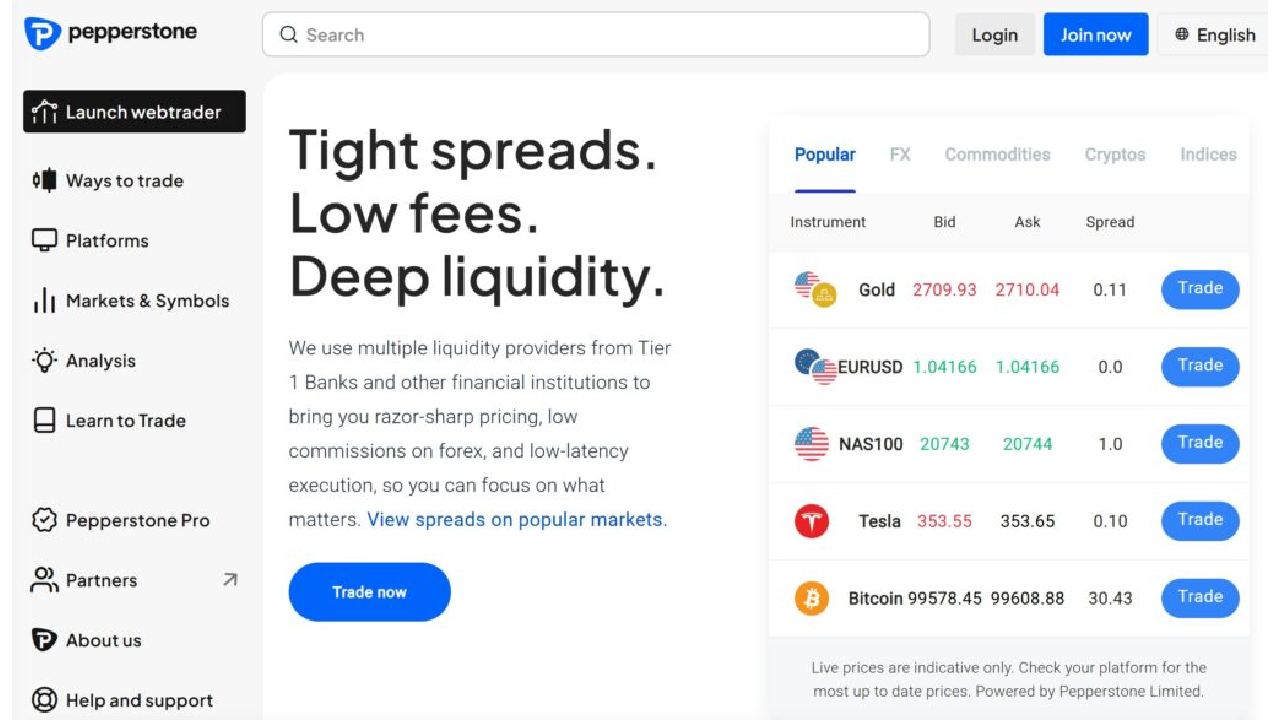
The broker has two types of accounts: the Razor account, which has tight spreads and low commissions and is designed for high-frequency traders and scalpers.
The standard account is commission-free, but has higher fixed spreads, perhaps better suited for swing traders or other long-term trading strategies. For example, its Razor account, using a GBP/USD pairing has a minimum spread of 0.0 pips, plus commission, while a EUR/GBP pairing starts at 0.1 pips, plus commission. The commission on forex trades on the Razor account is £2.25 per lot, per side.
The standard account starts at 1.0 pips with no commission for GBP/USD while it charges a minimum of 1.1 pips for a EUR/GBP pairing.
Some of Pepperstone’s advanced features and platforms may be overwhelming for novice traders. The broker offers a good selection of articles, guides and webinars for beginning traders. It also has a limited demo account, good for only 60 days, with $50,000 in virtual currency to practise on.
Learn more about Pepperstone from our review of this platform.
Pros
- Low spreads, particularly through its Razor account
- Good educational resources
- Advanced charting and technical analysis
Cons
- Limited to CFD trading only
- Small amount of non-forex trading
72% of retail investor accounts lose money when trading CFDs with this provider.
4. FP Markets: Best low-spread broker for advanced platform choices
- More than 70 forex pairs
- GBP/US spread begins at 0.4 pips on its raw account, 1.5 pips on standard account
- EUR/GBP spread is about 1.2 pips on the standard account, while on the raw account begins at 0.0 pips, though the average is 0.8 pips
FP Markets has a good number of tradeable assets (more than 10,000), including more than 70 forex pairs, plus, stocks, indices, commodities, and cryptocurrencies, but no non-CFD trading.
It offers the advanced MT5 platform, which is built for charts, indicators and other analysis tools. The MT4, Iress, cTrader and TradingView platforms are also available to its clients. It recommends MT4 for forex trading, however.
Its relatively low spreads on its raw account start from a minimum of 0.0 pips for the GBP/USD or EUR/GBP crosses, but this account type carries a commission.
Its standard account, though, with no commission, has slightly higher spreads with the GBP/USD pairing showing an average spread of 1.5 pips, compared with an average of 0.5 pips on its raw account. The EUR/GBP pairing starts at 0.0 pips and has an average spread of 0.39 pips on its raw account. The commission is $3 per lot each way for forex trades on the raw account.
It offers social trading, allowing users to automatically mimic the trades of experienced investors. FP Markets isn’t regulated by the FCA, though it’s licensed by another major watchdog, the Australian Securities and Investments Commission (ASIC).
Pros
- Low spreads are great for frequent forex trading
- Good educational resources
- Good educational resources that include courses, eBooks, podcasts, webinars and tutorials
Cons
- No direct share trading or any non-CFD trading
- Not regulated by the FCA
Contracts for difference (CFDs) are leveraged over-the-counter derivative products and carry a high level of risk to your capital.
You should only risk capital that you can afford to lose.
5. Admiral Markets: Best low-spread broker for forex choices
- More than 80 forex pairs
- GBP/USD spread begins at 0.3 pips on zero (raw) account and averages 1 pip on standard account.
- EUR/GBP spread averages at 0.1 pips on the raw account, and about 0.8 pips on the standard account.
Admiral Markets is regulated by the FCA in the UK. It is part of the Estonia-based Admirals Group. It focuses on forex and CFDs on indices, metals, energies, agriculture, commodities, crypto, stocks, ETFs and bonds, but also has actual stocks and ETFs for direct investing. CFD trading is also available on commodities futures and index futures.
The broker has a demo account that lasts 30 days and becomes unlimited if you open a live account. Its educational resources include videos, tutorials, Admiral Academy articles, e-books and a trader’s glossary. Some of its key features include fractional trading and negative balance protection.
Admiral Markets is known for its competitive pricing, with the typical spread at 0.8 on the EUR/USD currency pair and beginning at 0.7 pips on the EUR/GBP pair on its Trade account.
The spreads are lower on its Zero account, with the typical spread at 0.1 on EUR/USD and 0.6 on GBP/USD, and from 0.3 pips on its EUR/GBP pairing. It offers more than 45 forex pairs, including majors, minors and exotics.
See the broker’s detailed advantages and drawbacks in our review.
Pros
- Good number of forex pairs available for trading
- Solid educational resources that include videos, eBooks, Admiral Academy articles and a trader’s glossary
- Plenty of CFD and non-CFD investment options
Cons
- Limited demo account
- Does not offer copy trading
74% of retail investor accounts lose money when trading CFDs with this provider.
6. Prime XBT: No commission forex trading, low spreads
- More than 50 currency pairs
- GBP/USD spreads about 1.5 pips
- EUR/GBP spread of 1.1 pips
PrimeXBT is a trading platform known for its diverse asset selection, encompassing cryptocurrencies, forex, commodities, and indices. It attracts traders with its competitive trading fees and high leverage options, allowing for potentially significant returns.
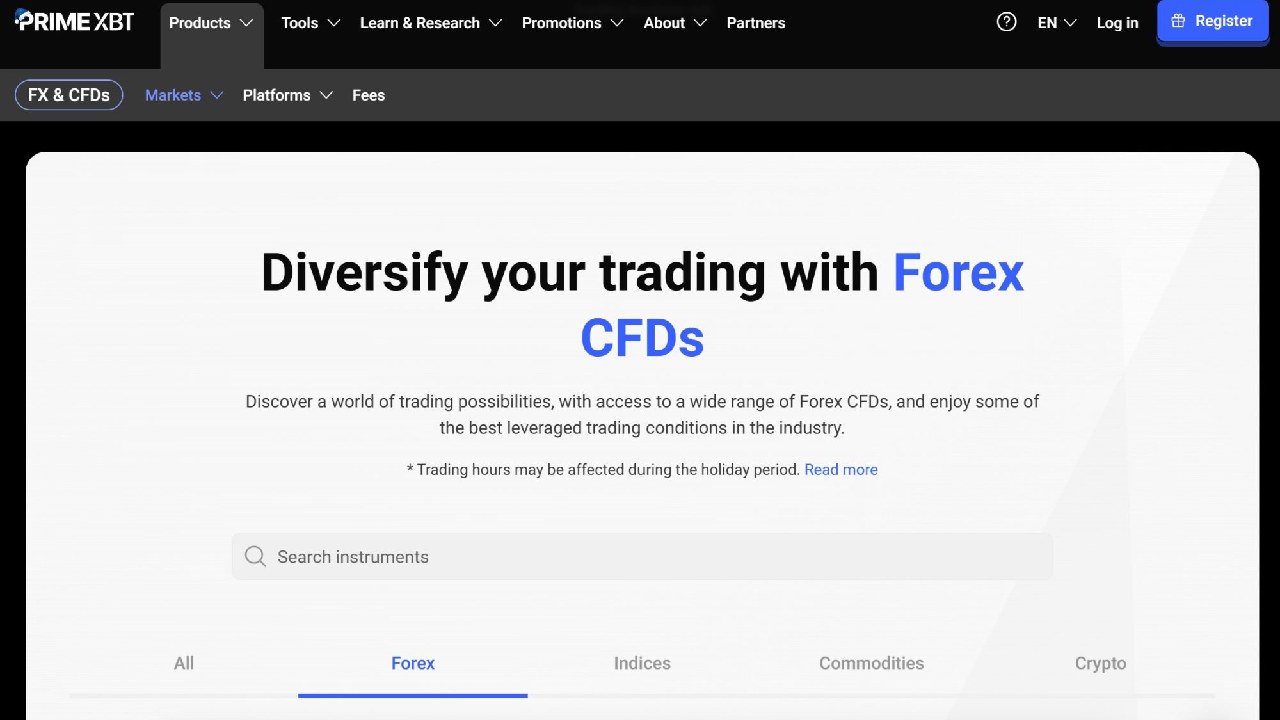
The biggest concern for UK residents, though, is PrimeXBT is operating without FCA regulation, meaning trading with the platform presents certain risks, such as traders having limited recourse in case of disputes or platform failures. The platform focuses on derivatives, such as CFDs, and does not have direct share trading.
PrimeXBT charges a 0.05% fee for trading cryptocurrencies. The fee is applied in addition to the spread. Currency pairs, commodities, and indices are traded without commission.
Read our comprehensive review for more insights on this broker.
Pros
- It offers a copy trading feature
- No-commission trading for commodities, indices and forex
- There is negative balance protection
Cons
- It’s not licensed by the FCA or other major financial authorities
- Offers a limited number of tradable assets
Crypto Futures and CFDs are high-risk, leveraged products that may not be suitable for all investors, as they can lead to significant losses.
7. Trade Nation: Best spreads for commission-free forex broker
- 46 currency pairs
- GBP/USD fixed spread of 0.8 pips
- EUR/GBP fixed spread of 0.6 pips
The broker focuses on CFD trading and offers slightly more than 1,000 tradeable instruments, a relatively small number that includes 46 forex pairs. It does focus on low-cost spreads, as it charges a minimum of 0.3 pips on a EUR/USD trade and 0.8 pips on a GPB/USD pair.
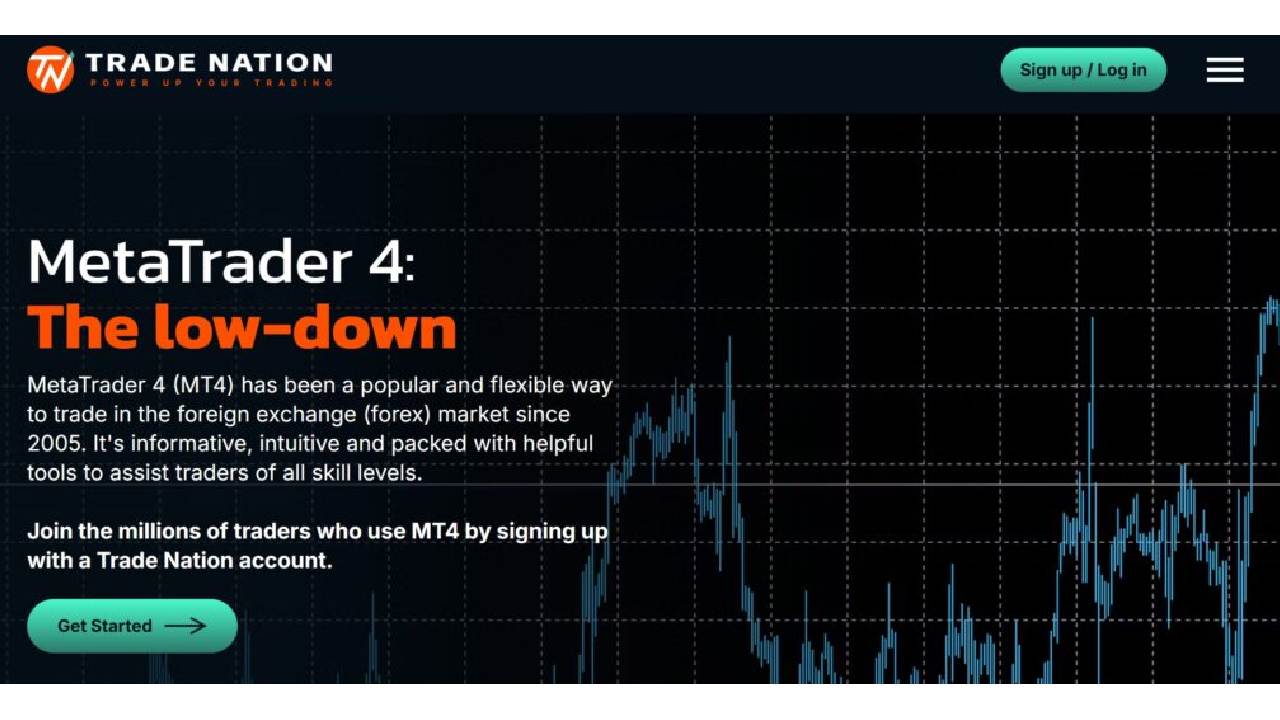
Trade Nation uses an in-house platform, TN Trader, as well as the TradingView platform and Metatrader 4, which comes with a copy trader option for novice traders who want to mimic what experienced traders are doing.
Some of its better features include an intuitive web site and no minimum deposit requirement. It also offers advanced charting through ChartIQ.
The broker also has a demo account with $10,000 in virtual currency attached. It also sponsors a knowledge base that includes articles, videos and podcasts, but the articles are on the basic level, not very advanced.
Pros
- It has relatively low-cost spreads
- It offers copy trading option
- Easy-to-use web site, with plenty of platform options
Cons
- A very limited amount of tradeable instruments
- Education resources are at a basic level
73.1% of retail investor accounts lose money when trading CFDs with this provider.
9. IG: Best UK forex broker with a large number of currency pairs
- More than 80 currency pairs
- GBP/USD spread from 1.0 pips
- EUR/GBP spread from 2 pips
IG is known for its wide choice of financial instruments, more than 19,000, including CFD and non-CFD trading. It offers a huge amount of forex pairs, more than 80, making it a popular choice for forex traders. It even has a demo account for forex, designed for traders who are not yet familiar with trading currencies.
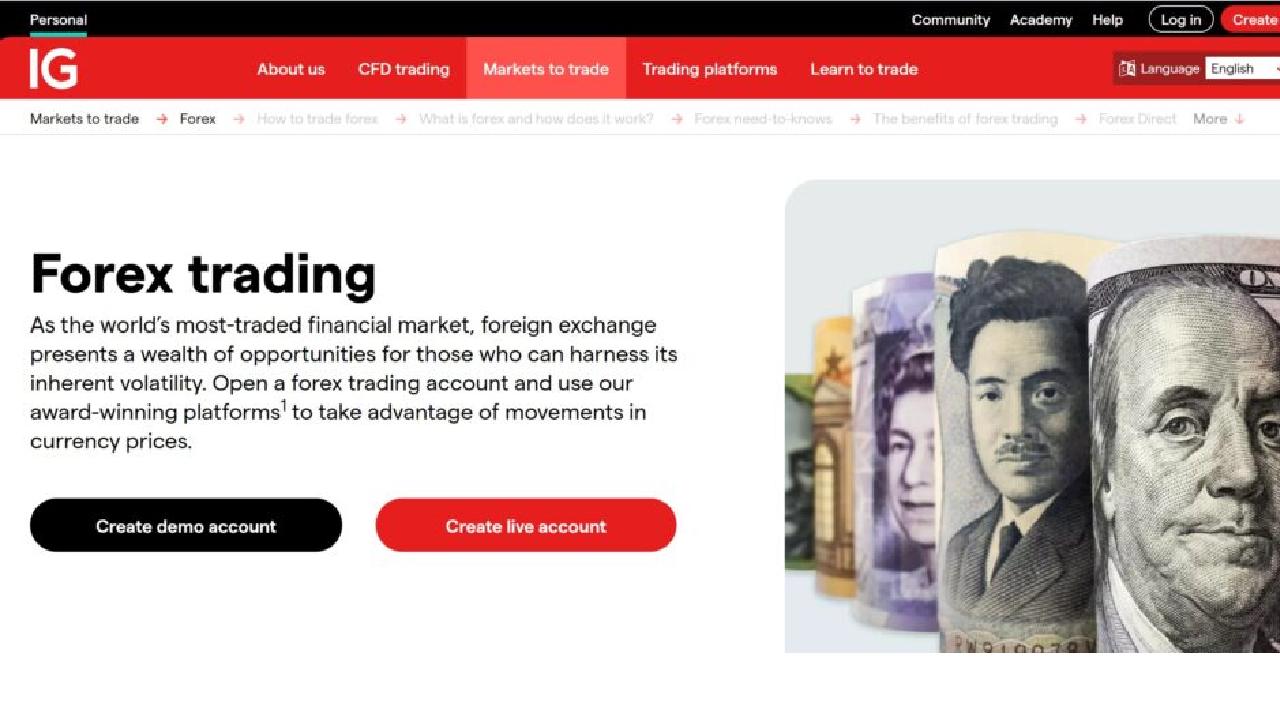
Its platform is renowned for its user-friendly interface, robust charting tools, and real-time market analysis, enabling traders to make informed decisions. IG provides access to a wide range of currency pairs, including major, minor, and exotic crosses, catering to diverse trading strategies.
One of the best things about IG is its transparency. All of its fees are built into the spread, with no separate commission. The EUR/USD average spread, according to the company, is 0.85 pips with the minimum spread being 0.6 pips with the minimum GBP/USD spread being 0.9 pips. The EUR/GBP spread has a minimum spread of 0.9 pips as well.
Pros
- Large amount of currency pairs to choose from as well as other financial instruments
- Fees are transparent and built into the spread
- Its platforms have advanced charting features
Cons
- It charges relatively high spreads for some forex trades
- No automated copy trading feature
67% of retail investor accounts lose money when trading CFDs with this provider.
The lowest spread UK brokers compared
The following is a summary table with these eight UK forex brokers’ spreads on raw/zero spread and standard, low-commission accounts for the euro against the dollar and the British pound against the dollar (cable) currency pairs.
| Broker | No. of currency pairs available | Raw GBP/USD spread | Raw EUR/GBP spread | Standard GBP/USD spread | Standard EUR/GBP spread |
| eToro | 60+ | n.a. | n.a. | 2 pips | 1.5 pip |
| XTB | 60+ | n.a. | n.a. | 1.4 pips | 0.9 pips |
| Pepperstone | 90+ | 0.0 pips | 0.1 pips | 1.0 pips | 1.1 pips |
| FP Markets | 70+ | 0.4 pips | 0.0 pips | 1.5 pips | 1.2 pips |
| Admiral Markets | 80+ | 0.3 pips | 0.1 pips | 1.0 pips | 0.8 pips |
| Prime XBT | 50+ | n.a. | n.a. | 1.5 pips | 1.1 pips |
| Trade Nation | 46 | n.a. | n.a. | 0.8 pips | 0.6 pips |
| IG | 80+ | n.a. | n.a. | 0.9 pips | 2 pips |
What is a spread in forex trading?
A spread in forex trading is the difference between the bid price (the price a trader receives when selling a currency pair) and the ask price (the price a trader pays to buy a currency pair). In simpler terms, it’s the cost of entering a trade and compensates the broker for their services.
Spreads are measured in pips (percentage in points), the smallest price movement in a currency pair. It’s typically the fourth decimal place for most pairs, representing 0.0001. For instance, if the EUR/USD moves from 1.1200 to 1.1201, it has moved one pip. Many of the best UK day trading platforms make these spreads transparent so traders can understand their costs upfront.
A lower spread means a smaller difference between the buying and selling price of a currency pair. If a trader enters a position with a 1-pip spread and the market moves 2 pips in the trader’s favour, he or she has already covered the spread cost and has a profitable trade. Conversely, a wider spread would require a larger price movement to break even.
What are raw spreads?
A raw spread provides traders in the UK with the most favourable market conditions possible. It reflects the true underlying price of a trading instrument, free from any extra markups added by the broker.
For instance, when trading the USD/CAD pair at 1.2768, a raw spread ensures you’ll execute trades at this exact price, without any additional costs. Most raw spreads, though, in forex are between 1 pip and five pips.
What is the difference between the minimum spread and the average spread?
The minimum spread is the smallest price difference between the bid and ask prices observed during a specific timeframe. In contrast, the average spread is the calculated mean of all the spread values recorded within that same period, reflecting the typical price difference between the bid and ask across various market conditions.
Essentially, the minimum spread represents the tightest possible spread a broker can offer, but it’s not always available. The average spread, on the other hand, indicates the overall mean spread during a specific period of time. When a broker quotes average spreads in their pricing table, they should disclose over what time period the average was measured.
How are forex spreads calculated?
To calculate the forex spread, subtract the bid price from the ask price. This difference, measured in pips, represents the cost of entering a trade. For instance, with a GBP/USD quote of 1.3089/1.3091, the spread is 1.3091 – 1.3089 = 0.0002, or 2 pips.
What counts as a low forex spread?
There are a lot of factors that go into what is considered a low forex spread. Time of day, liquidity of the market and type of forex pairs make a difference in the spread. However, generally, a tight spread will be between 0 and 3 pips.
What’s the difference between zero-spread brokers and low-spread brokers?
A low-spread broker offers a minimal difference between the bid and ask prices, while a zero-spread broker eliminates the spread entirely. Low-spread brokers still charge commissions, whereas zero-spread brokers may charge commissions in addition to any spread widening during market volatility.
Other trading instruments with spreads
Indices: CFDs on stock indices, like the S&P 500 or FTSE 100, often involve spreads.
Commodities: Contracts for Difference (CFDs) on commodities like gold, silver, oil, and natural gas are commonly traded with spreads.
Cryptocurrencies: CFDs on cryptocurrencies like Bitcoin and Ethereum are frequently traded with spreads.
Stocks: While many stockbrokers offer commission-based trading, some use a spread-based model, especially for options trading. To find brokers for low-cost stock investing, view our guide on the best online stockbrokers in the UK.
Are there any zero-spread brokers?
Yes and no. While there are brokers that may not charge any pips on a forex transaction, they still have to make money, so they charge other types of fees, like commission per trade. So, it’s not really a free trade, but for many investors, the cost savings on zero spreads can be significant, especially for frequent traders and scalpers.
Pepperstone, for example, offers 0 pips on some forex trades on its Razor account, but charges a commission, for example, on USD trades of $7 for every 100,000 units of the base currency traded, called a ‘lot’. So, if you trade two lots of USD/EUR, you will pay a total commission of $14.
This means that for every 100,000 units of the base currency traded, you will be charged a specific commission. For example, if the commission per lot is $7 and you trade 2 lots of EUR/USD (which is €200,000), you would pay a total commission of $14.
What is the difference between a standard account and a zero-spread account?
A standard trading account includes a built-in spread—the difference between the bid and ask price of a currency pair. This spread is how brokers typically earn revenue on each trade.
In contrast, a zero-spread account offers almost no difference between the buying and selling price. Instead of earning from the spread, brokers charge a small commission per trade. This setup is often favored by scalpers and high-frequency traders who rely on ultra-precise entry and exit points.
Whether you’re trading currencies or ETFs, understanding account types can help you choose the most cost-efficient option for your strategy.
How to choose a low-spread broker
Here are some of the most important factors to consider:
Regulation:
Prioritise brokers regulated by the Financial Conduct Authority (FCA). Choosing from UK forex brokers that hold FCA authorisation ensures strong consumer protection and adherence to strict financial standards.
Spreads, commissions, other costs:
Next, assess the spread and commission structure. Look for brokers offering raw spread accounts with minimal or no markup and compare commission fees across different brokers to find the most cost-effective option. Be aware of any hidden fees that may impact your overall trading costs.
Platforms, trading tools:
A good broker should offer a user-friendly trading platform with fast execution speeds and advanced features like charting tools, technical indicators, and automated trading options.
Customer and educational support:
Reliable customer support and educational resources are also crucial. A responsive customer support team can assist you with any questions or issues, while access to educational materials, webinars, and tutorials can help you improve your trading skills.
Additional safeguards:
Finally, consider additional features and benefits like negative balance protection, segregated client funds, and a diverse range of trading instruments beyond forex.
By carefully considering these factors, you can select a low-spread forex broker that aligns with your trading goals and risk tolerance.

How We Rate Brokers
We manually review the brokers on our list. Below are the key metrics we check before listing online brokers on the website. For further details, you can also take a look at our online brokers rating guide, featured on ValueWalk.
Regulations
Trading conditions
Trading products and platforms
Customer support
Education center
FAQs on low-spread brokers
Can I trust low-spread brokers in the UK?
Is there a broker with zero spreads?
What is a good spread for a forex broker?
Which forex pair usually has the lowest spread?
How to trade with low spreads?
Does Bitcoin have a spread?
What is a good spread for gold (XAU/USD)?
What is an ECN broker?
References
Disclaimer: CFDs are complex instruments and come with a high risk of losing money rapidly due to leverage. 46% of retail investor accounts lose money when trading CFDs with this provider. You should consider whether you understand how CFDs work and whether you can afford to take the high risk of losing your money.