


Disclaimer: Your capital is at risk
Exchange-traded fund (ETF) investing has become one of the most popular ways for both beginners and experienced investors to build wealth.
In this guide, I’ll walk you through everything you need to know about how to invest in ETFs in 2025, from the basics to practical strategies. To get started, the first step is selecting a reliable trading platform.
Short on time? Below, I’ve highlighted some of the best places to trade ETFs in 2025 based on overall investor experience.


Join a multi-asset broker with 24/5 trading for all S&P500 and Nasdaq100 stocks.
Join a multi-asset broker with 24/5 trading for all S&P500 and Nasdaq100 stocks.
- Trade the most popular cryptocurrencies, stocks and ETFs with a simple interface
- Copy other traders, ranked by their ROI and risk level
- Access smart portfolios composed cryptos, bonds, stocks, and more
Your capital is at risk.


- Tight spreads and fast execution
- Copy trade experienced investors
- Forex, CFDs, Indicies, Commodities & more

- Low fees and fast execution
- Invest in stocks, ETFs; fractional investing available
- Trade forex, commodities, stocks, indices, bonds
How to invest in ETFs – Step-by-step guide
Investing in ETFs is convenient as they are widely available through online brokers and traditional broker-dealers. Follow the steps below to invest in ETFs:
Open a brokerage account
The very first thing you need to invest in ETFs is a brokerage account. If you don’t already have one, you can open an account with any online broker that meets your investing needs in terms of cost, ETFs offered, customer service and more. Some of the best investing platforms in the USA are eToro, FP Markets, and Admiral Markets, many of which also provide portfolio builder tools to help plan your allocations.
Choose an ETF to invest in
The first step of opening a brokerage account is easy, but selecting the best ETFs requires a careful consideration. There are thousands of ETFs to choose from, such as S&P 500 ETFs, small cap ETFs and more, but it’s important to select the ones that meet your investment objectives and risk tolerance.
You can use research tools or an ETF screener to filter ETFs listed on major exchanges and make your search easier. Moreover, you can use different parameters to search for your chosen ETFs, such as trading volume, commission costs, past performance, expense ratio and holdings.Fund your account
After selecting ETFs to invest in, you need to transfer funds to your brokerage account. You can either make a one-time investment in ETFs or set up automatic investing with a regular plan. Setting up a regular investment plan will save you from the trouble of making frequent investment decisions. It is recommended that you keep some idle funds in your account to enable you to quickly take advantage of any investment opportunity that arises.
Place an order
To place an order, you need to log in to your trading platform, head to the order placement section, and enter the name of the ETF you want to invest in. Next, enter the number of ETF units you wish to buy and set the preferred price, if applicable. Finally, review the order details to ensure any errors are eliminated. After reviewing the accuracy of the entered details, submit the order.
Monitor your investment
Your journey doesn’t end after placing an order; instead, the most important step of ETF investing begins now, especially if you later decide to explore ETF options for hedging or income strategies. It is important that you regularly monitor your investment status to track any updates, price fluctuations, and relevant market news that may impact the value of your investment. If needed, you can also make adjustments to ensure your ETF investment remains in-line with your financial goals.
As you saw in the process above, the first step to investing in ETFs is opening a brokerage account. Let’s take a closer look at some of the best platforms where you can buy ETFs in 2025.
Where to buy ETFs
Similar to stocks, ETFs are traded on the stock exchanges, and thus, investors can easily buy them through their brokerages. However, you need to consider cost, the number of ETFs offered, and other related factors when selecting a platform to buy ETFs.
Some of the best platforms to buy ETFs are:
eToro
eToro is a great platform for investing in ETFs, offering a wide selection of funds. The platform allows users to search for different kinds of ETFs using various filters and see ETFs that others are investing in.
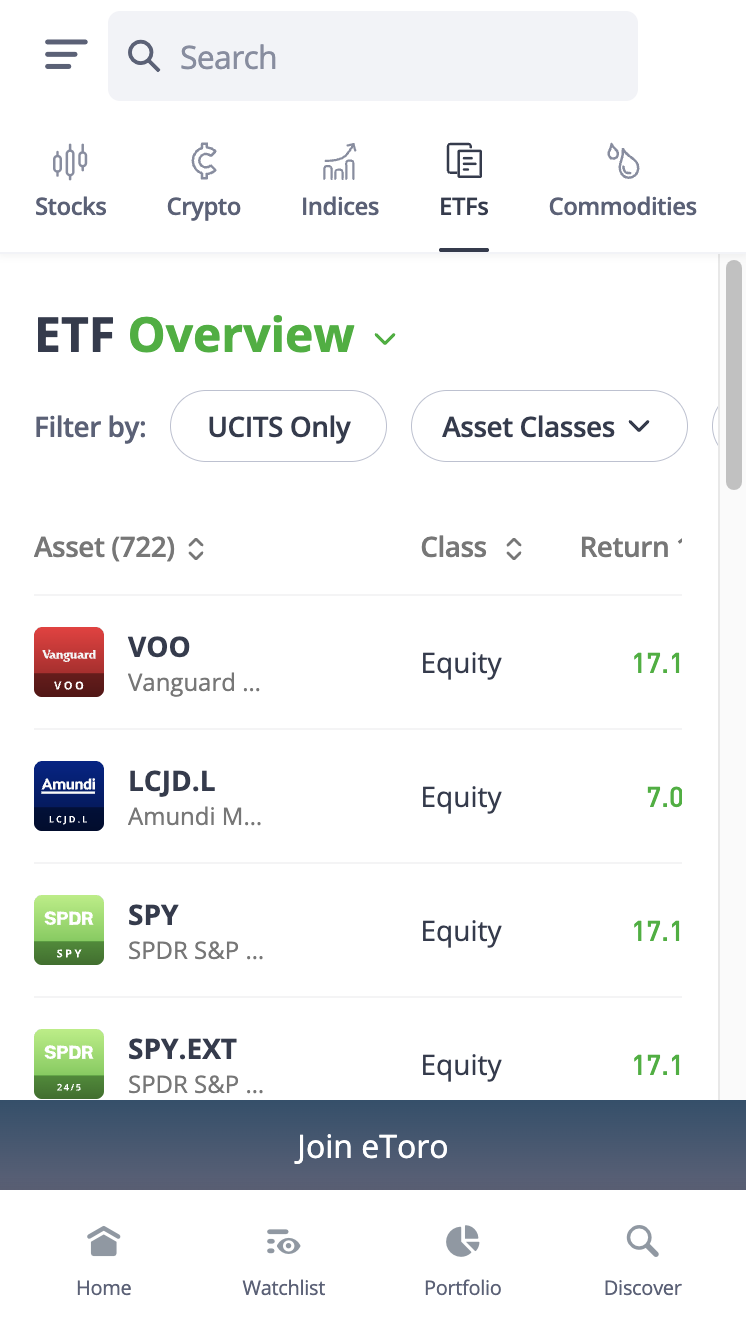
Buying an ETF on eToro is super easy as well. All you need to do is log in to your account, fund it using a credit or debit card, search ETFs you want to invest, enter your order details, and buy. eToro also ranks among the lowest in terms of ETFs trading fees.
Pros
- Low ETF and stock fees
- Social trading features
- User-friendly interface
Cons:
- Not available in all US states
- Absence of advanced trading tools and features
FP Markets
FP Markets is a leading broker with a substantial global presence. The broker supports multiple platforms, giving clients access to all types of ETFs and other investing instruments. Moreover, the platform offers competitive spreads on all investment products.
Beginners can benefit from FP Markets’ insightful educational materials and responsive customer support. FP Markets also offers a demo trading account to help beginners hone their ETF trading skills.
Fast order execution and low trading costs are the other pluses of FP Markets, while its commitment to regulatory compliance adds an extra layer of security.
Pros
- Comprehensive educational content
- Competitive spreads
- Fast order execution
Cons:
- High minimum deposit
- Comparatively fewer advanced trading tools
Admiral Markets
Admiral Markets allows investors to invest in thousands of stocks and ETFs globally. The platform blends sophistication with simplicity to offer a seamless trading experience. The broker also scores highly in terms of competitive spreads and user-centric design.
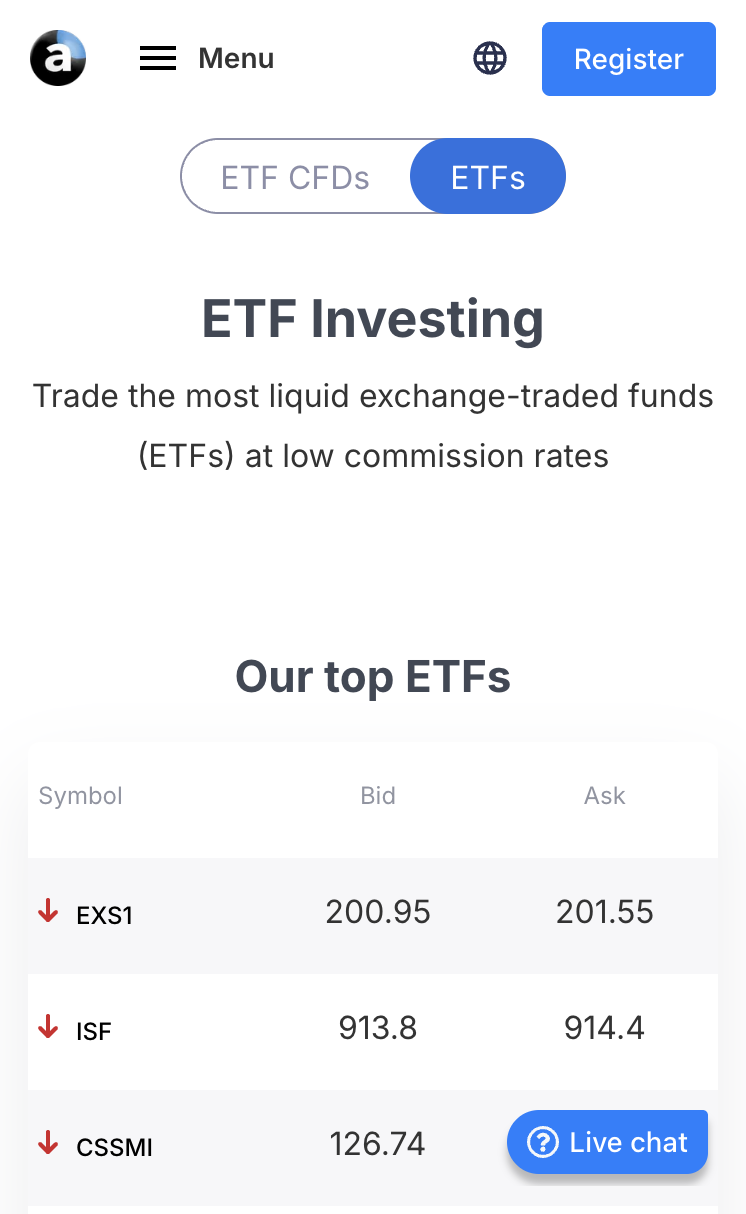
Deposits and withdrawals on the platform are fast and mostly free. Admiral Markets also has a well-designed, user-friendly mobile trading app with a good search function.
Moreover, the broker offers a comprehensive suite of educational resources, such as articles, webinars, tutorials, and seminars.
Pros
- Offers advanced trading features
- Makes available several volatility protection tools for managing risk
- Allows fractional investing and automated weekly or monthly recurring stock and ETF investments
Cons:
- Social trading features not as comprehensive as other top brokers
- High inactivity fee
Once you’ve opened a brokerage account and chosen where to buy, the next step is deciding which ETFs to invest in. To make that choice easier, let’s break down the main types of ETFs available
Types of ETFs
ETFs can be grouped into different categories depending on the assets they hold, the strategies they use, or how their transferable securities are managed.
Understanding these types will help you select funds that match your financial goals and risk tolerance.
ETFs by asset class
These ETFs are organized based on the kind of market exposure they provide. They’re often the first way investors think about diversifying their portfolios.
Equity ETFs
Equity ETFs track baskets of stocks. They may cover broad markets, focus on company size (large-cap, mid-cap, small-cap), or zoom in on specific sectors or regions.
These are among the most popular ETFs for beginners because they provide simple, diversified stock market exposure.
- Examples of equity ETFs: SPDR S&P 500 ETF Trust (SPY), Vanguard Total Stock Market ETF (VTI), iShares MSCI Emerging Markets ETF (EEM).
Bond (fixed-income) ETFs
Bond ETFs are a popular way to access fixed income investments, offering steady income and lower volatility compared to stocks. They are often used to balance portfolios or preserve capital.
- Examples of bond ETFs: iShares ETFs such as iShares U.S. Treasury Bond ETF (GOVT), iShares iBoxx $ Investment Grade Corporate Bond ETF (LQD), iShares National Muni Bond ETF (MUB).
Commodity ETFs
Commodity ETFs track the prices of physical goods like metals, energy, or agriculture. They are commonly used to hedge against inflation or diversify beyond traditional stocks and bonds.
- Examples of commodity ETFs: SPDR Gold Shares (GLD), Invesco DB Oil Fund (DBO), Teucrium Corn Fund (CORN), all of which operate under U.S. regulations such as the Commodity Exchange Act.
Real estate ETFs
Real estate ETFs invest in Real Estate Investment Trusts (REITs) and related securities, giving exposure to the property market without owning physical buildings. They are often used to add income and diversification.
- Examples of real estate ETFs: Vanguard Real Estate ETF (VNQ), iShares U.S. Real Estate ETF (IYR), Schwab U.S. REIT ETF (SCHH).
Currency ETFs
Currency ETFs follow the performance of one or more currencies. They can help investors diversify internationally or hedge against foreign exchange fluctuations.
- Examples currency ETFs: Invesco CurrencyShares Euro Trust (FXE), Invesco Chinese Yuan Trust (CYB), Invesco Japanese Yen Trust (FXY).
Crypto ETFs
Crypto ETFs give investors exposure to digital assets like Bitcoin (spot Bitcoin ETFs) and Ethereum (spot Ether ETFs) through traditional brokerages. These funds are especially appealing to those who want crypto exposure without managing wallets or exchanges.
- Examples of crypto ETFs: iShares Bitcoin Trust (IBIT), VanEck Bitcoin Trust (HODL), ProShares Bitcoin Strategy ETF (BITO), all of which are considered part of the broader category of exchange-traded products.
ETFs by strategy
Strategy-based ETFs are built with specific goals in mind, such as enhancing returns or protecting against downturns. This includes leveraged and inverse ETFs that amplify gains or move opposite to the market. They are more specialized than standard funds.
Leveraged ETFs
Leveraged ETFs use derivatives to magnify daily index returns, often targeting 2x or 3x performance.
They can deliver large gains but also steep losses, making them best for short-term trades rather than long-term investing.
- Examples of leveraged ETFs: ProShares UltraPro QQQ (TQQQ), Direxion Daily S&P 500 Bull 3X Shares (SPXL), ProShares Ultra S&P500 (SSO).
Inverse ETFs
Inverse ETFs are designed to profit when the underlying asset or index declines. They’re often used as hedges during market downturns or for short-term speculation.
- Examples of inverse ETFs: ProShares Short S&P 500 (SH), ProShares UltraShort QQQ (QID), Direxion Daily Small Cap Bear 3X Shares (TZA), many of which are also linked to derivatives traded on the Chicago Board Options Exchange.
Smart beta ETFs
Smart beta ETFs follow alternative index strategies instead of weighting solely by market cap, and their rules are usually designed by an index provider. They may target factors like value, momentum, dividends, or low volatility to try and improve risk-adjusted returns.
- Examples of smart beta ETFs: iShares MSCI USA Value Factor ETF (VLUE), Invesco S&P 500 Low Volatility ETF (SPLV), iShares Select Dividend ETF (DVY).
Hedged ETFs
Hedged ETFs protect investors from currency risk by offsetting foreign exchange fluctuations that might otherwise reduce returns. These are particularly useful when investing in international markets.
- Examples hedged ETFs: iShares Currency Hedged MSCI EAFE ETF (HEFA), Deutsche X-trackers MSCI EAFE Hedged Equity ETF (DBEF), WisdomTree Europe Hedged Equity ETF (HEDJ).
ETFs by management style and structure
Not all ETFs are managed or built the same way. Some aim to mirror the market closely, while others take a more hands-on or complex approach.
Passive (index) ETFs
Index ETFs aim to replicate the performance of a specific market index, much like a traditional index fund. They are known for low costs, broad diversification, and long-term reliability.
- Examples of passive ETFs: SPDR S&P 500 ETF Trust (SPY), Vanguard Total Stock Market ETF (VTI), iShares Core S&P 500 ETF (IVV), which are typically regulated under the Investment Company Act of 1940.
Actively managed ETFs
Active ETFs rely on professional managers who pick securities to try and outperform the market. They may provide higher returns but usually come with higher fees, since an investment adviser is actively managing the portfolio.
- Examples of active ETFs: ARK Innovation ETF (ARKK), JPMorgan Equity Premium Income ETF (JEPI), Avantis U.S. Small Cap Value ETF (AVUV).
Physical ETFs
Physical ETFs directly hold the securities or assets that make up their index. This makes them transparent and straightforward, as investors know exactly what the fund owns.
- Examples of physical ETFs: SPDR Gold Shares (GLD), iShares Silver Trust (SLV), Vanguard S&P 500 ETF (VOO).
Synthetic ETFs
Synthetic ETFs don’t hold the actual assets but instead use swaps and derivatives to mimic index performance. They’re common in European markets, especially on venues like the London Stock Exchange, and may involve counterparty risk.
- Examples of synthetic ETFs: Lyxor MSCI Emerging Markets UCITS ETF, db x-trackers S&P 500 UCITS ETF, Amundi ETF MSCI USA Synthetic UCITS ETF.
Thematic and niche ETFs
Thematic ETFs concentrate on specific industries or global trends, and some can even provide exposure to alternative investments.
They allow investors to align portfolios with growth opportunities, but their narrower focus can increase volatility compared to other funds.
AI ETFs / Technology ETFs
Examples: Global X Robotics & Artificial Intelligence ETF (BOTZ), ARK Next Generation Internet ETF (ARKW), iShares Expanded Tech-Software Sector ETF (IGV).
Clean energy ETFs / ESG ETFs
Examples: iShares Global Clean Energy ETF (ICLN), Invesco Solar ETF (TAN), SPDR S&P 500 ESG ETF (EFIV).
High-dividend ETFs
Examples: Vanguard High Dividend Yield ETF (VYM), Schwab U.S. Dividend Equity ETF (SCHD), iShares Select Dividend ETF (DVY).
Biotech ETFs / Healthcare ETFs
Examples: iShares Biotechnology ETF (IBB), SPDR S&P Biotech ETF (XBI), Health Care Select Sector SPDR Fund (XLV).
Semiconductor ETFs
Examples: iShares Semiconductor ETF (SOXX), VanEck Semiconductor ETF (SMH), SPDR S&P Semiconductor ETF (XSD).
Emerging market ETFs / China ETFs
Examples: iShares MSCI China ETF (MCHI), KraneShares CSI China Internet ETF (KWEB), iShares MSCI Emerging Markets ETF (EEM).
Bitcoin ETFs / Blockchain ETFs
Examples: VanEck Bitcoin Trust (HODL), Bitwise Crypto Industry Innovators ETF (BITQ), Global X Blockchain ETF (BKCH).
ETFs vs other investments
ETFs sit in a unique spot between simplicity and diversification, which is why many beginners compare them with other common investment choices before getting started.
These quick comparisons help clarify how each option works and what role it may play in a portfolio.
ETFs vs Mutual funds
Both offer diversified exposure, but the way they trade is different. ETFs move throughout the day like regular stocks, while mutual funds settle once per day after market close. Mutual funds can also come with higher management fees. I tend to see ETFs as more convenient because I can adjust my position at any time during market hours.
ETFs vs stocks
A single stock reflects the performance of one company, so the risk is concentrated. An ETF holds a group of securities, often across an entire sector or index. This broader mix helps smooth out company-specific swings and usually gives beginners a more stable entry point into the market.
ETFs vs index funds
ETFs and index funds often track the same benchmarks, but the experience of owning them can feel different. ETFs offer intraday pricing and generally have lower entry requirements. Index funds may still appeal to investors who prefer a set-and-forget approach through automated contributions, yet ETFs offer more flexibility if you want control over when you buy or sell.
ETFs vs bonds
Bonds are used for income and stability, but building a diversified bond portfolio can be harder than it looks. Bond ETFs simplify this by holding many bonds at once, covering different maturities or issuers in a single fund. It’s an easier way to add fixed-income exposure without selecting individual bonds.
ETFs vs precious metals
Physical gold or silver can act as a store of value, but storing and insuring metals can be inconvenient. Precious-metal ETFs track the price of assets like gold, silver, or platinum without needing to hold the metal yourself. They offer the same market exposure with much easier trading and lower upfront costs.
ETFs vs cryptocurrencies
Crypto can deliver fast gains but often comes with sharp price swings and technical hurdles like wallets and exchanges. Crypto ETFs give exposure to assets such as Bitcoin or Ethereum through a traditional brokerage account. They still carry the volatility of the underlying crypto but feel simpler for beginners who want regulated access.
ETFs vs real estate
Owning property directly involves large upfront costs, maintenance, and limited liquidity. Real estate ETFs, especially REIT-focused funds, offer exposure to the property market without the responsibilities of being a landlord. This way, investors get a similar simplicity to trading stocks, making it easier to add real estate exposure with smaller amounts of capital.
How to choose an ETF: Simple steps to find the right fund for you
You now know the main ETF classifications, but how do you choose the one that suits you best? Here’s a simple step-by-step process to follow:
Start with your goal
Be clear on what you want from your investment. Do you want long-term growth, steady income, or to diversify into a new market? Your investment goals will guide every other decision.
Search ETFs that match
Use your broker’s search bar or an ETF screener to filter funds by sector, region, or theme. This narrows the list to options that align with your objective.
Compare a few options
Look at the expense ratio, management fees, fund size, and trading volume. Lower costs and higher liquidity usually mean better efficiency and smoother trading.
Check the holdings
Check the top assets inside the ETF. This helps you see if you’re comfortable with the fund’s assets and the companies or securities it holds.
Pick the best fit
Select the ETF that best balances your goal, cost, and risk, as the right choice can vary for each particular investor. Remember, there’s no “perfect” ETF, only the one that fits your strategy, and seeking professional investment advice can help if you’re unsure.
Popular ETFs to know
Some ETFs stand out for their size, liquidity, and long track record. They are often used as portfolio cornerstones, as they offer clear exposure to well-known parts of the market.
Below are three of the most widely followed ETFs and what they represent.
SPDR S&P 500 ETF Trust (SPY)
SPY tracks the S&P 500 and has been trading since early 1993, making it the first ETF launched in the U.S. Its long history and heavy trading activity turned it into a common gauge of large-cap market strength.
As of late 2025, SPY managed roughly $680 billion in assets, and its long-term annualized return since inception has been close to 10–11 percent, reflecting the broader performance of the S&P 500 over time.
Vanguard Total Stock Market ETF (VTI)
VTI holds a wide mix of stocks, including large, mid, small and micro-cap companies. Many investors use it when they want exposure to the full U.S. market instead of just the largest firms.
Recent reports showed its asset base around $528–550 billion, one of the highest in the ETF industry. With thousands of holdings and an expense ratio near 0.03 percent, it remains one of the most efficient ways to track the overall U.S. equity landscape.
iShares Core U.S. Aggregate Bond ETF (AGG)
AGG covers the main investment-grade bond segments in the U.S., from Treasuries to corporate and mortgage-backed securities. Its size sits around $130 billion, making it a central reference point for many fixed-income investors.
Because AGG reflects the broader bond market, its movements give a quick sense of how interest rates and credit conditions are shifting, which is why it’s often used to balance stock-heavy portfolios.
The pros and cons of investing in ETFs
Understanding the potential benefits and drawbacks of ETF investing can help you maximize your returns.
Benefits of ETFs
- Diversification: ETFs allow investors to diversify their portfolios with a single investment. By investing in ETFs that mimic a broad market index or sector, investors can easily spread their risk across multiple securities.
- Liquidity: ETFs provide investors with liquidity and flexibility as they trade on stock exchanges. Liquidity allows investors to enter or exit positions easily.
- Transparency: Most ETFs are required to report their holdings on a daily basis. Such transparency allows investors to make informed decisions regarding their asset allocation and risk exposure.
- Low cost: Investing in ETFs is more cost-efficient than investing in actively managed mutual funds. Moreover, ETFs are more tax efficient as they trigger less capital gain distribution.
- Flexibility: The fact that you can easily buy and sell ETFs, just like stocks, gives you more control over your investments. Moreover, ETFs provide investors with flexibility when it comes to asset classes and investment strategies.
Disadvantages of ETFs
- Market risk: Like with other investments, ETF investing is vulnerable to market volatility, which can affect both short-term and long-term performance.
- Trading costs: Even though ETFs have a low-cost structure, costs may add up if you trade frequently. Investors typically pay a brokerage commission each time an ETF is bought or sold.
- Illiquidity: ETFs with lower trading volumes or ETFs that invest in niche markets or sectors may face liquidity risk, making them harder to buy or sell at a fair price. Such ETFs effectively increase your overall investing cost and are comparatively harder to enter and exit.
How are ETFs taxed?
Unlike mutual funds, ETFs are considered to be more tax-efficient because buying and selling occur through an exchange. Moreover, the ETF sponsor doesn’t need to redeem shares each time an investor plans to sell shares of the ETF.
In terms of tax treatment, ETFs held for more than a year are subject to long-term capital gains tax in the US. On the other hand, ETFs held for less than a year are taxed at ordinary income rates.
Additionally, any dividend and interest payments from ETFs are taxed like income from the underlying investments, such as stocks or bonds, and taxes may also apply when you sell securities held within the fund.
The bottom line
ETF investing is a simple yet effective way for each particular investor, whether beginner or experienced, to develop a diversified investment portfolio to achieve their financial goals.
Moreover, ETFs are a cost-effective option for gaining exposure to a broad range of securities with a limited budget.
By following the above steps, you can start investing in ETFs with proper research, strategic decision-making, and ongoing monitoring, navigating the ETF world with ease and confidence.
FAQs
How to buy ETFs for beginners?
Are ETFs a good investment?
Which ETF is best for beginners?
How is an ETF different from a stock?
Are ETFs safer than stocks?
What is the 3:5:10 rule for ETFs?
References
- Record ETFs flows driven by ‘unstoppable momentum’ from retail investors | Financial News | 2025
- 2025 ETF trends: What’s next for ETFs? | State Street | 2025
- Vanguard and Wellington Team Up to Launch Their First Active Equity ETFs | Barrons | 2025
- Inside the great ETF boom of 2025: ‘How do you navigate all this?’ | Market Watch | 2025
- Compounding Effects in Leveraged ETFs: Beyond the Volatility Drag Paradigm | Chung-Han Hsieh, Jow-Ran Chang, Hui Hsiang Chen | 2025
- How to invest in ETFs | eToro | 2025
- ETF Trading with FP Markets | FP Markets | 2025
- Statement on the Approval of Spot Bitcoin Exchange-Traded Products | SEC.gov | 2024