


UK trading platforms keep adding features that specifically cater for the substantial percentage of retail traders who engage in buying and selling financial instruments within the same day, exploiting price swings for a profit.
Day trading gained popularity during the COVID-19 pandemic, when people were confined to their homes amid a series of lockdowns, and has remained popular ever since. Typically aged between 18 and 34, day traders skew younger than the average investor, and they account for 65% of all online traders in the UK, according to Broker Notes.
It has also helped the spread of day trading that many platforms have moved away from charging commissions for trades. Ironically, the rise in day trading has also made markets more volatile, which is exactly what day traders need to flourish. In this guide, we review the seven top UK day trading platforms, with the most user-friendly features:
The top 7 UK day trading platforms ranked
Here’s a quick overview of our selections of the best UK day trading brokers. They made our list for enabling quick trades at relatively low prices.
- eToro: The Israel-based platform is best known for its copy trading features and social investing resources. It offers trading in more than 30 cryptocurrencies, forex, commodities, as well as stocks and ETFs.
- XTB: The platform has more than 500,000 customers and allows trading in stocks and forex, plus offer contracts for difference (CFDs) in stocks, forex, indices, ETFs, commodities and crypto. It’s based in Warsaw, Poland.
- Pepperstone: The Melbourne-based broker is known for fast execution speeds and competitive spreads. It offers CFD trading on forex, cryptocurrencies, as well as stocks, indices, metals, and commodities.
- FP Markets: The online broker, based in Sydney, focuses on CFD trading on forex, stocks, indices, commodities and cryptocurrencies. Its raw account has spreads from 0.0 pip, with a commission.
- Admiral Markets: The forex broker, part of Estonia-based Admirals Group, offers CFDs on indices, metals, energies, agricultural commodities, crypto, stocks, ETFs and bonds, as well as stock and ETF investing.
- Trade Nation: The trading platform specialises in low-cost fixed spreads for trading various CFD instruments, including forex, stocks, cryptocurrencies, commodities and indices. It’s based in London.
- IG: The company, formed in 1974 in London, is known for CFD trading on 18,000 instruments, including cryptocurrencies, indices and commodities, but also supports direct investing into stocks and ETFs.
Disclaimer: 46% of CFD traders lose money. Your capital is at risk.
- Show Full Guide
An in-depth look at today’s best platforms for day trading in the UK
Now, let’s break down the UK’s top day trading platforms, based on multiple factors, such as user-friendliness, range of instruments to trade, fees, alerts, charting and educational resources.
1. eToro: Easy-to-use platform, transparent fees
eToro gets strong marks for its intuitive interface that makes it easy to follow stocks, forex, commodities, and various sectors. The platform also has multiple features that help out novice day traders.
It was an early mover in copy trading, a feature that allows you to mimic the investing strategies of elite traders — and be rewarded if others copy your trading strategies.
It also provides a demo account with $100,000 in “play money” so traders can get their feet wet without paying for it. There’s quite a bit of social investing on the platform that can help traders as well.
It’s easy to open an account with this user-friendly broker. It offers more than 30 cryptocurrencies among the more than 5,000 financial instruments it delivers for CFD trading. These include stocks, forex, commodities, indices and crypto. The platform also has a Smart Portfolio feature that offers balanced and researched portfolios that can help those looking to invest in specific market segments.
One downside of eToro for day traders is that it charges a flat 1% fee on buying and selling crypto, and while it doesn’t charge commission for CFD trades, its bid-ask spread is larger than some companies.
Also, while it offers real shares, not just derivatives, there are certain limits on transferring shares, and only US stocks grant voting rights.
Check out our review of this broker for a full rundown on its services, advantages and drawbacks.
Pros
- User-friendly app
- Plenty of financial instruments
- Copy trading and demo accounts available
Cons
- Withdrawal fees apply/li>
- Inactivity fee charged after 12 months
- Higher spreads than some companies
Disclaimer: 46% of CFD traders lose money. Your capital is at risk.
2. XTB: Designed with the frequent trader in mind
XTB stands out for day traders because it’s known for executing trades quickly, has an easy-to-use interface and more than 5,800 financial instruments available for trading.
Its range of trading instruments, expanded in 2023, from contracts for difference (CFD) trading for stocks, indices, ETFs, commodities, forex and cryptocurrencies, to also allowing direct share buying and direct ETF buying with no commission.
Commission-free trading applies if you place less than £100,000 worth of trades a month. The platform enables trading across 16 major exchanges worldwide.
Less-experienced investors should benefit from its free demo account, which offers £85,000 in virtual funds, as well as its copy trading offer. The platform does a good job of educating investors, with a knowledge centre of more than 1,000 articles, as well as a regularly updated news feed.
What’s more, XTB pays up to 4.25% interest on uninvested funds held in the account, an edge over most platforms used by day traders.
XTB web platform has several tools to help investors, including updated market news, a listing of upcoming dividend announcements, a calendar of economic news and a market sentiment indicator that shows what various commodities and currencies are doing. Its home page allows investors to view many assets, including indices, stocks, commodities and currencies.
Our comprehensive XTB review has more details about the trading conditions on this platform.
Pros
- High interest rate on univested deposits
- Plenty of financial instruments to trade, including non-CFD trades
- No minimum deposit required
Cons
- Inactivity fee
- Higher spreads than some companies
70% of retail investor accounts lose money when trading CFDs with this provider.
3. Pepperstone: Great for forex day traders, advanced trading platforms
The platform is favoured by many day traders for forex, thanks to its more than 100 currency pairs and its relatively fast execution speed of 30ms. The company’s EDGE Razor account charges USD $3 per trade, but has narrower spreads, and that’s a big edge for active day traders.
It’s simple to begin with no minimum deposit required. Beginners might like its EDGE Standard account, which doesn’t charge commissions on trades but has a spread of 1.0 pips.
Some of the trading platforms available on Pepperstone include MT4, MT5, cTrader, TradingView, and its proprietary Pepperstone Trading Platform, most of which deliver solid technical analysis and charting for day traders, particularly those who use algorithms.
The company offers spread betting, as well as CFD trading. While both trading methods are similar, spread betting profits are usually not liable to capital gains tax.
The broker provides several platforms for copy trading. Its dedicated app, CopyTrading by Pepperstone, has been developed with Pelican Exchange Ltd. Users can also access copy trading services through the MT4 and MT5 platforms. The third-party DupliTrade platform is also available, and if you use cTrader as your main platform, you can emulate the moves of experienced traders through cTrader Copy.
Pepperstone gives its users access to a demo account, but that lasts for only 30 days, leaving beginners with a short window to get acquainted with trading. The biggest negative may be that the company provides relatively scant educational resources, with a smattering of articles and videos.
Check out our Pepperstone review for a detailed look at the broker’s services.
Pros
- No minimum deposit
- High execution speeds
- Standard account doesn’t charge commissions
Cons
- Limited to CFD trading
- Educational materials are lacking
72% of retail investor accounts lose money when trading spread bets and CFDs with this provider.
4. FP Markets: Fast execution speeds, plenty of investing options
FP Markets is a popular choice for day traders in the UK due to its competitive pricing, wide range of tradable assets, and advanced trading platforms. It offers various account types with competitive prices, including Standard and Raw accounts, catering to different trading styles and budgets.
Raw accounts provide tighter spreads, making them ideal for high-volume traders. In forex, it consistently trades from 0.0 pips on major currency pairs such as the EUR/USD, USD/JPY and GBP/USD.
The platform allows CFD trades in forex, indices, commodities, shares and cryptocurrencies, using advanced technical platforms such as MetaTrader 4, MetaTrader 5, cTrader and Trading View, and it offers a demo training account with USD $100,000 in virtual funds. It also offers social trading features that allow you to copy the traders of successful, experienced day traders.
Two of the negatives for FP Markets are the lack of non-CFD trading and that it isn’t regulated by the Financial Conduct Authority, the UK’s market watchdog. In Europe, it’s regulated, though, by the European Securities and Markets Authority (ESMA). At AUD $100, the minimum deposit for opening an account is higher than many of its competitors.
For more information, see our FP Markets review.
Pros
- Low spreads for forex
- Good technical analysis tools
- Provides copy trader and demo account options
Cons
- No non-CFD trading
- Not regulated by the FCA
- High cost to open an account
5. Admiral Markets: Day trading platform with lots of instrument choices
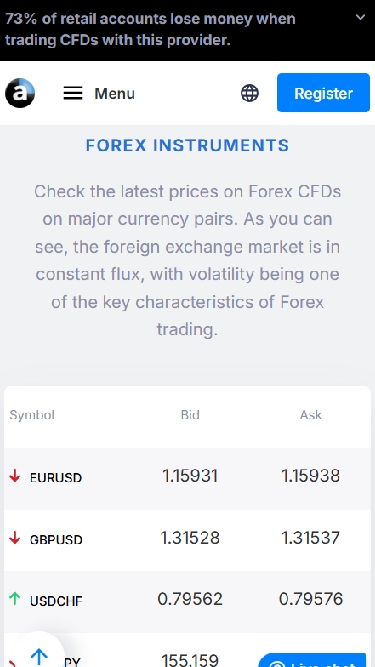
The UK trading platform, part of the Estonia-based Admirals Group, offers more than 8,000 financial instruments across six markets on MT4 and MT5, including plenty of CFD options: 80 forex pairs; more than 3,000 stocks; more than 370 ETFs, 40 indices, plus commodities and even bonds. It also delivers investing in the actual, not the underlying, assets on more than 4,500 shares and ETFs.
Some of Admiral Markets’ advantages are that it offers typical spreads from 0.5 pips and allows trading in fractional shares. It also has negative balance protection in place, making sure users never lose more than their account balance.
The platform receives high marks for customer support, with 24/5 assistance available by phone, email or live chat. The trader also has a demo account with $100,000 for practice trading.
Its educational resources include a “Zero to Hero” class that aims to teach forex trading in 20 days. It features Admiral Academy finance articles, with topics such as day trading strategies, trading videos, tutorials, and webinars.
The platform allows you to set up stop-loss and take-profit orders while copy trading and also has mirror trading, allowing you to automatically copy an experienced trader.
One negative is that it requires a $250 minimum deposit. It also charges an inactivity fee of €10 a month after two years of no trades.
Learn more about this trading platform’s offering from our Admiral Markets review.
Pros
- Thousands of CFD and non-CFD trading instruments
- Negative balance protection
- Educational materials, including on forex trading
Cons
- The demo account only lasts 30 days unless you sign up for a live account.
- Inactivity fee of €10 a month after two years of no trades
- Copy trader account
- Good technical analysis tools
- Demo account available
- No live chat customer support
- High forex spreads, in some cases
- Ability to trade stocks directly
- Good technical platforms
- Demo accounts available
- Higher fees for infrequent traders
- Not suited for novice investors
- Real-time market data: Access to current quotes, charts, and news.
- Technical analysis tools: Charts, indicators, and other tools for analyzing market trends.
- Order placement and management: The ability to place and manage various types of orders, like market orders, limit orders, and stop-loss orders.
- Real-time news updates: Stay informed about market events.
- Customizable alerts: Receive notifications based on specific market conditions.
- Mobile apps: Trade and monitor markets on the go.
- High liquidity: Forex markets are the most liquid in the world, offering numerous trading opportunities.
- 24-hour trading: You can trade currencies around the clock, providing flexibility.
- Leverage: Forex trading allows you to control larger positions with a smaller investment, but it also amplifies risks.
- Diversification: Trading indices like the FTSE 100 provides exposure to a basket of stocks, reducing individual stock risk.
- Leverage: Similar to forex, indices can be traded with leverage.
- Hedging: Commodities can be used to hedge against inflation or other economic risks.
- Price volatility: Commodities often exhibit significant price fluctuations, providing potential trading opportunities.
- Familiar market: UK investors may be more comfortable trading domestic stocks.
- Dividend income: Some stocks offer dividend payments, providing additional income.
- Trading style: Determine your trading strategy, and decide whether you are going to use scalping, swing trading, or other strategies.
- Markets: Identify the markets you want to trade, such as forex, stocks, or commodities.
- Features: Consider essential features, for example, real-time quotes, charting tools, and order types.
- UK Brokers: Focus on platforms regulated by the Financial Conduct Authority (FCA).
- Platform offerings: Compare features, fees, and customer reviews.
- Commissions: Compare commission rates for different trade sizes.
- Data fees: Assess costs for real-time market data and charting tools.
- Platform fees: Consider any monthly or annual subscription fees.
- Demo accounts: Use demo accounts to practice trading without risking real money.
- Functionality: Evaluate the platform’s ease of use, speed, and order execution.
- Reliability: Ensure the platform offers responsive and helpful customer support.
- Testimonials: Seek feedback from other traders about the platform’s performance and reliability.
- Monthly subscription fees: Some platforms charge a fixed monthly fee for access to their trading tools and services.
- Data fees: Platforms may charge fees for real-time market data, historical data, or advanced charting tools.
- Commission fees: Brokers may charge a fee per trade, often based on the number of shares or contracts traded.
- Spread: The difference between the bid and ask price of a security. This can contribute to trading costs, especially for low-volume traders.
- Conversion fees: If you trade foreign securities, your broker may charge a fee to convert your funds between currencies.
- Foreign exchange spreads: The spread on foreign currency pairs can be wider than domestic spreads, affecting trading costs.
- Inactivity fees: Some brokers charge a fee if your account remains inactive for a certain period. However, this is unlikely to be a concern for day traders, because they use the platform frequently.
- Withdrawal fees: Fees may be charged for withdrawing funds from your account, especially using certain methods.
- Wire transfer fees: Fees may apply for wire transfers, both domestic and international.
- Margin interest: If you use margin to leverage your trades, effectively, in other words, you borrow money from your broker, you’ll be charged interest on the borrowed funds.
- Regulatory fees: Also bear in mind that some brokers may pass on regulatory fees to their customers.
- Low fees: To minimize costs for frequent traders.
- User-friendly interfaces: To facilitate efficient trading.
- Quick execution speeds: To minimize slippage and ensure timely order execution.
73% of retail investor accounts lose money when trading CFDs with this provider.
6. Trade Nation: Demo trader, copy trading options for day traders

It’s easy for day traders to get started on Trade Nation because it doesn’t charge a minimum deposit and there’s no inactivity fee. Plus, you can actually practice on a demo trader without signing up for Trade Nation, and it offers USD $10,000 in virtual funds for this feature.
Experienced day traders can use its advanced trading platforms, which include its in-house platform TN Trader, as well as TradingView and MetaTrader 4.
Some of its perks for active traders include alternative data and market insights. Trade Nation’s copy trader program, TradeCopier, allows you to automatically mimic how certain experts trade, but it’s only available on the MetaTrader 4 platform. It has a decent amount of educational materials, but its searchable knowledge base runs sluggishly.
Trading is limited to CFD trading for forex, shares, indices, commodities, and cryptocurrencies. Forex spreads are variable but day traders can take advantage of fixed spreads on indices, commodities and bonds.
Customer service doesn’t include live chat, only a phone number, a chatbot and email. Most of its fees are low, with no trading commissions, but its spreads for forex can be high at times.
Pros
Cons
73.1% of retail investor accounts lose money when trading CFDs with this provider.
7. IG: Solid platform for experienced day traders

Day traders can open an account for free via bank transfer with IG, one of the top brokers for options trading in the UK. The platform is well-rounded, offering CFD trading, direct share and ETF trading, and access to over 13,200 financial instruments.
Some of the functions of IG that lend themselves to day trading include its advanced trading platforms and quick execution speeds.
It also offers negative balance protection, which prevents traders from losing more than the balance in their account. This protection is available for spread betting and CFD accounts, and it’s free and applied as soon as possible if a balance falls below zero.
The downsides to IG for day traders include relatively high share trading fees, though for more frequent traders, those fees drop. It also charges no commission on international stocks, and UK stocks cost £8 per trade.
However, the commission drops to £3 if you make more than three trades per month. US stocks are more expensive at £10 per trade, but free if you make more than three trades a month.
Pros
Cons
67% of retail investor accounts lose money when trading CFDs with this provider.
How do these UK day trading platforms stack up?
| Platform | Minimum deposit | Price to trade | Inactivity fee | FCA protection | Trustpilot score |
| eToro | US users $100, $50 after first deposit | 1% on cryptoNo commission on CFD stock trades | $10 per month after one year of inactivity | Yes | 4.2 out of 5 stars (24,286 reviews) |
| XTB | None | No commission on stocks or ETFs up to $100,000 in trades a monthSpreads on CFD trades | €10 a month after 12 months of inactivity | Yes | 3.5 out of 5 stars (1,181 reviews) |
| Pepperstone | $0 | Commission free (price built into the spreads) | None | Yes | 4.4 out of 5 stars (2,544 reviews) |
| FP Markets | AUD $100 | Commission free on standard account (price built into the spreads) | None | No | 4.8 out of 5 (6,717 reviews) |
| Admiral Markets | £250 | Commission free on standard account (price built into the spreads) | equivalent of €10 | Yes | 3.9 out of 5 (2,054 reviews) |
| Trade Nation | None | Commission free (price built into the spreads) | None | Yes | 4.4 out of 5 (848 reviews) |
| IG | £0 on bank transfers£250 for PayPal or credit cards | £8 to buy or sell UK stocksOr £3 (conditions apply) | £12 for accounts that have been inactive for 24 months | Yes | 3.6 out of 5 stars (6,983 reviews) |
What is a day trading platform?
A day trading platform is a software tool designed to facilitate buying and selling securities within a single trading day. UK trading platforms typically offer:
Leading UK day trading platforms often include additional features such as:
Some of the risks and rewards of day trading
Day trading as a trend continues to grow, even as multiple studies show that most day traders lose money. Therefore, it pays to use your broker’s educational resources to improve your skills. Trading platforms also typically offer a demo trading account, allowing users to learn the ropes in a risk-free, simulated environment using virtual funds.
Before opening a live account, you may even sign up with multiple brokers for a UK demo trading account and test-drive their trading interfaces, analytical tools, fees and other trading conditions without risking before committing your own capital.
On the plus side, though, profits from spread betting, a form of derivative trading strategy that a lot of day traders use, are tax free in some cases in the UK. This will enhance the overall results of your trading activity.
What are the best markets to day trade in the UK?
Choosing the best markets and assets for day trading in the UK depends on several factors, including your risk tolerance, trading experience, and investment goals. However, some popular options among UK day traders include:
1. Forex:
2. Indices:
3. Commodities:
4. Stocks:
What are the most effective day trading strategies?
Day trading involves various strategies, each with its own risk profile and potential rewards. Here are some of the most common approaches:
Scalping
Scalping is a high-frequency trading strategy where traders aim to profit from small price movements. They quickly buy and sell securities, often holding positions for only a few seconds or minutes. Therefore, scalping requires a highly liquid market and low transaction costs.
Gap Trading
Gap trading involves exploiting price gaps that occur when a stock opens significantly higher or lower than its previous day’s closing price. Traders capitalize on these gaps by anticipating the direction of the stock’s subsequent movement. Understanding market news and events that can influence stock prices during non-trading hours is crucial for successful gap trading.
Momentum Trading
Momentum traders identify securities with strong upward or downward momentum and try to ride the wave of the trend. Therefore, this strategy requires the ability to quickly recognize trends and use stop-loss orders to manage risk.
Breakout Trading
Breakout trading focuses on assets that break above or below support or resistance levels. A successful breakout often requires higher-than-normal trading volume to indicate strong conviction.
Contrarian Trading
Contrarian traders believe that securities that have been steadily rising or falling are likely due for a correction. They look for signs of a reversal and trade accordingly.
Range Trading
Range trading involves identifying securities that trade within a specific price range. Traders buy when the stock reaches the lower end of the range and sell when it reaches the upper end. This strategy requires understanding support and resistance levels and using stop-loss orders.
News-Based Trading
News-based trading involves making trading decisions based on current news reports. Traders may capitalise on overreactions to news or identify opportunities through the sympathetic effect (when a stock’s movement influences similar companies in the same sector).
How to choose the right platform for day trading?
By following these steps, you can find the best UK day trading platform for your investment style:
1. Define Your Needs:
2. Research and Compare:
3. Evaluate Fees:
4. Test the Platform:
5. Check Customer Support:
6. Read Reviews:
By following these steps, you can select a trading platform that aligns with your individual needs and goals for day trading in the UK.
What fees will I be charged as a day trader?
Because they trade more frequently, day traders are more likely to feel the crunch from trading platform fees than other traders. Some of the fees associated with day trading:
Platform Fees
Trading Fees
Foreign Exchange Fees
Other Fees
Our methodology for selecting the best UK platform for day traders explained
First, we focused on UK-based trading platforms known for their:
Additionally, we included a range of platforms suited for both beginners and advanced users. This includes several copy trading platforms in the UK, which are ideal for new traders looking to mirror successful strategies while they build experience in fast-moving markets.