


Space stocks are taking off in 2025. The expansion in the space industry, coupled with the impact of high-technology innovations that drive space travel, has whetted investors’ appetite for stocks in the sector.
The global space economy is projected to rise to $1.8 trillion by 2035, up from $630 billion in 2023, taking into account inflation, according to a report by McKinsey & Company.
There are several ways for investors to benefit from this growth. Read our guide for our picks of the 10 best space stocks worth considering right now.
Top trading and investing platform
- Ideal for beginner investors
- Copy trade other successful investors
- Access 6,000+ stocks for local and global exposure

The top 10 space stocks to invest in now – Overview
- Leidos (LDOS): The company is providing scientific, engineering, systems integration, and technical services, mainly to the US government. It’s increasing its involvement in the space sector.
- Airbus (EADSY): The French company is known for its commercial aircraft, but it also has separate divisions for defense, helicopeters and space.
- Lockheed Martin (LMT): The US-based major defense contractor has a significant space business, including satellite manufacturing and launch capabilities.
- L3Harris Technologies (LHX): The US space and defense electronics company significantly boosted its space capabilities through the acquisition of Aerojet Rocketdyne, a key rocket engine manufacturer.
- Intuitive Machines (LUNR): The firm specializes in lunar landers and exploration vehicles. It achieved the first commercial lunar landing by a US company in 2024 and has significant NASA contracts.
- Boeing (BA): The aerospace company has a proud tradition in space, including the development of the Space Launch System (SLS) for NASA’s Artemis program and the manufacture of satellites.
- Planet Labs (PL): The company, founded by three NASA scientists, runs a large group of Earth observation satellites, providing imagery and data analytics.
- BlackSky (BKSY): The real-time, space-based intelligence firm delivers high-frequency imagery, analytics, and monitoring of the most critical and strategic locations, economic assets, and events.
- Rocket Lab (RKLB): A launch specialist focused on providing small satellite launch services and vertically integrating the space supply chain.
- AST SpaceMobile (ASTS): The US satellite designer and manufacturer is building the first global cellular broadband network in space.
Your capital is at risk.
- Show Full Guide
A closer look at the top space stocks to invest in
Let’s see a detailed analysis of the top space stocks that investors may consider adding to their portfolio in 2025:
1. Leidos: Close connections to the space industry
LDOS stock price chart
Leidos (NYSE: LDOS) is involved in every aspect of the US government, providing scientific, engineering, systems integration, and technical services for defense, aviation, information technology, and biomedical research.
The contractor has performed mission-critical work for NASA for more than 20 years and is involved in several government contracts connected with space. The stock is up more than 32% this year and more than 15% in the past year.
In the quarter, it landed a $760 million subcontract with NASA to provide critical astronaut health and performance services and research support. It also had a $2.2 billion classified contract with the intelligence community and a $540 million, seven-year deal to continue enhancing and maintaining AI-enabled software for counterterrorism efforts.
In October, it won a 19-year contract from Kazakhstan’s air navigation service provider to modernize the air traffic control system. It didn’t disclose the value of the order.
Third-quarter revenue totaled a record $4.5 billion, a 7% increase year-over-year, along with earnings per share (EPS) of $2.82, a 5.2% rise over the same period last year. The company, despite the government shutdown that impacted business for nearly three weeks, lifted its 2025 earnings and margin guidance and retained its earlier estimates for full-year revenue.
The defense contractor also pays a quarterly dividend that yields approximately 0.92%, and it has just increased its dividend by 7.5% over the prior quarter to $0.43 per share.
Your capital is at risk.
2. Airbus: Flying above US tariffs
Airbus stock price chart
France-based Airbus (OTC: EADSY), the second-largest commercial aircraft maker, qualifies as a space stock due to its significant interests in space and defense. Its shares are up more than 48% so far this year and more than 51% in the past year.
It’s more profitable than its main rival, Boeing. Airbus is better positioned to navigate complications related to rising tariffs in the US, as it conducts significant business with Europe and China.
However, it has some production in the US, and plans to open its second A320 final assembly line in Mobile, Alabama, in October.
In the first nine months, revenue climbed 7% year over year to €47.4 billion. Nine-month revenue at its Defence and Space division rose 17% to €8.9 billion. EPS rose 46% year over year to €3.34.
The planemaker is also teaming with Italian company Leonardo and French company Thales to combine their respective space activities into a new company. Under the deal, Airbus will own 35% of the company, with the other two holding 32.5% each, Reuters reported.
Airbus also delivers a dividend that yields around 1%. It said it plans to increase the upper end of its dividend payout range to 50% from 40% previously. That means this is likely to be the fifth consecutive year it has increased its twice-yearly dividend.
Airbus invests in space through Airbus Ventures, its venture capital arm. It is also is part of major space projects, including the Artemis program. Airbus is building the Orion European Service Module (ESM) for NASA’s Moon missions, and Starlab, a commercial space station intended to replace the International Space Station.
It’s also building Biomass, a satellite designed to measure the carbon footprint of companies by mapping aboveground biomass (forested areas) throughout the globe. The company is also developing satellites that will aid in weather forecasting and climate analysis, in collaboration with the European Space Agency. One of these was launched into space in August.
Your capital is at risk.
3. Lockheed Martin: The safest stock in space?
LMT stock price chart
Lockheed Martin (NYSE:LMT) is a global defense technology company with a dedicated division focused on the space industry. It designs, builds, and tests lunar and deep space exploration vehicles.
These include commercial and military satellites, space probes, missile defense systems, the Orion spacecraft used by NASA and the external tank used on the Space Shuttle. Lockheed also has three other divisions: Aeronautics, Missiles and Fire Control, and Rotary and Mission Systems.
The company has recently unveiled a couple of partnerships to further its interests. It plans to invest $50 million in California-based maritime drone manufacturer Saildrone, enabling the company to equip Lockheed’s air-to-ground missile launchers with Saildrone’s unmanned surface vessels.
It also signed a Memorandum of Understanding (MoU) with German company Diehl at the Berlin Security Conference, with the goal of pairing Diehl’s guided missile and ground-based air defense systems with Lockheed’s integrated air and missile defense (IAMD) capabilities.
The stock is down more than 6% so far this year and more than 14% in the past year. However, its space business has been delivering revenue and profit growth for the company.
Third quarter revenue was $18.61 billion, a 9% year-over-year increase. EPS rose 2% to $6.95.
Space revenue increased to $ 3.36 billion from $3.08 billion in the year-earlier quarter, which the company attributed to $160 million higher sales for strategic and missile defense programs, as well as an additional $70 million from national security space programs.
Total operating profit was $2.28 billion, rising 7% from a year earlier. Operating profit in the space division jumped 22% to $331 million. It also has a significant backlog of $179.1 billion in orders, including $38.4 billion in its space segment.
The defense firm, however, lowered its 2025 operating profit guidance by $1.5 billion, or 18%, to $6.65 billion, raising its full-year revenue expectation to between $74.25 billion and $74.25 billion from an earlier forecast of between $73.75 billion and $74.75 billion.
Lockheed Martin returned $1 billion to shareholders in the quarter and raised its limit for future repurchases by $2 billion to $9.1 billion. It further delighted shareholders with boosting its quarterly dividend by 5% to $3.45 per share. It has raised its dividend for 22 consecutive years.
While somewhat dependent on US military and government spending, Lockheed Martin sees possible inroads in Europe, where nations are increasing their defense budget. Nearly 25% of Lockheed’s sales are international. Europe is responsible for about 40% of that total, followed by Asia and the Middle East.
Your capital is at risk.
4. L3Harris Technologies: More revenue, with more profit
LHX stock price chart
L3Harris Technologies (NYSE: LHX) has been a US defense contractor for more than a century. It provides main and upper-stage engines for NASA’s launch vehicles, solid rocket motors for missiles and space launches, as well as in-flight propulsion systems used on spacecraft.
It also supplies components for spacecraft and satellites, as well as enabling communications in space. In 2023, it acquired Aerojet Rocketdyne, whose propulsion systems had been integral to every US space and missile system, as well as the most significant space advancements.
The company is experiencing strong demand for its rocket components and is expanding testing at its site in Camden, Arkansas, where it produces more than 100,000 rocket motors annually, ranging from SUV-sized units to those as small as a palm.
Its shares are up more than 31% this year and more than 12% over the past year. The company reported strong third-quarter earnings and raised full-year revenue and profit forecasts.
In the quarter, revenue rose 7% year over year to $5.7 billion, while EPS rose 10% over the same period last year, to $2.46. Management raised the 2025 revenue guidance to $22 billion from $21.75 billion and the full-year non-GAAP EPS estimate to between $10.50 and $10.70 from a range of $10.40 to $10.60 earlier.
The company has raised its quarterly dividend for 24 consecutive years, including a 3.4% increase this year to $1.20 per share, quarterly, which delivers a yield of approximately 1.74%.
Your capital is
5. Intuitive Machines: Making historic moves in space
Intuitive Machines stock price chart
The space technology and infrastructure company Intuitive Machines (NASDAQ: LUNR) soft-landed its Nova-C class lunar lander on the moon. This was the first time the US had been to the moon’s surface since 1972. It marked the first commercial lunar landing, and the company has been involved in four NASA lunar missions.
The stock is down more than 47% this year and more than 41% over the past year. Much of that is due to the company’s recent attempts to raise money. However, if its IM-3 Lunar Mission is successful next year, its shares could jump.
The company said on Nov. 4 it is spending $800 million, including $450 million in cash and $350 million in Intuitive stock, to buy spacecraft manufacturer Lanteris Space Systems, formerly Maxar Space Systems.
Third-quarter revenue was $52.4 million, a 10.3% decrease year over year, and the company had a backlog of $235.9 million at the end of the quarter. However, it did narrow its loss per share to $0.06 after a loss per share of $0.83 in the same period last year. Intuitive forecats that fourth-quarter revenue would likely be close to third-quarter revenue.
The company’s better cost management is a big part of a potential turnaround. However, concerns persist regarding delayed government contracts and ongoing negative cash flow.
Your capital is at risk.
6. Boeing: Plenty of space to operate and improved sentiment
BA stock price chart
Boeing (NYSE: BA) is the world’s largest aircraft manufacturer by market capitalization. It operates in three segments: commercial airplanes, defense, space and security, and global services.
The stock is up more than 6% so far this year and 17% over the past year.
The aerospace giant has plenty of exposure to space. It provides engineering support services for the International Space Station (ISS) and designs, builds, and operates advanced space and communications systems.
However, it has just had a setback, as NASA revised Boeing’s 2014 contract for the Boeing Starliner spacecraft, reducing the number of missions for the craft to four from six, with only cargo and no crew on the next mission.
Financially, there are legitimate concerns about the company because it hasn’t turned an annual profit since 2018. However, bear in mind that, along with Airbus, Boeing is one of only two companies that make jet planes for commercial airlines, so it has a huge moat.
Boeing said in its 2025 Pilot and Technician Outlook (PTO), that airlines will need almost 2.4 million new aviation professionals through 2044 to meet growing travel needs. That also means an increased need for more planes.
It has a backlog of more than 5,900 orders for commercial jets. It also has relatively stable defense contracts, including those connected to the space industry.
Third-quarter revenue grew by 30% year over year to $23.3 billion. It had a loss per share of $7.14, compared to a loss per share of $9.97 in the same period a year ago. Its Defense, Space & Security segment is profitable, with a margin of 1.7% and revenue of $6.9 billion, up 25%, year over year. It also got approval to increase its 737 production from 38 planes a month to 42.
Your capital is at risk.
7. Planet Labs: Branching out, headed to profitability
PL stock price chart
Planet Labs (NYSE: PL) focuses on global, daily satellite imagery and operates the largest fleet of imaging satellites for earth observation. The information gleaned from those satellites serves agriculture, forestry, intelligence, education, and finance companies. It has launched more than 600 satellites and has more than 140 in orbit.
The stock is up more than 194% so far this year and more than 200% in the past year. In the second quarter, revenue increased 20% year-over-year to a record $73.4 million. It isn’t profitable yet but it did have $6 million in adjusted EBITDA, its third straight quarter of adjusted EBITDA profitability.
It also increased its backlog by 244% over the same quarter a year ago, to $736 million. Net loss narrowed to $8 million from $16 million in net loss in the same year-earlier quarter. The company also recently released its first photos taken by its Pelican 3 satellite, showing clear images of Turin, Italy, from 458 kilometers in space.
Planet Labs has recently signed four major contracts that should help its bottom line: a multi-year, €240 million contract from Germany to support European peace and security; an expansion of the company’s HSA contract with the Defense Innovation Unit (DIU) in support of INDOPACOM.
It signed a seven-figure deal with the U.S. Navy for maritime awareness in the Pacific Ocean, as well as another seven-figure contract from NATO for space-based surveillance, maritime awareness functions, and enhanced indications and warnings.
In July, the company said its satellite production is now fully ramped and operational, and it had shipped its Pelican-3 and Pelican-4 satellites to Vandenberg Space Force Base ahead of their launch aboard SpaceX’s Falcon 9 rocket.
The satellite imagery company also boosted its yearly revenue forecast to between $281 million and $289 million from an earlier estimate of between $265 million and $280 million. It now sees that its adjusted EBITDA loss won’t exceed $7 million, compared to earlier forecasts showing a potential $12 million adjusted EBITDA loss.
There is some risk, however, given the company’s limited cash reserves of $271.5 million. However, that should be enough to allow the company to operate until it can deliver a profit within two years.
Your capital is at risk.
8. BlackSky Technology: A clearer picture of future growth
BKSY stock price chart
BlackSky Technology (NYSE: BKSY) supplies high-level imagery for the defense industry. It recently stated that it is on track to launch six Gen-3 satellites this year and begin general commercial availability to customers in the fourth quarter.
SpaceX appears to be encroaching on BlackSky’s business of providing satellite-supported direct internet to cell phones or computers. SpaceX recently spent $17 billion, along with a $2 billion agreement to assume debt payments, to acquire EchoStar’s spectrum licenses. However, BlackSky is much closer to launching this service, giving it a first-to-market advantage.
The contractor isn’t profitable but appears to be headed in that direction. Its shares are up more than 63% this year, and more than 50% in the past year.
The company delivered the first high-resolution images from its third Gen-3 satellite less than 24 hours following the satellite’s successful launch in November.
Third quarter revenue fell 12.9% year over year to $19.6 billion, due to the expiration of its Electro-Optical Commercial Layer contract with the US National Reconnaissance Office and other uncertainties in the US government budget. EPS improved 33% over the same period last year to a loss of $0.44. It has a backlog of $322.7 million and cash of $147.6 million.
The company, though, won a multi-year contract valued at more than $30 million with a strategic international defense customer to
deliver high-cadence Gen-3 tactical ISR services at scale, and another multi-million dollar contract to deliver Gen-3 imagery services to the US government.
There’s a lot of excitement about the prospects for its Gen-3 satellites because of their low-latency intersatellite communication links and ability to automatically detect, identify, and classify more vehicles, aircraft, vessels, and other objects of interest. Additionally, its satellites can see through smoke and haze using short-wave infrared bands.
Your capital is at risk.
9. Rocket Lab: Meteoric share growth over the past year
Rocket Lab stock price chart
US-based Rocket Lab (NASDAQ: RKLB) designs, builds, launches, and manages rockets and satellites for a diverse customer base, including government agencies and academic institutions. It’s on pace to launch more than 20 satellites this year.
Rocket Lab has recently completed its acquisition of Geost, a maker of electro-optical and infrared sensors, for up to $325 million. The move is intended to expand its end-to-end capabilities for US national security, with the launch, spacecraft, and now payloads. It also completed its purchase of German laser communications company Mynaric in the third quarter.
It’s planning a return-to-Earth cargo mission, possibly as early as next year, using its Neutron launch vehicle, part of an experiment by the Air Force Research Laboratory. The stock is up more than 66% so far this year, following a rise of more than 55% in the past year.
In the third quarter, Rocket Lab had record quarterly revenue of $155 million, rising 37% year over year. Loss per share narrowed to $0.03 from loss per share of $0.10 in the same quarter last year.
In the fourth quarter, the company is predicting revenue of between $170 million and $180 million and gross margins of between 37% and 39%. It may take some time for the company to become profitable, but it appears to be heading in that direction.
Your capital is at risk.
10. AST SpaceMobile: Answering the call for better cell service
AST SpaceMobile stock price chart
Midland, Texas-based AST SpaceMobile (NASDAQ: ASTS) is developing the first global cellular broadband network in space, designed to operate directly with standard, unmodified mobile devices, for both commercial and government applications.
Its satellites would enable internet service directly to cell phones or computers without the need for cables or terminals. It could be a game-changer, particularly in underdeveloped areas.
Over the past six months, its workforce has increased by more than 100% to 1,800. On Nov. 25, it announced it was building two new manufacturing sites in Texas and Florida, as it continues to expand its operations.
So far this year, the stock has increased by more than 171%. Over the past year, it has soared 142%. Earlier this year, the stock received a boost when it was added to the US large-cap Russell 1000 Index.
In the third quarter, AST SpaceMobile posted revenue of $14.7 billion, a 124% increase over the same period last year. Its loss per share was $0.45, compared to a loss per share of $1.10 in the third quarter of 2024.
AST said it’s on pace for five orbital launches by the end of the first quarter of 2026, with launches every one to two months on average, to reach its goal of 45 to 60 satellites by the end of 2026
All in all, the firm aims to launch 243 of its oversized satellites by 2028.
Your capital is at risk.
Year-to-date performance of the best space stocks in 2025
Compare the top space stocks in a handy table in the order of this year’s performance:
| Ticker | Company | Performance (YTD) |
| NYSE: PL | Planet Labs | +194.06% |
| NASDAQ: ASTS | AST SpaceMobile | +171.23% |
| NASDAQ: RKLB | Rocket Lab | +66.86% |
| NYSE: BKSY | BlackSky Technology | +63.67% |
| OTC: EADSY | Airbus | +48.54% |
| NYSE: LDOS: | Leidos | +32.77% |
| NYSE: LHX | L3 Harris Technologies | +31.91% |
| NYSE: BA | Boeing | +6.93% |
| NYSE: LMT | Lockheed Martin | -6.8% |
| NASDAQ: LUNR | Intuitive Machines | -47.69% |
The case for investing in space stocks
The space industry is experiencing robust growth, primarily driven by advancements in launch technology, particularly reusability pioneered by SpaceX.
This has significantly reduced launch costs, making space more accessible for various ventures. Additionally, the miniaturization of technology has led to the development of smaller, more affordable satellites such as Cubesats. This is further contributing to the industry’s expansion.
Investing in the space industry is characterized by high risk and high reward. While some companies demonstrate immense success, others, such as Virgin Orbit, highlight the potential for swift failure. Despite the inherent risks, the industry is projected to reach a valuation of US $1 trillion by 2030 or 2040.
The main types of space stocks
Space stocks represent publicly traded companies with a hand in the vast space industry. This spans everything from satellite operations to space tourism and defense. These companies generally fall into several key categories based on their primary focus within the sector.
Satellite companies
These companies are dedicated to developing, manufacturing, and operating satellites for various applications, including communication, Earth observation, and navigation. Notable examples in this area include EchoStar (NASDAQ: SATS) and Planet Labs PBC (NYSE: PL).
Space transportation companies
This category encompasses firms that provide essential launch services, such as Rocket Lab (NASDAQ: RKLB). It also includes those venturing into the burgeoning field of space tourism, such as Virgin Galactic (NYSE: SPCE).
Space defense companies
These specialize in the creation and production of defense-related space systems and advanced technology. Companies such as Northrop Grumman (NYSE: NOC) and L3Harris Technologies (NYSE: LHX) are prominent players here.
Space exploration and research companies
For those interested in pushing the boundaries of exploration, these companies are focused on ventures such as lunar and planetary exploration. Intuitive Machines (NASDAQ: LUNR) and Redwire (NYSE: RDW) are good examples of companies in this innovative spaceHo.
Space infrastructure and services
These provide crucial support to the entire industry. Their offerings range from space data analytics and in-space manufacturing to vital satellite infrastructure. Spire Global (NYSE: SPIR) and AST SpaceMobile (NASDAQ: ASTS) illustrate the diverse services these companies provide.
Your capital is at risk.
Pros and cons of investing in space stocks now
Here’s a breakdown of the positives and negatives of space stocks, based on the provided information:
Some of the benefits of investing in space shares
Robust industry growth: The space industry is experiencing significant expansion, indicating a dynamic and evolving market. This growth is driven by technological advancements and increased accessibility to space.
Reduced launch costs: Innovations such as reusability have drastically lowered the cost of sending payloads to orbit. This makes space ventures more economically viable and opens up new opportunities.
Technological miniaturization: The development of smaller, more affordable satellites reduces the cost of design and launch. This makes satellite deployment more accessible and frequent.
High potential for returns: The industry is characterized by “high-reward” opportunities. Successful investments could lead to “literally astronomical” profits.
Helps spur satellite technology: Satellites, particularly smallsats, have demonstrated their value in environmental monitoring, such as tracking natural disasters. Governments use them for surveillance and intelligence gathering. They also provide global internet access and increase the reliability of operations.
Some of the drawbacks of investing in space shares
High-risk investment: The space industry is inherently “high-risk.” This means there’s a significant chance of substantial losses, as evidenced by the “swift downfall of Virgin Orbit.”
Technical challenges and operational risks: Despite increasing reliability, “technical elements such as launching and operations present a significant risk.” Failures in these areas can lead to substantial financial setbacks for companies and investors.
Uncertain timeframe for market valuation: While a $1 trillion valuation is projected, the exact timing (2030 vs. 2040) is still an estimate. This introduces some uncertainty for long-term investment strategies.
A summary of the pros and cons of investing in space stocks
Let’s recap the advantages and risks of space stocks:
Pros
- Robust industry growth
- Reduced launch costs
- Technological miniaturization
- High potential for strong returns
- Proven utility of satellites
Cons
- High-risk investments
- Technical, operational challenges
- Uncertain time frame for market valuations
Alternative ways of investing in the space industry
Buying space sector ETFs
There’s another way to benefit from the expected rapid growth of the space industry without buying the stocks of individual companies: by investing in space-focused exchange-traded funds (ETFs).
Here are some popular examples:
ARK Space Exploration & Innovation ETF (ARKX): he fund is up more than 35% over the past year and more than 39% so far this year. It’s an actively managed fund, with a relatively high expense ratio of 0.75%. ARKX looks for long-term growth by investing at least 80% of its assets in domestic and foreign equity securities of companies that are engaged in space exploration and innovation.
The fund was initiated in 2021. It provides diversification with a fairly even mix of large-cap, mid-cap, and small-cap stocks. It has 34 holdings and no one stock accounts for more than 9% of its holdings, with its top holding being Teradyne (NASDAQ: TER) at 8.3%.
Procure Space ETF (UFO): The fund is up more than 43% so far this year and more than 38% over the past year. It looks for investment results that correspond to the performance of an equity index called the “S-Network Space Index,” before the fund’s fees and expenses.
The fund invests at least 80% of its net assets in companies of the index that derive at least 50% of their revenues or profits from space-related business. The fund has 48 holdings, led by AST SpaceMobile at 5.86%. Its expense ratio is 0.75%.
VanEck Space ETF (JEDI): The fund aims to track the performance of the MVIS Global Space Industry ESG Index (MVSPCTR). This index is designed to capture the performance of the largest and most liquid companies involved in the global space industry.
At the same time, it adheres to ESG (Environmental, Social, and Governance) criteria. It has 25 holdings, led by AST SpaceMobile at 11.04% and an expense ratio of 0.55%. The fund is up more than 60% so far this year and more than 63% over the past year.
Your capital is at risk.
Space and Orbit Universe Smart Portfolio from eToro
eToro’s Smart Portfolios are various combinations of assets, automatically managed by eToro’s professionals that are available for users for hands-off investing.
Rather than directly for space stocks or ETFs, in 2023 eToro launched a Smart Portfolio that is focused on space tech that can be tracked from the broker.
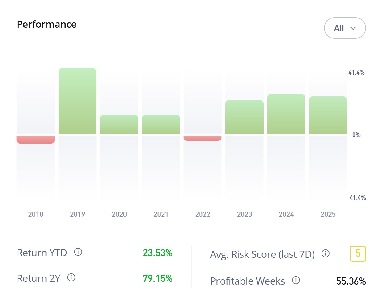
The smart portfolio is composed of 30 stocks that focus on different sectors, from satellites to space exploration. The main advantage of the smart portfolio is that there are zero management fees. It’s up more than 29% so far this year.
It can be an additional option for those who wish to have exposure to space technology without the need to pay high management fees.
Copy Trading does not amount to investment advice. Your investments’ value may go up or down. Your capital is at risk.
Trading CFDs on space stocks and space industry ETFs
Many brokers, including eToro, allow traders to trade space stocks and ETFs via contracts for difference (CFDs), providing exposure to the space sector without requiring ownership of the underlying assets.
Trading these stocks and ETFs through CFDs means betting on their price without actually owning the underlying assets. This could be an attractive option for many investors to attempt to make money from the sector if they understand what factors move the prices of these securities.
With CFDs you can bet on rising as well as falling markets. You may also be able to trade CFDs with leverage, a loan from your broker, which may enable you to take a larger position than your deposit. That is, however, risky, as it amplifies your gains as well as your losses. Therefore, it’s only recommended for experienced traders.
Read our educational guide to CFDs to find out more about how they work.
Note: CFD trading is not available in the US.
Risk disclaimer: 46% of retail investor accounts lose money when trading CFDs with this provider.
How to invest in space companies?
Buying space stocks can be a great way to add growth potential and diversification to your portfolio. There’s a lot of excitement around the opportunities for companies that are involved with the space industry. However, like any other investment, there are things to keep in mind before you blast off.
First, it’s important to understand the industry, which incorporates different types of companies, from satellite manufacturing and launching services, to space tourism companies, aerospace companies, and defense industry stocks that have space divisions.
Once you do your research, it is important to make sure your investments fit in with your portfolio and risk profile.
There are four key considerations when choosing space stocks:
Step 1: Understand the different types of space stocks
There are different types of space stocks. Aerospace companies and defense companies with space divisions may experience slower growth than pure-play space stocks, but their diverse revenue streams provide them with greater stability.
Pure-play space stocks, such as satellite manufacturing or launch companies, provide more potential growth, but due to their greater risk, need to be more carefully looked at.
Step 2: Evaluate individual companies
Recognizing that the industry presents a high degree of risk alongside the potential for substantial rewards, seek companies with strong revenue growth and a healthy balance sheet. Like any other growth industry, sometimes the companies that succeed are the ones that simply outlast their competitors.
Therefore, take a look at how much debt each company carries along with its cash balance. See what kind of market share the companies you are considering have and if they have defensible moats, that is, a strong market niche.
Step 3: Invest in companies that align with your goals
Not every investor is keen on defense industry stocks, for example, or are you more excited about space tourism or satellite companies? Do you consider a company’s ESG record when making decisions?
It’s also important to review your portfolio and identify areas where you need to diversify, as well as the level of risk you are willing to take on.
Step 4: Keep a close eye on your investments
Investing in space stocks isn’t like investing in utilities or other more stable stocks. Follow industry news and keep an eye on your stock’s financial performance.
Quarterly earnings reports can give an early heads-up to a future rise or plummet in a stock’s price. It also makes sense to follow analysts whose job it is to follow the space industry.
Your capital is at risk.

How We Rate Stocks
We review each stock that is selected. Below are the key metrics we check before listing stocks on the website. For further details, you can also take a look at our stocks rating guide, featured on ValueWalk.
Balance sheet
Potential Growth
Competitiveness
Liquidity
Space stock FAQs
What is the best space stock?
Can I invest directly in NASA?
What should I know before investing in space stocks?
Are there space ETFs?
Are space stocks suitable for beginners?
Can I invest directly in SpaceX
References
Global space economy growth report
Airbus memorandum of understanding with Thales, Leonardo
Lockheed Martin third-quarter earnings
L3Harris third-quarter earnings
Intuitive Machines collaborates with Space Forge
Intuitive Machines second-quarter earnings
Intuitive Machines wins CMMI level 3 rating for making software
L3Harris Technologies second-quarter earnings
Boeing’s third-quarter earnings
Planet Labs fiscal 2026 first-quarter report
BlackSky Technology third-quarter report
Rocket Lab third-quarter earnings
AST SpaceMobile third-quarter report
Disclaimer:
eToro is a multi-asset platform which offers both investing in stocks and cryptoassets, as well as trading CFDs.
Please note that CFDs are complex instruments and come with a high risk of losing money rapidly due to leverage. 51% of retail investor accounts lose money when trading CFDs with this provider. You should consider whether you understand how CFDs work, and whether you can afford to take the high risk of losing your money.
This communication is intended for information and educational purposes only and should not be considered investment advice or investment recommendation. Past performance is not an indication of future results.
Copy Trading does not amount to investment advice. The value of your investments may go up or down. Your capital is at risk.
Don’t invest unless you’re prepared to lose all the money you invest. This is a high-risk investment and you should not expect to be protected if something goes wrong. Take 2 mins to learn more
eToro USA LLC does not offer CFDs and makes no representation and assumes no liability as to the accuracy or completeness of the content of this publication, which has been prepared by our partner utilizing publicly available non-entity specific information about eToro.