


Investors looking to earn income from their portfolio should consider including high-yield bond exchange traded funds (ETFs). High-yield bond ETFs offer investors exposure to baskets of corporate bonds that have been rated below investment grade (lower than BBB- or Baa3), or junk, by major credit rating agencies.
High-yield bonds have the potential for equity-like returns, and are less sensitive to interest rates than other fixed-income securities, though they carry higher risk. Bundled in an ETF, they have the added benefits of diversification, strong liquidity, transparency and tax efficiency.
Read on for a list of six of our tried-and-true favorite high-yield bond ETFs, as well as a seventh that is new. Six of them are available for trading on eToro and all deliver monthly dividends.
Top trading and investing platform
- Ideal for beginner investors
- Copy trade other successful investors
- Access 6,000+ stocks for local and global exposure

The top 7 high-yield bond ETFs to invest in now
Here’s an overview of the top seven high-yield bond ETFs that we picked using a specific screening process to weed out risk and boost returns.
- SPDR Bloomberg High Yield Bond ETF (JNK): It invests in publicly issued US dollar denominated, fixed-rate, taxable corporate bonds with remaining maturities of at least a year but not more than 15 years.
- iShares iBoxx $ High Yield Corporate Bond ETF (HYG): It’s one of the largest high-yield bond ETFs globally by assets under management and trading volume. It focuses on junk-rated corporate bonds.
- The iShares 0-5 Year High Yield Corporate Bond ETF (SHYG): It seeks to track an index composed of US dollar-denominated, high-yield corporate bonds with remaining maturities of less than five years.
- PIMCO 0-5 Year High Yield Corporate Bond Index Exchange-Traded Fund (HYS): It focuses on an index of short-term below-investment-grade bonds with less than five years maturity remaining.
- iShares Fallen Angels USD Bond ETF (FALN): The ETF seeks returns mirroring the price and yield performance of an index of high-yield corporate bonds that were previously rated investment grade.
- Invesco Fundamental High Yield® Corporate Bond ETF (PHB): It seeks corporate bonds that are SEC-registered securities and uses an underlying index that has a “fundamental-weighted” approach.
- TCW Core Plus Bond ETF (FIXT): Created just recently, this ETF is an actively managed fund that is designed to maximize total return while maintaining broad market exposure.
Your capital is at risk.
- Show Full Guide
An in-depth look at these top high-yield bond ETFs to invest in
For this guide, we looked for high-yield corporate bond ETFs with strong long-term performance, low expense ratios, strong diversity and high dividend yields. See our detailed analysis.
1. SPDR Bloomberg High Yield Bond ETF: Low expenses, high return
The fund, which launched in 2007, provides wide exposure to the “junk” bond market by tracking the price and yield performance of the Bloomberg High Yield Very Liquid Index.
The index includes publicly issued US dollar denominated, non-investment grade, fixed-rate, taxable corporate bonds that have a remaining maturity of at least one year, but not more than 15 years. Over the past five years, the ETF has had a total return of 25.47%, and so far this year, its total return is 4.18%.
It has 1,200 holdings, which gives it a superior diversity to some high-yield bond ETFs. The largest represented sector is consumer cyclical at 16.82%, followed by communications at 14.05%.
No one corporate bond of its slate is responsible for more than 0.62%. It pays a monthly dividend with a yield of 6.63%. It has a relatively low expense ratio of 0.40%.
Your capital is at risk.
2. iShares iBoxx $ High Yield Corporate Bond ETF: Wide exposure, good liquidity
This ETF will invest at least 80% of its assets in the component securities of the Markit iBoxx USD Liquid High Yield Index, and at least 90% of its assets in fixed income securities of the types included in the underlying index that the advisor believes will help the fund track the underlying index.
While HYG keeps most of its assets inside of the US, it does offer a slice of international exposure as well. The ETF is dominated by corporate bonds, the majority of which have investment grades between B and BB. HYG has a total return of 4.34% so far this year and over the past five years, has delivered a total return of 27.04%.
The fund, which began in 2007, is actively managed, so its expense ratio, at 0.49%, is higher than passively managed ETFs. It has a solid number of holdings at 1,272, giving it ample diversification.
The highest percentage among its holdings is CCO Holdings LLC at 2.34%. Consumer cyclical is its top sector at 17.64%, followed by communications at 16.88%. The weighted average maturity of the fund is four years, and 44.4% of the holdings have a maturity of three to five years.
The fund’s monthly dividend yields 5.83% annually and has a payout ratio of 53.62%, so it’s easily sustained.
Your capital is at risk.
3. The iShares 0-5 Year High Yield Corporate Bond ETF (SHYG): Less risk, more dividend
The fund, which launched in 2013, tracks the Markit iBoxx USD Liquid High Yield 0-5 Index, which is made up of US dollar-denominated, high-yield corporate bonds with remaining maturities of less than five years. The point is, by holding more short-term bonds, there’s less exposure to interest-rate risk.
Over the past five years, it has given a total return of 30.54% and so far this year, its total return is 3.15%. SHYG delivers a monthly dividend with an annual yield of 7.66%. The expense ratio is 0.30%.
The fund has 1,066 holdings, with consumer cyclical responsible for 20.05% and communications at 14.90%. Its bonds include only three companies with slightly more than 1%, CCO Holdings, Transdigm, and Tenet Healthcare.
Your capital is at risk.
4. PIMCO 0-5 Year High Yield Corporate Bond Index ETF: High yield, low interest-rate risk
Founded in 2011, the ETF looks to track the total return of the BofA Merrill Lynch 0-5 Year US High Yield Constrained IndexSM. It has 893 holdings, fewer than some ETFs on this list, so diversity may be a concern.
Technology accounts for 8.3% of its holdings, followed by media cable at 6.7%. The fund focuses on bonds with a short maturity, giving it less interest-rate risk. The average maturity length is 3.49 years.
The fund has an expense ratio of 0.56%, higher than the rest of the ETFs here. Its dividend of $0.57 per share per month delivers an annual yield of 7.35%, higher than the other ETFs in this list.
So far this year, the fund has a total return of 3.94%. Over the past five years, its total return has been an impressive 36.43%.
Your capital is at risk.
5. iShares Fallen Angels USD Bond ETF: Focusing on overreactions
Created in 2016, this ETF looks to mirror the Bloomberg US High Yield Fallen Angel 3% Capped Index. The bonds in the index were all previously rated investment grade. The thinking is that because of their slippage into junk territory, they may be oversold, delivering a solid yield opportunity with less risk.
FALN has only 169 holdings, making it the least diversified ETF on this list. The most prevalent sector in its holdings is consumer cyclical at 25.42%, followed by communications at 12.83%.
The ETF’s expense ratio is 0.25% as it’s passively managed. The terms of the bonds are a little longer than some on this list with an average age to maturity of 4.71 years. The bonds in the ETF are market-value weighted with a 3% cap on each issuer.
So far this year, the total return on the ETF is 3.38% and over the past five years, it has been a solid 32.22%. The yield on its monthly dividend is 6.26%
Your capital is at risk.
6. Invesco Fundamental High Yield Corporate Bond ETF: Selective, at a higher price
This ETF uses a sampling methodology to track the RAFI Bonds US High Yield 1-10 Index (Index). It generally will include 80% of the bonds in the index.
That selectivity also means a slightly higher expense ratio at 0.50%. About 78% of the bonds it holds have a credit rating of BB.
The fund, which began in 2007, carries only 263 holdings, heavily tilted toward consumer discretionary bonds at 23.09%, followed by industrials at 11.62%. Its monthly dividend yields 5.76% annually, slightly below average for this list.
Over the past five years, it has had a total return of 25.95% and so far this year, its total return is an impressive 7.83%.
Your capital is at risk.
7. TCW Core Plus Bond ETF (FIXT): New kid on the block
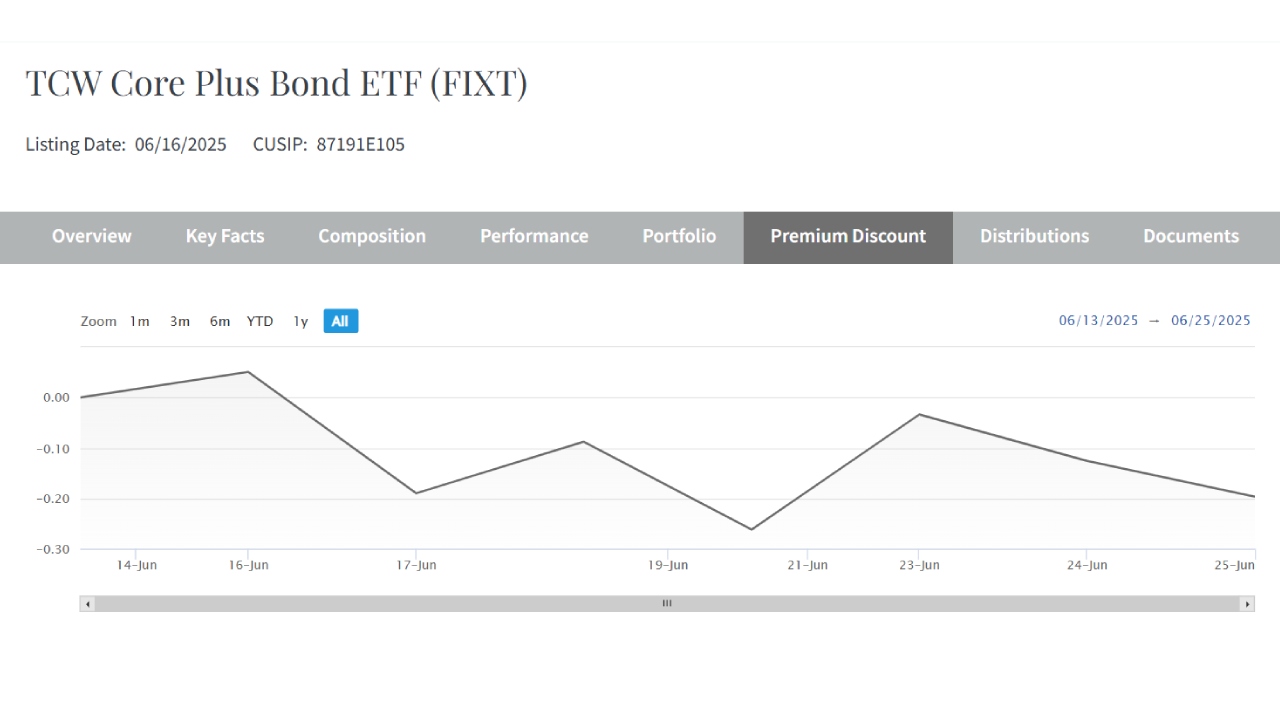
There are a few things different about this particular fund, which was just launched on June 16. First, it’s actively managed, but even with that, the expense ratio is relatively low at 0.40%.
The ETF is technically a new “old” ETF as TCW purchased the assets and liabilities of the predecessor mutual fund, the TCW MetWest Intermediate Bond Fund, which had been delisted in 2024. FIXT is so new that it’s not yet available at all brokers.
There was also a prior fund with the same ticker that was focused on the niche of disaster recovery and companies that provide essential products and services in disaster preparedness, mitigation and recovery.
Unlike the other ETFs in this list, FIXT pays out its dividends on a quarterly, rather than a monthly basis. The fund’s objective is to seek to maximize long-term total return by buying investment grade as well as below-investment grade bonds.
It has 527 holdings, and the fund looks to tap into the 48% of the public bond market that is not part of the Bloomberg US Aggregate Bond Index, a market capitalization-weighted index of investment-grade, fixed-rate debt issues.
The fund uses what it calls a dynamic sector allocation, allowing it to take advantage of opportunities as they arise. It has not been announced what its dividend will be, so the dividend yield cannot be determined yet.
Year-to-date performance of these top-ranked high-yield bond ETFs
Compare our top picks, their year-to-date performance and expense ratio, in an easy-to-view format:
| Ticker | ETF | YTD price performance | Expense ratio |
| BATS: JNK | PDR Bloomberg High Yield Bond ETF | +1.25% | 0.40% |
| NYSEARCA: HYG | The SPDR Portfolio High Yield Bond ETF | +0.08% | 0.49% |
| NYSEARCA: SHYG | The iShares 0-5 Year High Yield Corporate Bond ETF | +1.26% | 0.30% |
| NYSEARCA: HYS | PIMCO 0-5 Year High Yield Corporate Bond Index ETF | +0.81% | 0.56% |
| NASDAQ: FALN | iShares Fallen Angels USD Bond ETF | +0.62% | 0.25% |
| NYSEARCA: PHB | Invesco Fundamental High Yield Corporate Bond ETF | +1.49% | 0.50% |
| NYSEARCA: FIXT | TCW Core Plus Bond ETF | +29.43 | 0.40% |
Your capital is at risk.
The case for investing in high-yield bond ETFs
High-yield bond ETFs are investment vehicles that pool money from many investors to buy a diversified portfolio of high-yield, also called “junk” or “speculative grade” bonds. These fixed-income securities are issued by companies with lower credit ratings, typically below investment grade (lower than BBB- or Baa3 by major rating agencies like S&P or Moody’s).
Because these companies are deemed riskier, they must offer significantly higher interest rates, or “yields,” to attract investors, compensating them for the increased likelihood of default.
High-yield bond ETFs provide an efficient way for investors to gain exposure to this segment of the bond market. Instead of buying individual high-yield bonds, which can be illiquid and difficult to research, an ETF offers a diversified basket.
This inherent diversification helps spread the risk, so the default of a single company doesn’t severely impact the overall investment.
Bond ETFs first hit the market in 2002 and their use has accelerated since then. Their exchange-traded nature makes them easy to access and trade, they usually have lower expense ratios than other investment products, and they offer strong liquidity, transparency, tax-efficiency, and diversification.
What to consider when choosing high-yield bond ETFs
When investing in ETFs you need to familiarize yourself with key terminology of the asset class and learn how they work and what factors to look at when assessing their merits for your portfolio.
Considering these aspects will help you choose the one that best fits your investment strategy and risk tolerance.
Active or passive management:
High-yield bond ETFs come in two main types. Passive ETFs aim to simply mirror the performance of a specific high-yield bond index. They essentially “track the market.”
In contrast, active ETFs have a dedicated team of investment professionals who actively manage the fund, making decisions on which bonds to buy and sell based on market conditions and their expertise. This approach attempts to outperform the market.
Expense ratio:
This is the annual fee you’ll pay as a percentage of your investment. For instance, if an ETF has a 1% expense ratio and you own $10,000 worth of shares, you’ll pay $100 in fees each year. These fees cover the fund’s operational, management, and marketing costs, so lower is generally better.
Number of holdings:
This refers to how many individual bonds the ETF holds. An ETF with a larger number of underlying securities — say, 1,000 bonds compared to 50 — is typically less risky. More holdings provide a greater cushion against the default of any single bond, enhancing diversification.
Current yield:
This tells you the annual return a bond generates based on its current market price and annual interest payment. For an ETF, it’s the weighted average of the current yields of all the bonds it holds. It helps you understand the income stream you can expect relative to the ETF’s price.
Distribution frequency:
This indicates how often you’ll receive your share of the interest payments (coupons) from the bonds in the ETF. This could be monthly, quarterly, or annually, depending on the fund.
Average maturity:
This is the market value-weighted average time until the bonds and loans in the portfolio mature, usually expressed in years. It gives you an idea of the portfolio’s overall sensitivity to interest rate changes; generally, longer maturities mean higher sensitivity.
Average yield to worst (YTW):
This is a conservative measure of a bond’s potential return, representing the lowest possible yield an investor can receive without the issuer defaulting. For an ETF, it’s the average minimum yield across all its holdings.
Yield to maturity (YTM):
This is the market-weighted average total return you can expect from the bonds in the portfolio if they are held until their maturity date, assuming no defaults. It’s often considered a more comprehensive measure of return than current yield.
Sector breakdown:
This shows the percentage of the ETF’s investments allocated to different industries, such as energy, consumer discretionary, or industrials. It helps you understand the fund’s industry diversification and exposure.
Regional breakdown:
This illustrates how the ETF’s portfolio is diversified across different geographic regions or countries (e.g.: 30% in Europe, 20% in the US). This provides insight into the fund’s geographic exposure and diversification.
Fund quality breakdown:
This details the proportion of the portfolio invested in bonds with various credit ratings (e.g.: 38% BB, 10% B, 25% CCC or lower). It’s crucial for assessing the overall credit risk of the ETF.
Fund maturity breakdown:
This shows how the investments within the fund are spread across different maturities (the time until the principal is repaid). This is a key indicator for the ETF’s sensitivity to interest rate fluctuations and its overall risk profile.
Short-term bonds (maturing within a year) are less risky and more liquid, while longer maturities can be riskier (more sensitive to interest rate changes), but with higher potential returns.
Performance:
Always review the fund’s historical performance over various time periods (e.g., 1-year, 3-year, 5-year, 10-year) to understand how it has performed in different market conditions. While past performance doesn’t guarantee future results, it offers valuable context.
Pros and cons of investing in high-yield bond ETFs
There are plenty of advantages of investing in high-yield bond ETFs. However, it’s important to also know the risks and drawbacks.
Some of the benefits
One of the biggest draws of high-yield bond ETFs is their higher income potential. Because these bonds are issued by companies with lower credit ratings, they offer significantly higher interest than investment-grade bonds to compensate investors for the increased risk.
High-yield bond ETFs also offer diversification within the bond market. By holding a basket of various high-yield bonds from different issuers and industries, the ETF inherently mitigates the impact if a single bond defaults.
There’s also the potential for equity-like returns with less volatility than stocks. While riskier than their investment-grade counterparts, high-yield bonds often correlate with equities, meaning they tend to perform well during periods of economic growth. However, their fixed-income nature can provide some cushion against the sharper downturns compared to stocks.
Another significant advantage is their liquidity and ease of trading. Unlike individual bonds, which can be less liquid and harder to buy or sell, ETFs trade on stock exchanges throughout the day like stocks, making them easier to trade.
Some of the drawbacks
The most critical disadvantage is higher default risk. High-yield bonds are issued by companies with lower creditworthiness, meaning there’s a substantially greater chance these companies could fail to make interest payments or repay the principal compared to investment-grade companies. This can lead to capital loss within the ETF.
These ETFs also show considerable sensitivity to economic downturns. High-yield bonds are highly cyclical, with their performance closely tied to the overall health of the economy. In a recession or economic slump, corporate earnings typically decline, increasing the likelihood of defaults among speculative-grade companies.
Another concern is lower liquidity compared to investment-grade bonds in stress periods. While the ETFs themselves are generally liquid, the underlying market for high-yield bonds can become illiquid during times of market stress or financial crises.
A summary of the benefits and drawbacks of investing in high-yield bond ETFs
Pros
- Higher income potential
- Diversification within bond markets
- Equity-like returns with less volatility
- Liquidity and ease of trading
Cons
- Higher default risk
- Sensitivity to economic downturns
- Lower equity compared to investment-grade bond ETFs
Other ways of investing in high-yield bonds
Instead of investing in high-yield ETFs there are some alternative ways in which investors can enjoy some of the same benefits. These are:
Investing in high-yield bonds directly
You can buy individual high-yield corporate bonds directly from broker-dealers. This approach gives you direct control over your specific bond holdings.
However, unlike with ETFs, there isn’t as much diversification when you buy high-yield bonds directly, so it’s important to see the investment as part of your overall portfolio.
Some considerations for direct investment include researching the financial health of the issuing company by reading the bond’s prospectus to understand their financial condition, how they plan to use the proceeds, the bond’s terms, and the associated risks.
Direct investment requires a stronger understanding of fixed-income market mechanics and credit analysis.
eToro’s YieldGrowth Smart Portfolio
eToro has a YieldGrowth Smart Portfolio that is made for investors who want more yield, giving up completely on risk control. It includes 13 high-yielding bond ETFs in one package.
The portfolio is up 2.47% so far this year, and has been around for 2.2 years. The minimum investment to enter the portfolio is $500.
Trading CFDs on high-yield bond ETFs
There are brokers, such as FP Markets and eToro, that offer high-yield bond ETFs that can be traded through contracts for difference (CFDs), allowing traders to gain exposure to these investments without owning the underlying assets.
Trading these ETFs, betting on their price, without bothering with ownership, could be an attractive option for many investors, if they understand what factors move the prices of these securities. With CFDs you can bet on rising as well as falling markets. Read our CFD guide to find out how they work.
Copy Trading does not amount to investment advice. Your investments’ value may go up or down. Your capital is at risk.
Our methodology: How we selected the best high-yield bond ETFs
When looking for the best high-yield bond ETFs, we looked for those ETFs that had a good number of holdings to provide more diversification and safety. We also looked for those with relatively low expense ratios, so as not to eat up at any profits the ETFs might deliver. Of course, because these types of bonds are for income-oriented investors, we looked for above-average dividend yields. Lastly, we looked for those with a positive return over the past five years.
To do that we set up a screener to look for high-yield bond ETFS that had a dividend yield of at least 6.39%, which is at least two percentage points above the 10-year treasury note of 4.39%, we looked for those ETFs with at least 600 holdings or more, those that had an expense ratio of 0.37% or below and a five-year return of 4% or more.
These high-yield corporate bonds are often called “junk bonds,” a term that can discourage investors, but in reality, they have been dependable with default rates below 3% over the past 30 years. Plus, by mixing them together in an ETF with other corporate bond holdings, the risk of a single default is watered down.
FAQs on high-yield bond ETFs
What is the best high-yield bond ETF?
What is the risk of high-yield bond ETFs?
What are high-yield bonds used for?
What is the highest yielding bond fund globally?
Are high-yield bond ETFs the same as junk bond ETFs?
References
eToro’s YieldGrowth Smart Portfolio fact file
Disclaimers:
eToro is a multi-asset platform which offers both investing in stocks and cryptoassets, as well as trading CFDs.
Please note that CFDs are complex instruments and come with a high risk of losing money rapidly due to leverage. 51% of retail investor accounts lose money when trading CFDs with this provider. You should consider whether you understand how CFDs work, and whether you can afford to take the high risk of losing your money.
This communication is intended for information and educational purposes only and should not be considered investment advice or investment recommendation. Past performance is not an indication of future results.
Copy Trading does not amount to investment advice. The value of your investments may go up or down. Your capital is at risk.
Don’t invest unless you’re prepared to lose all the money you invest. This is a high-risk investment and you should not expect to be protected if something goes wrong. Take 2 mins to learn more.
eToro USA LLC does not offer CFDs and makes no representation and assumes no liability as to the accuracy or completeness of the content of this publication, which has been prepared by our partner utilizing publicly available non-entity specific information about eToro.