


It’s not too late to invest in Bitcoin in 2025. But it may be too late for life-changing “got in early” gains. If you watched the 2024 rallies from the sidelines and feel left behind, you aren’t alone. Fear of missing out is what brings many investors to the table.
But the days of turning pocket change into a fortune overnight are likely gone. Still, a new opportunity has emerged. Bitcoin is no longer a wild speculative experiment. It has matured into “digital gold,” offering a more sustainable long-term case for investors.
- Show Full Guide
The short answer: Have you missed the boat?
No, you haven’t missed the boat, but the strategy must change because Bitcoin isn’t a one-week bet anymore. Adoption still looks early, with estimates placing global crypto ownership below 10%. The market feels more mature now. U.S. spot bitcoin ETPs were approved on January 10, 2024. Many investors can get exposure through a regular brokerage account via issuers like BlackRock and Fidelity. That shift also lines up with calmer trading. Kaiko called the ETF launch a turning point, and reported that 30-day volatility has stayed below prior extremes since launch. This matters because Bitcoin can feel less niche and more like a standard investment option.
Understanding where we are in the Bitcoin cycle (Post-2024 halving)
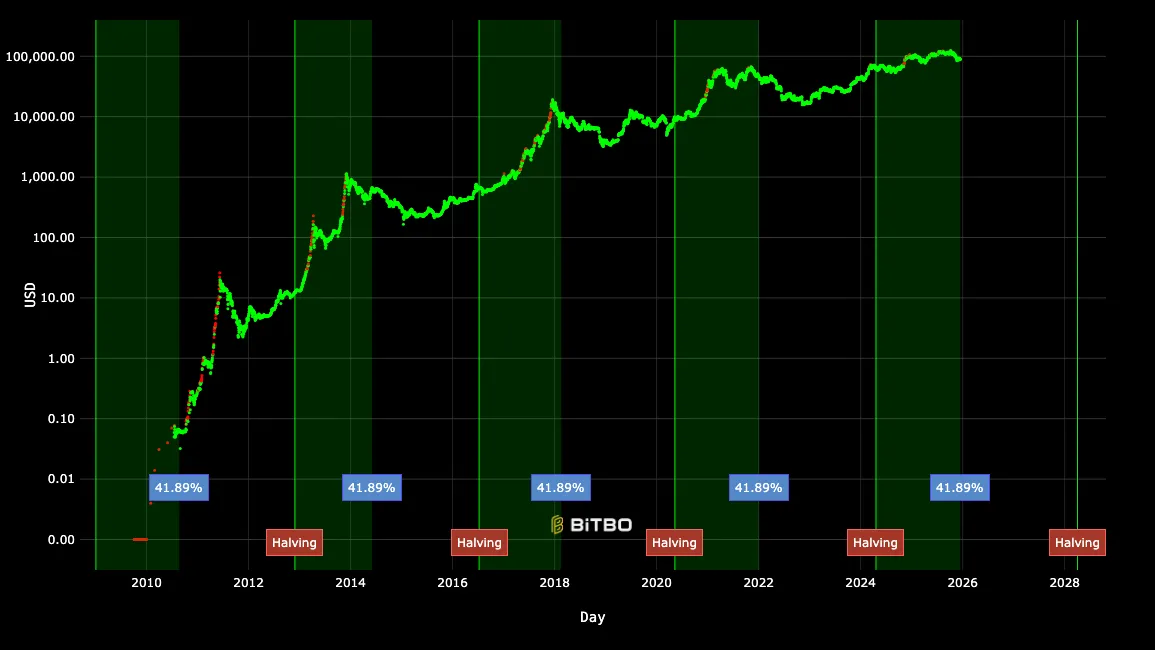
The 4-year cycle explained
Bitcoin’s four-year cycle comes from the halving. It slows how fast new Bitcoin enters the market. This happens about every four years, every 210,000 blocks. Each halving cuts miners’ rewards 50%, like 6.25 BTC ⇢ 3.125 BTC. Over time, supply tightens and new supply flow slows on schedule. That repeat pattern helps explain the hype around halving cycles.
Fewer new coins can change how the market behaves when demand stays the same or grows. But the halving does not control everything, because price also reacts to sentiment and broader markets. Comparison of 2025 price action with historical post-halving years, we still see significant price moves.
You can track a clear pattern of sharp expansion after each halving. After the 2012 halving, Bitcoin rose from about $12 in late 2012 to over $1,100 by November 2013. And after the 2016 halving, Bitcoin pushed to nearly $20,000 by the end of 2017. For the 2020 halving cycle, Bitcoin topped in the high $67,000s by November 2021. In the latest cycle, Bitcoin set a new high above $126,000 in October 2025. Since then, action has stayed muted, and while 2025 still swings, it hasn’t followed the same rhythm as previous halvings.
Diminishing Returns theory
As Bitcoin’s total value grows, it takes more new money to move the price by the same percentage. On one major ranking, Bitcoin sits around a $1.785T market cap, compared with gold near $30.387T and silver around $3.599T. Bitcoin can look more like silver on that scale, while gold still remains far ahead. That size shift changes your expectations, because 100x in weeks fits a tiny market, not a trillion-dollar asset.
When you plan a Bitcoin investment strategy for 2025, aim for steady results, like 2x to 5x over years. Track progress by your time in market and how consistent you are. Put that into action setting a time horizon and sticking to a regular buy plan. Decide upfront when to take partial profits, rather than waiting for a life-changing spike.
The bull case: why smart money is still buying Bitcoin?
Large buyers still buy Bitcoin because regulated access has expanded, and balance-sheet demand has stayed visible in public filings. And the “digital gold” framing keeps a simple reference point in view, since Bitcoin is still small next to gold by total value.
Institutional adoption & ETFs
Some pension-linked investors now use U.S. spot and futures Bitcoin ETFs. These trade like regular funds in many brokerage accounts. Quarterly SEC filings also show who holds these ETFs. For example, the State of Wisconsin Investment Board disclosed millions of shares in BlackRock’s iShares Bitcoin Trust by end of 2024.
So when you hear “institutional adoption” in 2025, it often means institutions buying ETF shares for controlled exposure. Corporate treasuries show a simpler version. Some companies buy Bitcoin directly and report it.
Strategy Inc., formerly MicroStrategy, reported this in a Form 8-K dated December 15, 2025. It said it bought 10,645 BTC for about $980.3 million from December 8 to 14, 2025. The same filing shows total holdings of 671,268 BTC as of December 14, 2025. That points to a deliberate treasury approach, not a short-term trade.
The “Digital Gold” narrative
Bitcoin and gold compete as “store of value” assets, so people compare their market caps. A market cap is the total value of an asset. The bull case starts with a simple gap: Bitcoin is still much smaller than gold. If Bitcoin captured 20% of gold’s market value, its market cap could reach about $6T.
Spread across Bitcoin’s 21 million coin cap, that would imply a higher price per coin. Total value would rise while supply stays fixed. So when you hear “digital gold,” the point is that adoption shifts can change the math fast. This is especially true when you compare Bitcoin to an asset as large as gold.’
The bear case: risks you must consider in 2026
Looking indifferently, Bitcoin may also see further price declines courtesy of two risks that could change how the market perceives the asset.
1. Regulatory hurdles
In the U.S., regulators have opened clearer paths in some areas. SEC approved spot Bitcoin ETP listings on January 2024. Still, U.S. crypto rules remain split between multiple agencies. Policy changes can affect the cryptocurrency exchanges and custody options you use to buy and hold Bitcoin.
In the EU, MiCA became fully applicable on December 30, 2024. Some member states can extend the transition window until July 1, 2026. That can change how firms offer Bitcoin services. In Asia, the picture is mixed. Hong Kong leans on licensing, while mainland China keeps a trading ban and crackdowns.
2. Technology risks & competition
Quantum computing could someday weaken Bitcoin wallet security. If it gets powerful enough, attackers might move coins without permission. But we’re not there yet. Public research still shows a wide gap between today’s machines and what it takes to break standard blockchain keys.
The U.S. National Institute of Standards and Technology (NIST) is publishing “quantum-safe” standards. The goal is to help systems upgrade before this becomes urgent. Meanwhile, other blockchains compete adding speed and app features. But Bitcoin still holds the largest share of crypto market value. Many rivals now build around its store-of-value role, instead of trying to replace it.
Strategic entry: how to invest in late 2025
Late 2025 calls for structure, not hype. Bitcoin now trades in a market with deeper liquidity and clearer access than earlier cycles. Below, we’ll cover three simple entry approaches. We’ll also explain how they handle volatility and the trade-offs to expect.
Dollar Cost Averaging (DCA)
Timing the top is risky. You often buy after a strong run, then feel pressure when the price drops. Dollar cost averaging means investing the same amount at set intervals. You do this no matter what the market does, which keeps decisions steady. A simple start is a small weekly buy, like $10 to $50. The routine matters more than picking one perfect day.
The 1% to 5% rule
A small Bitcoin allocation keeps you involved without making one asset your whole plan. Bitcoin can swing hard, so keeping it at 1% to 5% of net worth helps limit damage. This matters if you buy at the wrong time in the cycle. It also gives you a clear number, like $200 to $1,000 on $20,000 net worth. The rest can stay in steadier assets.
Lump Sum vs. Drip Feeding
This choice matters because it sets your starting risk. A lump sum puts all your money in at once. It can work if you’ll hold through drops, but it can feel brutal after a dip. Drip feeding spreads buys over weeks or months. It reduces regret from a bad entry, but it can lag if price rises early. That can leave you partly in cash for longer.
Comparing Lump Sum investing to Drip Feeding
| Factor | Lump sum | Drip feeding |
| Speed | Pro: Instant exposure Con: one entry point | Pro: Gradual exposure Con: slower entry |
| Timing risk | Pro: No delay Con: Can land near a peak | Pro: Spreads timing Con: May miss early gains |
| Stress | Pro: One decision Con: Harder to sit through drops | Pro: Routine buys Con: Needs patience |
| Best when | Pro: You can hold through swings Con: Emotions can bite | Pro: You want a simple habit Con: Takes longer |
| Typical setup | Pro: Invest once, then hold Con: No “second chance” | Pro: Buy weekly Con: More steps |
| What research says | Pro: Often ahead over time Con: Depends on the path | Pro: Helps avoid bad timing Con: Can lag in rising markets |
Conclusion
Bitcoin has shifted from a speculative toy to a more institutional asset. Big, regulated channels now sit at the center of the market. You can see it in U.S. spot bitcoin ETPs and corporate treasuries holding BTC in public filings.
But that doesn’t remove risk. Bitcoin still trades like a volatile asset, and it can reprice fast when sentiment flips. The key change is who can buy and hold it at scale. Over time, that can shape how the market behaves.
You aren’t early, but you aren’t necessarily late. You’re investing in a more mature market than the 2017-era. That maturity shows up as steadier access and, in some post-spot-ETF periods, lower realized volatility than past extremes. Swings still happen.
Your edge now comes from process. The easy gains from being first are mostly gone, so discipline matters more than hype. If you plan to hold beyond a short trade, storage becomes part of the investment, so read our guide on how to securely store your crypto in 2025.
FAQs
Will Bitcoin ever hit $1 million?
Is Bitcoin safe for retirement savings?
What happens if I buy at the all-time high?
References
Digital Currency Ownership Data | Triple-A
Markets in Crypto-Assets Regulation (MiCA) | European Securities and Markets Authority (ESMA)
China’s central bank vows crackdown on virtual currency, flags stablecoin concerns | Reuters