


Bitcoin staking is the latest trend. Over 58,500 BTC, worth more than $6 billion, is already staked across different platforms. For years, Bitcoin holders had just one way to earn: wait for the price to go up. But that’s changing. New tools are making it possible to earn yield on your Bitcoin without giving it up.
Whether using a crypto exchange or a decentralized protocol, staking lets your BTC work while you hold it.
What is Bitcoin staking?
Bitcoin staking is a way to earn rewards by locking up your BTC for a certain period of time. You’re not trading or spending it, you’re putting it to work. It’s like letting your Bitcoin sit in a savings account that pays you for keeping it there.
This is a newer concept for Bitcoin. Staking has been popular with other cryptocurrencies like Ethereum, which use a system called proof-of-stake. Bitcoin doesn’t work like that; it still runs on proof-of-work. But new tools and platforms now let you “stake” Bitcoin in creative ways.
Some services let you lend your Bitcoin out. Others wrap it into a different format that can be used on different blockchains. And now, some networks are building ways to stake Bitcoin directly on-chain.
How to stake Bitcoin
Before you can stake BTC, you’ll need to own some. If you’re in a hurry, it’s even possible to buy Bitcoin with a credit card with no verification on certain platforms.
This said, staking Bitcoin isn’t one-size-fits-all. It depends on where you want to stake, how much control you want, and how comfortable you are with crypto tools. But whether you choose an exchange or go the on-chain route, the steps usually follow the same core process.
Bitcoin staking using a crypto exchange
Staking Bitcoin on a cryptocurrency exchange is one of the quickest and beginner-friendly options. Exchanges like Kraken will let you stake by depositing your BTC and opting into their yield program in just a few clicks. All this can be done without the need to set up wallets, deal with keys, or manage smart contracts.
Once your BTC is in the exchange account, you pick a staking product. Some have flexible terms, and others lock your funds for a set time. Staking rewards are typically automatically paid into your account.
Bitcoin staking using a decentralized platform
Babylon is one of the first platforms offering on-chain Bitcoin staking. You stake your BTC directly, without wrapping it or moving it to another blockchain ecosystem. It utilizes Bitcoin-native security and allows your BTC to help secure other networks in exchange for yield.
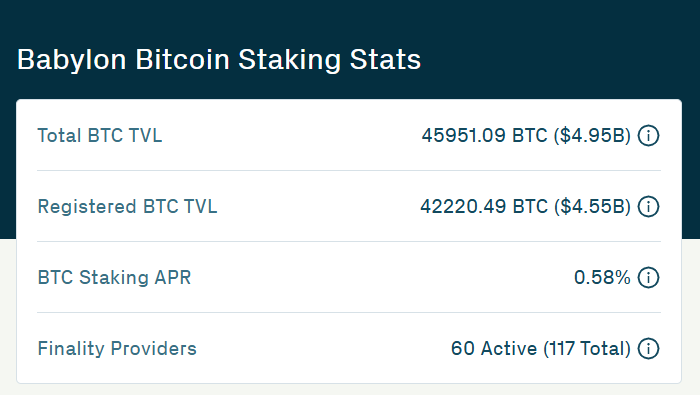
To stake with Babylon, you connect a Bitcoin wallet, deposit your BTC into their protocol, and choose a staking pool. Everything runs transparently through smart contracts, and you can monitor your funds on-chain.
This approach gives you complete control of your cryptocurrency holdings and usually pays higher rewards than centralized platforms. But it does require a bit more setup and comfort with crypto tools. Babylon is ideal if you want true on-chain exposure and believe in keeping your BTC decentralized.
The staking APR for Bitcoin changes frequently. At the time of this writing, Babylon’s BTC APR dropped to 0.33%, and around 55,000 BTC are staked.
How does Bitcoin staking work?
Platforms simulate BTC staking by using tokenized Bitcoin. You lock your real BTC, then receive a wrapped version like wBTC (on Ethereum) or sBTC (on Stacks). This wrapped token functions similarly to Bitcoin but operates on networks that support smart contracts.
While you’re not staking BTC in the Bitcoin network itself, the wrapped Bitcoin allows you to earn a yield in a decentarlized structure. Another method uses newer Bitcoin-native systems that don’t require wrapping. These utilise smart contracts or shared custody setups to enable you to stake your real BTC without transferring it to another chain.
Babylon is one of the first projects doing this on-chain. No matter the method, the idea is simple: you agree to lock up your Bitcoin, usually for a set time.
Why doesn’t Bitcoin support traditional staking?
Bitcoin utilizes a consensus mechanism known as Proof of Work (PoW) Miners solve math problems to validate transactions and earn rewards. It’s different from Proof of Stake (PoS), where users lock tokens to help secure the network.
Because Bitcoin doesn’t run on PoS, it has no native staking mechanism. You can’t just “stake” BTC by default. As blockchain technology has evolved, Bitcoin staking is now a viable option.
Bitcoin staking rewards
Staking rewards vary based on the platform and method you choose.
Centralized platforms like Kraken offer Bitcoin staking through the exchange. You deposit your BTC, and they lend it out to generate returns, currently between 0.10% – 0.15% annual percentage rate (APR). Other exchanges may offer a greater return in the form of a token (not BTC).
Decentralized options, like Babylon, offer on-chain BTC staking. These use smart contracts or Bitcoin-native systems to let you earn yield directly without handing over control. Babylon’s current annual yield is 0.58% APR. It is dynamic and changes frequently.
While centralized staking is convenient, decentralized platforms give you more control, transparency, and often higher BTC yields.
Bitcoin staking benefits and risks
| Benefits | Risks |
| Generate passive income | Funds (BTC) may be lost |
| You don’t need to sell your BTC. | Exchange or platform risk |
| Simple setup (esp. on exchanges) | Reduced control of your assets |
| Ideal for long-term investors. | Funds are locked for a time period. |
| Not much effort, especially when using CEX. | Rewards lack transparency. |
On-chain Bitcoin staking benefits and risks
| Benefits | Risks |
| Higher potential rewards | Smart contract vulnerabilities |
| Full control of your BTC | Requires technical knowledge |
| Greater transparency | Slashing risks |
| No reliance on centralized parties | Wallet/key management responsibility |
| Direct participation in protocols | Newer platforms need more testing |
Is Bitcoin staking safe?
BTC staking safety depends on where Bitcoin is staked. On-chain staking may have greater risks. If the smart contracts are compromised or vulnerabilities are found in the protocol, the staked BTC may be unsafe.
Staking with a crypto exchange, however, may grant you access to the protection fund in case of an exploit. The protection fund may vary from one exchange to another, and you must ensure BTC staking is also protected in the event of an exploit.
Summary
Bitcoin staking is a powerful way to earn a passive yield if you are holding Bitcoin. Many exchanges support BTC staking through their platforms, making it easier even for those that are new to crypto earn BTC rewards.
For crypto investors who want more control over their Bitcoin, decentralized protocols provide an adequate solution but require more technical knowledge. Beginners may struggle with staking their own Bitcoin.
FAQs
What does Bitcoin staking mean?
Is Bitcoin staking regulated?
What is the interest in Bitcoin staking?
Is Bitcoin staking risky?
Can I lose money staking Bitcoin?
References
Documents Show SEC Taking Anti-Crypto Staking Stance | PYMNTS.com
What Is BTCFi And How It’s Bringing Utility to Bitcoin | CoinGecko
Crypto Staking Doesn’t Violate U.S. Securities Law, SEC Says | CoinDesk