



There has been no bigger catalyst for growth in the past few years than artificial intelligence, or AI. Since ChatGPT surfaced, the phenomenon has cut across industries as often the mere mention that a company is ramping up its investment in AI can send its stock soaring.
As NVIDIA CEO Jensen Huang said on the company’s earnings call in February 2024, AI is a revolution that is ushering in a whole new way of computing.
“My expectation is that what is being experienced here in the United States, in the West, will surely be replicated around the world, and these AI-generation factories are going to be in every industry, every company, every region … [T]his last year, we’ve seen a generative AI really becoming a whole new application space, a whole new way of doing computing, a whole new industry is being formed and that’s driving our growth,” Huang said.
Thus, when it comes to picking the top AI stocks, it is not easy because of the ubiquity of the technology. However, there are certain stocks that have AI at the center of their business and should thrive for years to come, as the AI revolution is still in its early days.
Here are the 10 best AI stocks with long-term upside.
Top trading and investing platform
- Ideal for beginner investors
- Copy trade other successful investors
- Access 6,000+ stocks for local and global exposure

Our picks of the 10 best AI stocks for 2025
- Nvidia: In July 2025, the AI poster child became the first company in history to reach a $4 trillion valuation, fueled by unrelenting demand for its Graphics Processing Units (GPUs) that power AI models.
- Microsoft: After investing $13 billion in ChatGPT developer OpenAI, the world’s second most valuable company has been infusing its products, including its Office software suite and the Azure Cloud with AI.
- Broadcom: The Silicone Valley-based maker of networking chips stands to benefit from several trends: the spread of AI technology, the 5G wireless boom and the increased demand for data centers.
- Meta Platforms: The shares of Facebook and Instagram’s parent reached a record high in June as CEO Mark Zuckerberg hired top AI talent from rivals and set up a superintelligence team to develop its AI models.
- Alphabet: Google’s parent is spending $75 billion in 2025 mainly on AI features at Google, YouTube, and Google Cloud. It has developed a ChatGPT rival, Gemini, to help preserve its online search supremacy.
- Arm: The UK firm designs and licenses processors to clients such as Apple, Nvidia and Samsung, earning royalties. Its designs, crucial for AI, are present in cloud servers, data centers and 99% of smartphones.
- Micron Technology: The only US-based memory-chip maker’s shares have added more than 170% this year, paced by its AI and data center segments. It will benefit from the ”reshoring” trend among its customers.
- Symbotic: The US-based AI-powered supply-chain technology company uses robots to make warehouses more efficient. It counts two of the world’s largest retailers, Walmart and Target, among its clients.
- AMD: The processor maker’s share price has more than doubled this year, driven by expectations that its latest AI chip lineup will be able to challenge Nvidia’s new-generation products.
- IBM: One of the world’s oldest computer companies has shifted focus to the high-growth AI field with its Watsonx platform of corporate AI tools. Its AI order book topped $9.5 billion at the end of September.
Disclaimer: Your capital is at risk.
A detailed look at these top-ranked AI stocks
Let’s take a detailed look at the 10 best AI stocks available in markets right now and the investment case and growth drivers for each.
1 . Nvidia: The quintessential AI stock’s rally has further to extend
Nvidia (NASDAQ:NVDA) has become the poster child for AI stocks based on its meteoric gains, which have driven it to become the first publicly traded company to reach $4 trillion market value.
This semiconductor giant makes AI-enabled graphics processing units (GPUs) for computers, cars, gaming systems and other devices.
However, it generates most of its revenue from data centers, which process huge volumes of data. Nvidia controls about 98% of the GPU market at data centers, where its roster of clients includes Microsoft, Amazon, Alphabet and Meta Platforms.
Nvidia’s returns have been phenomenal. Over the past five years, its shares have gained more than 1,300%, and they are up more than 120% from this year’s low hit in April on the back of the Trump administration’s sweeping tariffs.
The gains may have further to go, according to the average 12-month price estimate of $238.89, based on 39 Wall Street analysts covering the stock, surveyed by TipRanks.
In its fiscal second quarter, Nvidia posted statutory profit of $26.42 billion, or $1.08 cents per share, rising from $0.67 in the same period last year. Revenue jumped 56% from a year earlier to $46.7 billion.
Your capital is at risk.
2. Microsoft: Open AI’s partner infuses Office, Azure with AI tools
Is Microsoft (NASDAQ:MSFT) an AI stock? The answer is yes, at least from this vantage point.
Microsoft has a minority “economic interest” in one of the biggest AI companies in the world, OpenAI, which created ChatGPT. The tech giant tried to buy OpenAI outright but settled for a partnership establishing its Azure cloud-computing platform as the exclusive cloud partner for OpenAI.
The software giant also has a non-voting seat on OpenAI’s board. Through this partnership, Microsoft has become a leader in this space, and AI has driven its growth and market share gains in cloud computing.
Microsoft stock has a one-year return of about 22% and a market cap of $3.75 trillion, making it the world’s second most valuable company, behind Nvidia.
Your capital is at risk.
3. Broadcom: Its chips power AI data centers, boosting revenue
Broadcom (NASDAQ:AVGO) is another semiconductor stock fueled by its AI chips. The company makes chips mainly for wireless connectivity, so it is poised to benefit from the 5G wireless boom. Broadcom’s chips power 5G networks and its infrastructure.
Its revenue is growing at a pace in the high double digits, led by broad-based AI adoption and increased demand for data centers.
Nvidia focuses on the generative-AI GPUs that handle complex, AI-driven tasks on the network that Broadcom’s chips facilitate.
Thus, these two chipmakers are not really competitors, although both will stand to benefit from the AI boom as leaders in their respective realms.
Additionally, Broadcom’s purchase of visualization-software producer VMWare in 2023 should further diversify its revenue streams.
Broadcom has a one-year return of 99%, with the gains pushing its market cap to $1.67 trillion.
Your capital is at risk.
4. Meta Platforms: Big AI spender sets up superintelligence team
Meta Platforms (NASDAQ:META) has fully focused its future on AI technology. In 2025, the company plans to spend $60 billion to $65 billion on capital expenses, up from $39.23 billion 2024, with most of the increase going to AI.
The social media company’s AI goals have taken center stage ever since CEO Mark Zuckerberg revealed a plan “to invest aggressively to support our ambitious AI research and product-development efforts.”
Meta has been investing in AI across the company’s business — from advertising to social media and the Metaverse, a collection of technologies using augmented reality.
Investors seem to approve of the company’s AI vision as shares touched a record in June when news broke of the creation of Meta’s Superintelligence Labs, which will house all its AI research and product development.
Zuckerberg has been on a hiring spree in recent months, poaching AI talent from rivals for Meta’s “superintelligence team.” Alexandr Wang, the former CEO of Scale AI, in which Meta bought a 49% stake for $14.3 billion, heads up the division.
Your capital is at risk.
5. Alphabet: Integrating AI bot into Google to protect search dominance
Like Meta, Alphabet (NASDAQ:GOOG) is also embracing AI. It has fallen behind its competitors in the AI arms race, but it is making up for that with major investments in the field.
Most notably, Alphabet rolled out its Gemini AI platform last year. Gemini rivals the offerings from Microsoft and OpenAI with AI functionality that it’s using across Alphabet’s cloud, Google, YouTube, Gmail and other businesses.
Alphabet’s dominance in online search has come under threat as people are increasingly using generative AI chat bots as search engines. Integrating Gemini in Google and other parts of its business is key to preserving its position.
In the third quarter, Alphabet’s consolidated revenue rose 16% from the same year-earlier quarter to $102.35 billion, underpinned by the company’s “full stack approach to AI,” and the “global rollout of AI Overviews and AI Mode in Search in record time,” according to CEO Sundar Pichai.
Google Cloud’s revenue rose 34% in the quarter to $15.2 billion, driven partly by AI infrastructure and generative AI tools. The company is raising its capital expenditure to $75 billion this year from $52.5 billion in 2024, primarily to build out its AI infrastructure, including data centers, servers, and networking equipment.
Alphabet’s shares have grown 61% in the past 12 months and have added 52% this year, and they trade at 28 times earnings, which is favorable compared to big tech rivals, such as Microsoft or Amazon (NASDAQ:AMZN).
Your capital is at risk.
6. Arm: UK chip designer’s shares have nearly tripled since Sept. 2023 IPO
Arm Ltd. (NASDAQ:ARM) is a UK-based semiconductor company that only started trading on the Nasdaq two years ago, in September 2023. However, it has made quite a splash since then, rising about 192% from the $51 IPO price.
Arm operates in a unique niche within the semiconductor space as it provides the architecture, or instruction manual, for chips that it then licenses to other semiconductor companies for a royalty fee.
The partners, which include Nvidia and smartphone makers Apple (NASDAQ:AAPL) and Samsung, then customize and make their own chips based on their needs. Arm earns revenue from the sales of the products that contain its designs.
The chips Arm designs are also power-efficient, which is a big advantage over those from its competitors. The company’s mission is to reduce the “insatiable” energy needs of AI, making its chips much in demand.
Arm itself is betting big on the AI-driven expansion of the data center market to drive revenue. The chip designer targets a 50% share of the data center central processing unit market by the end of the year, compared with 15% at the end of 2024, Reuters reported in March, citing company executives.
Your capital is at risk.
7. Micron Technology: AI-powered growth phase sends revenue to record
The many semiconductor stocks on this list occupy different parts of the industry, just as Micron Technology (NASDAQ:MU) does.
Micron specializes in memory and data-storage chips in computers, smartphones, and servers at data centers, and the spread of generative AI technology has lifted the need for its products.
“We are in the very early innings of a multi-year growth phase driven by AI as this disruptive technology will transform every aspect of business and society,” Micron CEO Sanjay Mehrotra told investors and analysts on an earnings call in March last year.
And, indeed, Micron has been capitalizing on this trend. It has seen a huge jump in revenue from its high-bandwidth-memory (HBM) chips used in data centers for AI-related storage needs.
In fiscal 2025, which ended August 28, the chipmaker posted record revenue of $37.4 billion, nearly 50% higher than in 2024, mostly driven by dynamic random-access memory (DRAM) and HBM chips.
Micron sees a “robust demand environment” in the fiscal first quarter and expects revenue to grow by 11% from the previous quarter to a record $12.5 billion at the midpoint of its guidance.
Micron stock has been up nearly 180% over the past 10 months and, given the expected revenue growth, its valuation doesn’t seem excessive at 32 times earnings.
Your capital is at risk.
8. Symbotic: Share price more than doubles as revenue soars and loss shrinks
Symbotic (NASDAQ:SYM) makes robotics used by stores to automate their warehouse operations. The autonomous robots Symbotic develops incorporate AI technology, which informs their functions. The company’s clients include two of the world’s largest retailers: Walmart and Target.
Symbotic is a relatively new company, and it is not profitable, posting a $32 million net loss in the most recent quarter ended June 28. It widened from $27 million in the same year-earlier quarter. However, adjusted EBITDA, an operating profit measure that strips out one-off items, improved to $45 million from $3 a year earlier.
Meanwhile, revenue rose 26% year over year to $592.12 million, and thanks mainly to this encouraging set of results, the stock price has more than doubled this year.
Your capital is at risk.
9. AMD: GPU market underdog takes on Nvidia with new chip series
Advanced Micro Devices (NASDAQ:AMD) is a direct competitor of Nvidia, as it specializes in GPU chips for computers and gaming. It has lagged Nvidia in developing AI-enabled chips.
However, it is making up for lost time by investing heavily in AI to try to dent Nvidia’s massive market share advantage. AMD CEO Lisa Su in June unveiled the MI350 processor lineup, which, she said, can directly challenge Nvidia’s Blackwell line.
She added that her previous estimate that the global AI processor market would reach $500 billion in revenue by 2028 “seems well within grasp.”
In the third quarter, AMD’s data-center revenue grew 22% year over year to $4.3 billion, driven by its fifth-generation processors and the latest GPUs — a trend that should continue, given the market’s expected size.
AMD has more than doubled its share price this year, and has tripled it over the past five years.
Your capital is at risk.
10. IBM: Computer veteran’s AI platform has gained $9.5 billion of business
International Business Machines, better known as IBM (NYSE:IBM), has been given new life in the AI age. Through its Watsonx platform, IBM has carved out a niche.
The software governs AI models for companies, making sure the AI content and data is accurate. Businesses can also use Watsonx to train, evaluate and develop AI models.
IBM has seen growth every quarter since the platform’s launch last year, and it already had a $9.5 billion book of business at the end of September.
This growth engine and IBM’s cheaper valuation compared to other AI players, at a forward price to earnings (P/E) ratio of about 25, make it one to watch.
IBM stock is up 45% over the past year, and unlike many AI companies, it offers a decent dividend. Its dividend yields 2.17%, nearly twice the average for S&P 500 members, and it has raised its quarterly dividend amount for 30 consecutive years.
Your capital is at risk.
Comparing the top-ranked AI stocks
Compare our top picks, based on their year-to-date performance and price-to-earnings ratio, in an easy-to-view format.
| Ticker | Stock | YTD price performance | P/E ratio |
|---|---|---|---|
| NASDAQ: NVDA | Nvidia | +39.41% | 54.88 |
| NASDAQ: MSFT | Microsoft | +20.58% | 35.91 |
| NASDAQ: AVGO | Broadcom | +53.36% | 90.90 |
| NASDAQ: META | Meta Platforms | +4.36% | 27.68 |
| NASDAQ: GOOG | Alphabet | +51.79% | 28.20 |
| NASDAQ: ARM | Arm Ltd. | +16.86 | 192.36 |
| NASDAQ: MU | Micron Technology | +177.67% | 31.98 |
| NASDAQ: SYM | Symbotic | +162.89% | N/A |
| NASDAQ: AMD | AMD | +102.25% | 120.58 |
| NYSE: IBM | IBM | +40.55% | 37 |
Your capital is at risk.
What is AI?
AI is technology that is designed to perform tasks that would otherwise require human intervention, like digital assistants, autonomous cars, and GPS, to name a few examples. It’s able to do so through algorithms that seek to model the decision-making process of humans by using data.
The more data an AI gathers, the more it “learns,” enabling it to produce better decisions. This process is also known as machine-learning.
Generative AI, the technology leveraged by the chatbot ChatGPT, is another term you hear a lot about. It refers to what is called “deep machine learning,” in which the AI models can process large amounts of raw data that is not supervised or structured by human intervention, using all that data to create new content.
We are still in the formative days of AI, so what the future will hold remains to be seen. However, this technology will certainly disrupt industries, create new ones, lead to data privacy and ethics concerns, and be subject to regulations as it develops.
The risks of investing in AI stocks
It will be increasingly difficult to categorize AI stocks in the years ahead because the technology will be so intertwined in all businesses.
For now, it’s kind of like the early days of personal computers and internet stocks. There will be companies we barely know now or haven’t even heard of yet that will grow into behemoths. For every one of those, there will be many that get acquired or swept into the dustbin of history. Anyone remember Lycos, Excite, or eToys.com?
Thus, investors should be very careful about looking for the next high-flier because almost any company could also easily be the next bust – even when seeking stocks to buy under $10. One metric investors should look for is profitability.
If a company isn’t profitable or at least moving toward it, it may be a red flag, particularly if revenue is not increasing at a robust clip. An even bigger red flag is companies with high valuations that aren’t generating consistent profits.
The best of what’s around
This list reflects companies that are large, established brands that should be around for years to come and benefit from the AI wave.
However, this is a fast-evolving industry, so investors will want to keep a close eye on it – especially as sectors like web3 stocks and AI should continue to drive growth for a long time.
We consider a wide range of factors before choosing the best AI tools stock pickers for US and global investors. Learn more about our methodology below:
Our methodology
When identifying the Top blockchain stocks to invest in, we use a comprehensive methodology that includes the following key factors:
- Stock Performance. This is one of the key factors we look at. Specifically, we want to know if the stock has a history of outperformance, consistently beating its benchmarks or industry peers. We generally look back at least 10 years, but for a young industry such as AI, we might use a shorter timeframe for some companies.
- Earnings growth. We examine how consistent the company has been in generating year-over-year earnings growth. Ideally, we are looking for stocks that generate double-digit annual earnings growth over a multi-year period.
- Reasonable Valuations. As these are AI stocks, some are going to have higher price-to-earnings ratios stocks from some other sectors. That said, we want to ensure that the P/E, price-to-sales, and other valuation measures aren’t unusually high given the stock’s historical ranges. That could signal that factors other than revenue or earnings are driving the price higher and it may not be sustainable.
- Market Share. It’s important to consider how dominant the company is in a given market. Is it a leader in its market, or among the leaders in multiple markets? Many of the top stocks, like Amazon, for example, have a leg in several markets. Market leaders are generally going to have strong earnings power. Also, is the company gaining, or losing, market share.
- Competitive Advantages. A company’s competitive advantages hold the key to its enduring success. We look at what advantages a stock has over its competitors. We gauge whether its scale and pricing power are superior, or it has a unique product or service. We look at whether the company has a moat that makes its advantages hard to overcome or penetrate.
- Growth Catalyst. In addition to any competitive advantages, it’s important to look for other growth catalysts that could spur the stock higher. Some examples: Did it expand into new markets through an acquisition? Are there new or pending regulations that could help or hinder the company? Are there new products coming? Are there changes taking place in the industry?
- Capital/Financial Strength. The foundation upon which a company can grow is its financial or capital strength. We look to see if it has a significant, and growing, amount of operating cash or free cash flow, because that will allow it to invest in its future growth or navigate downturns. Also, we look to see if its debt is reasonable so that a disproportionate amount of earnings isn’t going to pay down debt.
- Efficiency. Another key consideration is how efficient the company is in turning a profit. While all industries are different, the operating margins and profit margins will give you a sense of how much a company is spending to generate profit. Higher, and rising, margins mean the company is operating more efficiently.
- Stable Leadership. We look at the leadership of the company and how stable it has been over the years. While a lot of turnover in the corner office is a sign of instability, the best companies – especially the best tech stocks – tend to have longer-tenured CEOs and seamless succession plans.
- Analysts’ Estimates. While we don’t solely rely on what Wall Street analysts think of a company or stock, we certainly gauge their consensus recommendations and price targets in determining the best stocks.
Get real-time news and alerts with Benzinga Pro
Those looking to stay on top of the latest news and developments in the AI space can take advantage of trading signals like Benzinga Pro. The platform is the only software available to retail investors that provides the fastest live newsfeed.
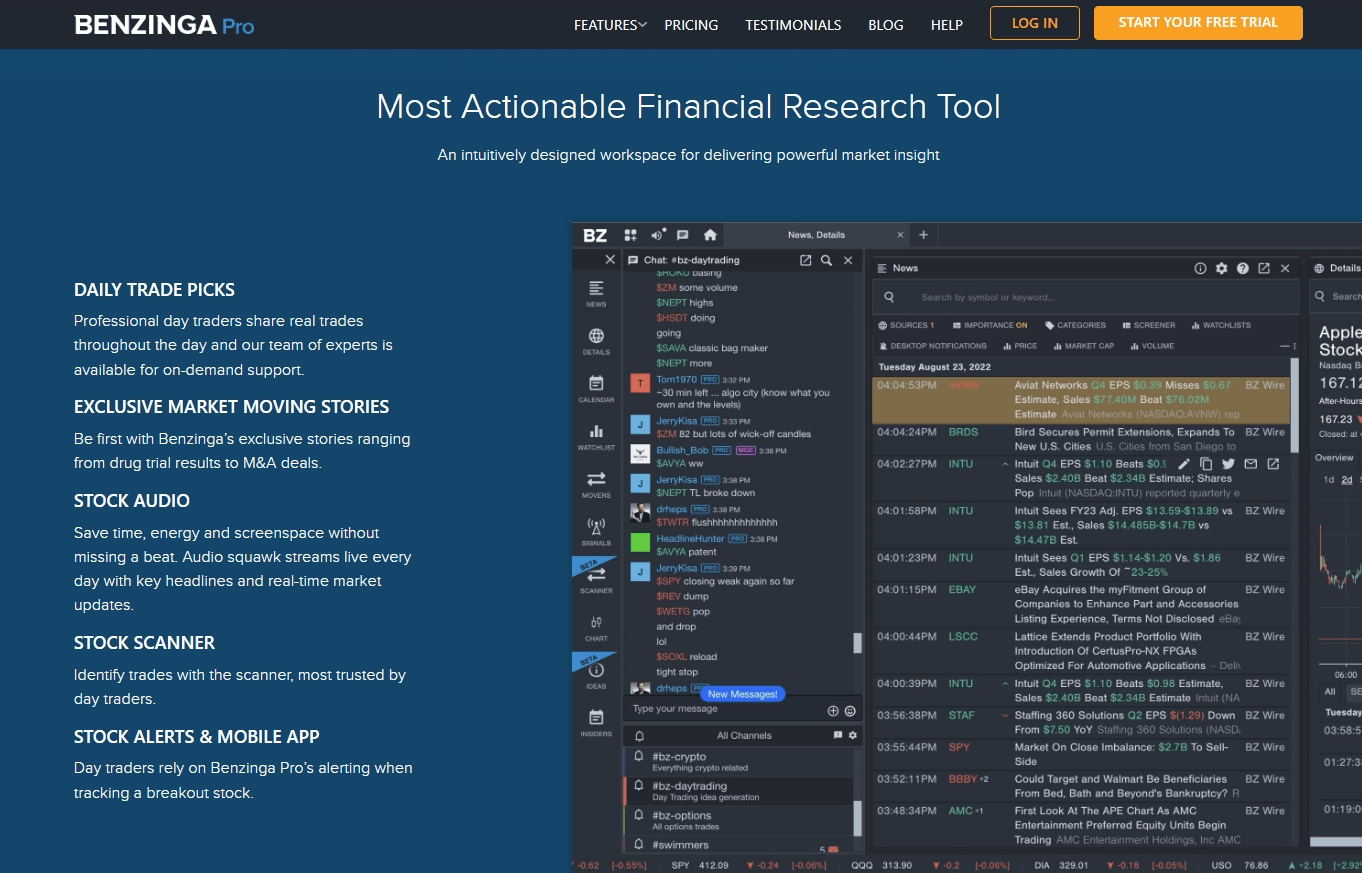
Benzinga Pro users gain exclusive market insights and commentary from expert traders and analysts, giving them an edge over other traders. Platform members can customize their news feeds to prioritize different stocks and sectors to see only the most relevant information for their trading portfolios.
Another key feature of the stock signal platform is the audio squawk. This live-streaming audio service delivers market-moving information that keeps investors updated even without a monitor. The squawk delivers daily live updates, including top headlines and key stock announcements.
Other news alerts and market developments can be set up so that Benzinga Pro traders can instantly get notifications on mobile or desktop. Plus, new users can try the 14-day free trial to test all these powerful features before making a full payment. You can also explore AI stock trading bots to further boost your market edge.
AI Stock FAQs
What is the best AI stock to buy now?
What are the top 5 AI companies?
Who has invested the most in AI?
References:
- AMD CEO Lisa Su’s prediction about the global processor market’s growth
- AMD’s third-quarter financial results
- IBM’s third-quarter earnings report
- Symbotic fiscal third-quarter earnings
- Micron CEO Mehrotra on multi-year growth phase
- Arm Holdings targets 50% share of data center CPU market
- Alphabet’s third-quarter earnings report
- Meta CEO Zuckerberg sets out AI strategy
- Microsoft’s OpenAI interest
- Nvidia fiscal second quarter financial results
Disclaimers:
eToro is a multi-asset platform which offers both investing in stocks and cryptoassets, as well as trading CFDs.
Please note that CFDs are complex instruments and come with a high risk of losing money rapidly due to leverage. 51% of retail investor accounts lose money when trading CFDs with this provider. You should consider whether you understand how CFDs work, and whether you can afford to take the high risk of losing your money.
This communication is intended for information and educational purposes only and should not be considered investment advice or investment recommendation. Past performance is not an indication of future results.
Copy Trading does not amount to investment advice. The value of your investments may go up or down. Your capital is at risk.
Don’t invest unless you’re prepared to lose all the money you invest. This is a high-risk investment and you should not expect to be protected if something goes wrong. Take 2 mins to learn more
eToro USA LLC does not offer CFDs and makes no representation and assumes no liability as to the accuracy or completeness of the content of this publication, which has been prepared by our partner utilizing publicly available non-entity specific information about eToro.