


If you are relatively new to cryptocurrencies, you may wonder how to stake Ethereum. Ethereum staking means you agree to lock up some of your ETH to help secure the Ethereum network, and in exchange, you get rewards. This article provides a detailed guide on how to stake Ethereum and some benefits, risks, and general tips to be aware of.
How does staking Ethereum work?
Staking ETH means locking some of your crypto in a smart contract to work as a validator on the network. The network then randomly selects validators with 32 ETH to help secure the network by verifying transactions and adding new blocks to the blockchain.
In exchange for staked Ethereum, validators earn rewards, including a percentage of network transaction fees and freshly minted ETH. Different methods to stake ETH depend on how much you are willing to stake and the potential risks involved.
Though you require 32 ETH to become a validator, it is possible to stake less depending on your chosen method.
How to stake ETH with a crypto exchange
Staking Ethereum with a crypto exchange is one of the easiest methods. It requires no blockchain knowledge, and ETH can be purchased directly from the exchange and then staked.
Create an account
Choose a crypto exchange to open the account. It is very important to select an exchange that not only supports Ethereum staking but also has a good reputation. If you are uncertain which exchange to choose, see the top cryptocurrency exchanges..
Purchase ETH
You must now purchase the ETH to stake it. Crypto exchanges allow you to easily buy and sell cryptocurrencies using your preferred payment methods, such as bank transfer, credit card, or debit card. If you are crypto-savvy and you have ETH in your wallet, it can be transferred to the exchange of your choice.
Select staking options
In the exchange, look for the staking option. The vast majority of the top exchange will offer ETH staking. The yield (in %, APR or APY) will be displayed prior to staking the cryptocurrency.
Stake ETH
Once you have decided the amount, stake the ETH.You are now ready to earn ETH staking yield, which will be added to your account periodically depending on the payout schedule and staking rules.
How to stake Ethereum with a crypto wallet
Similar to crypto exchanges, ETH can also be staked through a crypto wallet. If don’t have a wallet, a hot crypto wallet may be the most convinient method and mostly free.
Select a compatible wallet
You first need to select a wallet that supports Ethereum staking. Some wallets are only compatible with a specific cryptocurrency. Ensure it supports Ethereum.
Transfer ETH
Transfer ETH to the staking platform, whether it is an exchange or another platform. Some wallets will have the option to stake ETH directly from the walles. Make sure the address you are sending ETH to is correct.
Stake
Once the coins were transferred to the platform of your choice, ETH can now be staked and you’ll start earning a pasive yield on the amount you choses to stake.
Different Ethereum staking methods
As said above, there are different staking methods, and understanding each of them will allow you to choose the best one for you.
Solo staking
Solo staking, often known as node staking, requires a crypto wallet and technical knowldge. It is the most secure method, but it requires you to own at leasr 32 ETH, which are worth over $50,000. Furthermore, you need to set up your own validator node to take part in the staking process.
Solo staking is considered to be the gold standard for staking, as users get full participation rewards and don’t need to trust anyone else with their funds. For solo staking, users need to install the required Ethereum client software and ensure it is online and operational 24/7.
ETH staking pools
ETH staking pool can be done directly from your wallet, on decentralized platforms, and crypto exchanges. If you don’t have 32 ETH or don’t want to lock your 32 ETH, then you can use pooled staking.
Pool operators manage staking pools, and they take care of the technical aspects, including the distribution of rewards. Rewards are distributed according to pre-set rules, which are typically based on the number of ETH staked.
If you are new to crypto and prefer participating in a pool from your wallet, the Ledger wallet have an option to stake from the wallet without the need of using an exchange or other platforms.
Ethereum liquid staking
Liquid staking can be done using a crypto wallet or via an exchange like Coinbase (cbETH). It is a relatively new method for staking Ethereum in exchange for rewards. As the decentralized finance space evolved, liquid staking allows you to stake your crypto without any locks while maintaining access to the liquidity (hence the term liquid staking).
Maintaining access to liquidity means you can lend or trade your liquid tokens to amplify the yield. Rocket Pool is a known DeFi application for Ether liquid staking. ETH is exchanged for rETH, which is the liquid token. rETH can be used to provide liquidity to decentralized exchanges, as collateral for a loan, or as a trade.
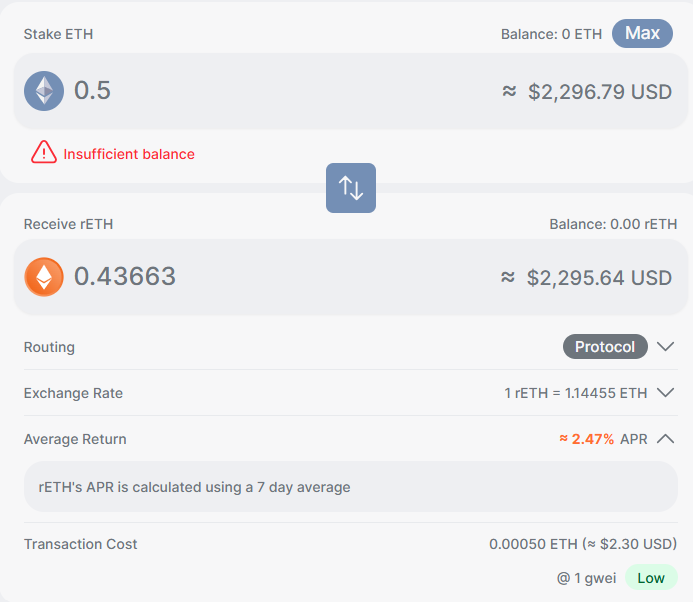
Holding rETH in your wallet has a current return (APR) of around 2.47%. 0.5 ETH was used as an example. You decide whether to use rETH for other DeFi apps. Liquid restaking is another popular choice.
It is worth noting that Rocket Pool also offers node staking.
Staking-as-a-service
If you don’t want to deal with hardware requirements, but still want to earn staking rewards, staking-as-a-service is the option. Staking-as-a-service means authorizing a service provider to use your ETH in your best interests.
Staking-as-a-service is considered to be the least secure option, as you are trusting a third party with your ETH. Thus, it is important that you choose a service provider with a strong track record and robust security measures. You must also consider the fees charged by the service providers.
How profitable is it to stake Ethereum?
Staking Ethereum can be a profitable investment, especially when the ETH is witnessing increased growth. According to Coinbase, the current estimated reward rate of Ethereum is 2.09% if investors hold their asset for 365 days.
Like with most investments, staking also requires long-term commitment from investors. Furthermore, your exact reward depends on several factors, including how much ether you have, staking yields, and transaction fees.
Moreover, you can maximize your rewards by following best practices for staking, and using ETH staking calculators.