


With inflation having eased gradually in the UK from its 2022 peak, allowing the Bank of England to ease borrowing costs five times since last August, to the lowest in more than two years, December 2025 could be the perfect time to enter the UK stock market.
Several other trends are also boosting UK stocks this year, with the FTSE100 reaching another record high. UK stocks benefited as President Donald Trump’s tariffs have prompted investors to diversify away from the US.
Defence shares rose as governments pledged to raise military spending amid conflicts in Ukraine and the Middle East, and miners gained as gold and silver prices soared.
For new and inexperienced investors, though, the wealth of options can be overwhelming. Should you buy a high-flying FTSE 100 star like Rolls-Royce, the highest dividend payers, such as Astra Zeneca or Shell, or perhaps banking giants like Barclays or Lloyds Banking Group?
We’ll attempt to demystify this below, running through our picks of the best UK stocks to buy now.
Top trading and investing platform
- Ideal for beginner investors
- Copy trade other successful investors
- Access 6,000+ stocks for local and global exposure

Our picks of the top 7 UK stocks to invest in now
Here’s an overview of our selection of the seven most exciting UK stocks to look at right now:
- Rolls-Royce Holdings: The London-based aerospace and defence company designs and manufactures power systems, such as high-performance engines for aircraft, naval vessels, and industrial applications.
- GSK: The London-based drugmaker, formerly known as GlaxoSmithKline, has a huge pipeline of therapies for respiratory diseases, cancers and infections. It has raised its 2025 sales and EPS forecast.
- Barclays: The fifth largest European lender by assets operates a UK retail bank with 20 million customers, a UK corporate and a private banking unit, a global investment bank and a US commercial bank.
- easyJet: Founded in 1995, the British low-cost airline operates 1,207 routes across 38 countries with 355 aircraft. Beyond flights, it also offers holiday packages, travel insurance, and airport transfers.
- Legal & General Group: Dating back to 1836 the British asset manager with significant presence in the UK and the US, provides investment services, lifetime mortgages, pensions, annuities, and life assurance.
- Vodafone Group: The UK telecom company provides mobile phone and fixed broadband services to 340 million customers across 15 countries, including the UK, Germany, Türkiye, South Africa and Egypt.
- Marks and Spencer Group: The iconic British retailer, also known as M&S, traces its roots back to 1884. It sells clothing, footwear, homeware and high-end food items in nearly 1,500 stores globally.
Disclaimer: Your capital is at risk.
- Show Full Guide
A closer look at the best UK stocks to buy in 2025
Here is a closer look at our picks for the seven best UK shares to buy now, with a deeper analysis of revenues, company activity, and wider market trends.
All stock data on this page originates from eToro’s in-built charting and analysis tools.
1. Rolls-Royce Holdings (RR): A FTSE high-flyer with the potential for more growth
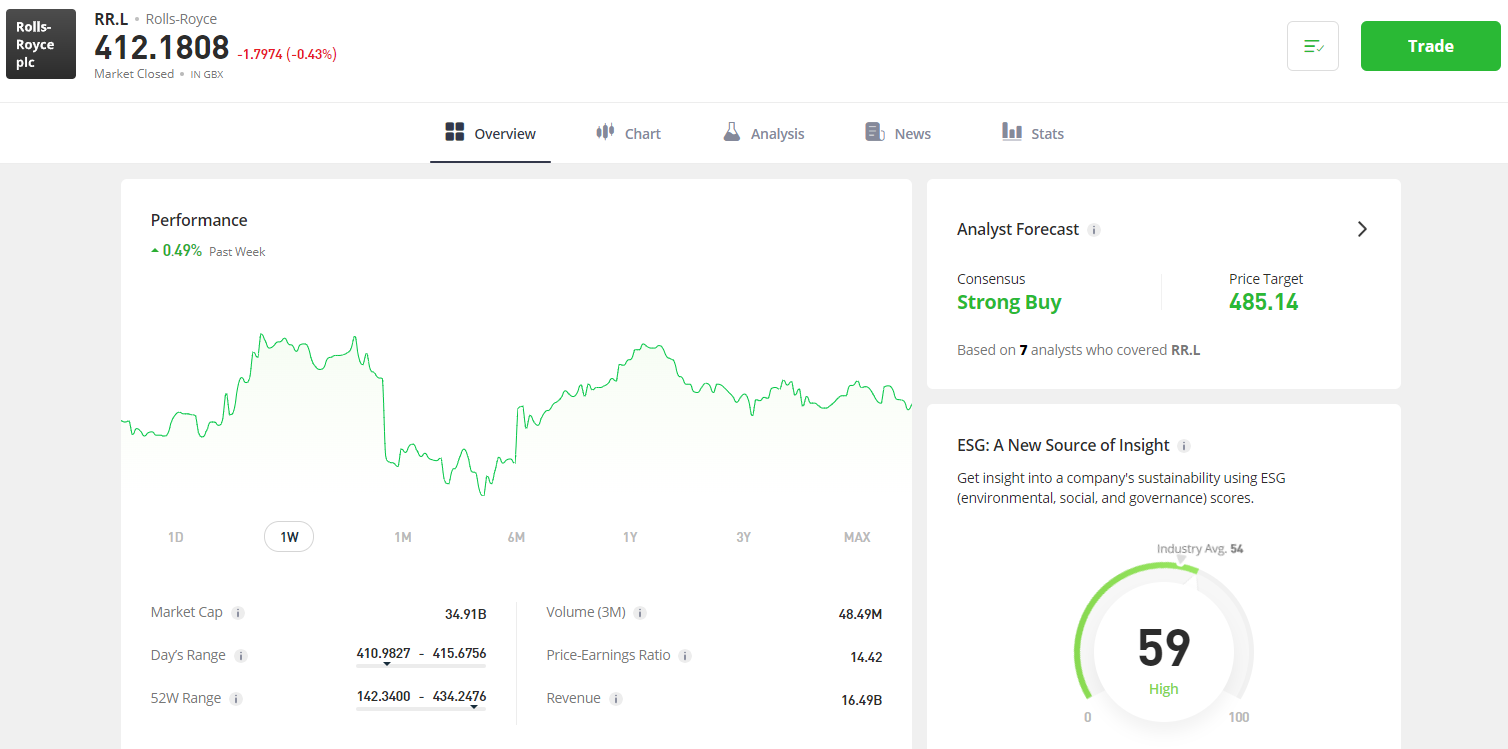
Comfortably among the best UK stocks to consider, aerospace and defence giant Rolls-Royce has enjoyed an incredible stock market run of late, with its share price up by 1,560% in the past five years and nearly 106% in the past 12 months.
The the shares have had average annualised return of 65% over the last five years.
This marries up with the firm’s impressive financial performance. In the first half of 2025, underlying revenue rose 13% on an organic basis (adjusted for currencies and some items) to £9.06 billion, and underlying operating profit, the company’s preferred profitability measure, increased 50% organically to £1.73 billion.
The results that beat analyst expectations, drove the company’s shares to a record high on 31 July, and past the £90-billion valuation mark.
The financial performance prompted CEO Tufan Erginbilgiç to raise his full-year profit forecast. He now expects an underlying operating profit of between £3.1 billion and £3.2 billion. The previous estimate was for underlying operating profit of between £2.7 billion and £2.9 billion.
Management reinstated dividend after reporting its 2024 full-year result, at 6 pence per share, and revealed that the company will pay an interim dividend of 4.5 pence per share from the first-half earnings. The aircraft engine maker is in the process of buying back £1 billion of its own shares, having completed £400 million of the programme by 30 June.
Analyst forecasts
The impressive company and stock performance is also reflected in analysts’ outlook on the stock. As of August 2025, out of 16 analysts covering the stock, 11 labelled it as ‘buy,’ with one ‘hold’ and one ‘sell’ recommendation.
Despite retreating in April on the back of Trump’s tariffs after reaching a record in March, there could be further growth on the horizon for RR’s stock price as business remains brisk.
With efforts to broker a peace in the conflict in Ukraine failing, Europe and the US are boosting defence spending, driving demand for military equipment. Similarly, the firm continues to see strong demand for aircraft engines this year.
Moreover, Rolls-Royce’s price-to-earnings ratio, at about 17, has remained low compared to its market peers of about 32 on average. This could be a strong indicator that the stock is attractively priced, and therefore, it remains one of the best UK companies to invest in.
Your capital is at risk.
2. GSK: Pharma stock at attractive valuation with solid passive income
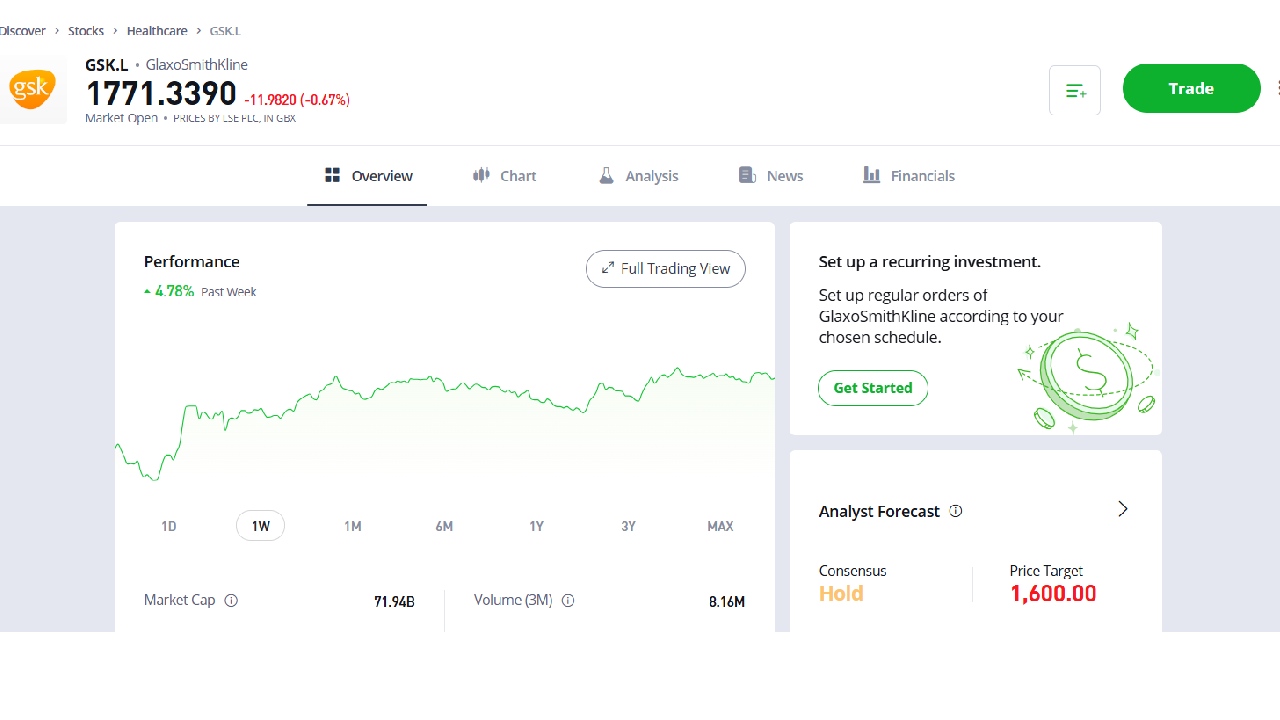
The UK’s second most valuable drugmaker, with a market cap of £72.6 billion, is making up for falling vaccine sales with increased revenue from its cancer and respiratory therapies.
The well-established pharmaceutical company is trading at around 13 times earnings, which is below average among its peers. While warning about the outlook for vaccine sales, especially in the US amid growing scepticism, management lifted its forecasts for full-year sales growth to between 6% and 7% from an earlier estimate of 3% to 5%.
It also sees core earnings per share rising between 10% and 12% in 2025, rather than by 6% to 8% as forecast earlier.
In the third quarter, GSK posted revenue of £8.55 billion, up 7% year over year at actual exchange rates, with core EPS of 55 pence, up 11% on the same basis.
The growth drivers include specialty medicine sales of £3.4 billion, up 16% year over year, and oncology sales of £500 million, up 39%.
Another bonus for beginners is that GSK has a quarterly dividend of 16 pence that yields around 3.6%. It also has £900 million left to spend on its own shares from an ongoing £2 billion share buyback programme. That makes it easier to stick around for the company’s burgeoning pipeline.
The company said it has had three major new product approvals so far this year, with another expected in December. Its pipeline has a further 14 therapies worth £2 billion a year between now and 2031.
Your capital is at risk.
3. Barclays (BARC): Severely undervalued with a decent dividend yield
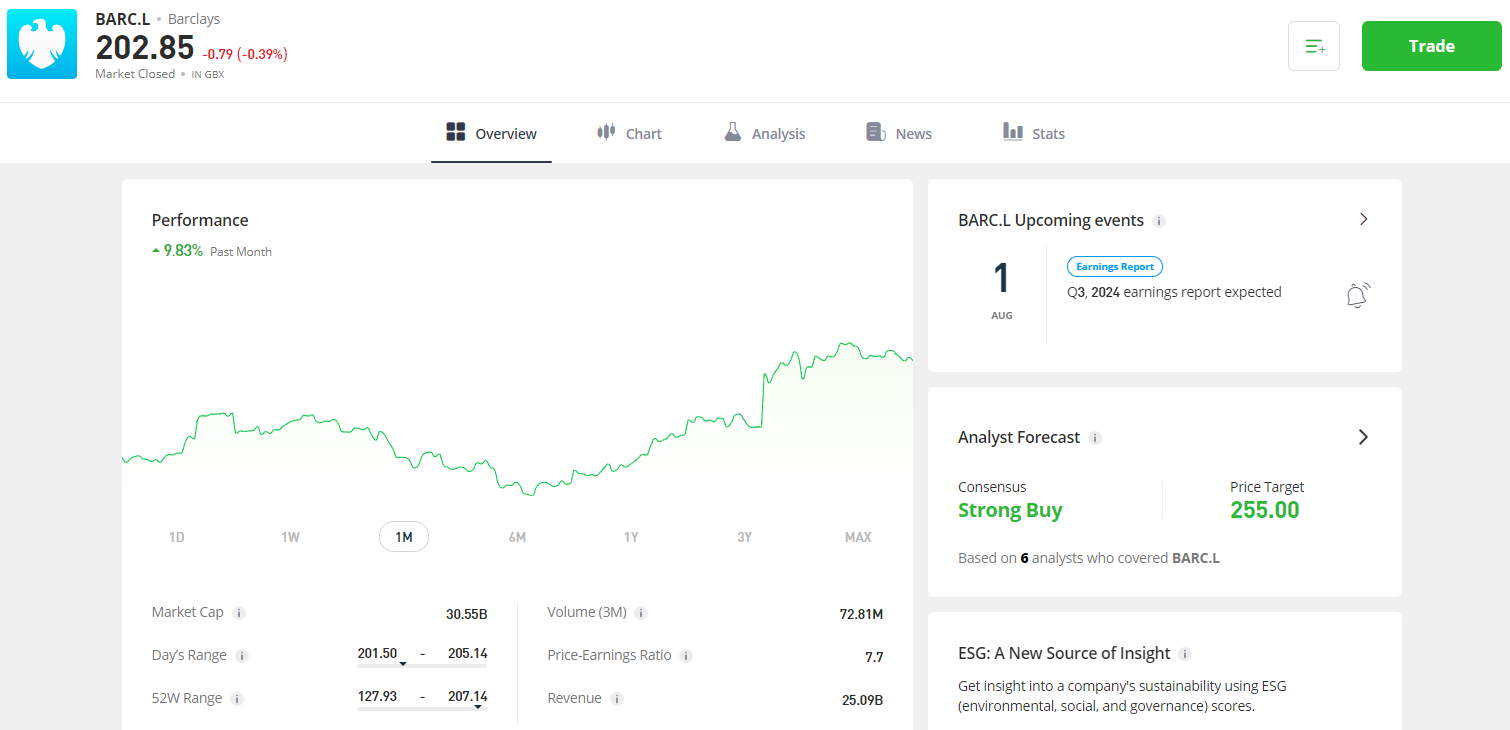
Barclays stock has been thriving in 2025, emphatically outperforming the FTSE100 with a value increase of more than 50% since the turn of the year. It has topped the UK benchmark index’s performance on a 12-month and 5-year horizon, too.
Crucially, this run of good fortune represents a major rebound, with the high street bank’s share price having hit a 52-week low of 223.75 pence in November last year. Now hovering around the 400 pence mark, the firm’s stock has risen by 65% in a year.
Even if you’ve missed the boat on this run, investing in Barclays may still be a smart move. This is primarily due to valuation, with the stock’s price-to-earnings ratio sitting around the 10 mark, lagging the industry average.
This, in the grand scheme, is remarkably good value for investors.
Moreover, the firm offers a dividend yield of 2.1%, which some analysts say will reach 5.5% in 2026. This, combined with the potential for ROI, could make the stock highly attractive this year and next.
Your capital is at risk.
4. easyJet (EZJ): Staging an emphatic post-pandemic recovery
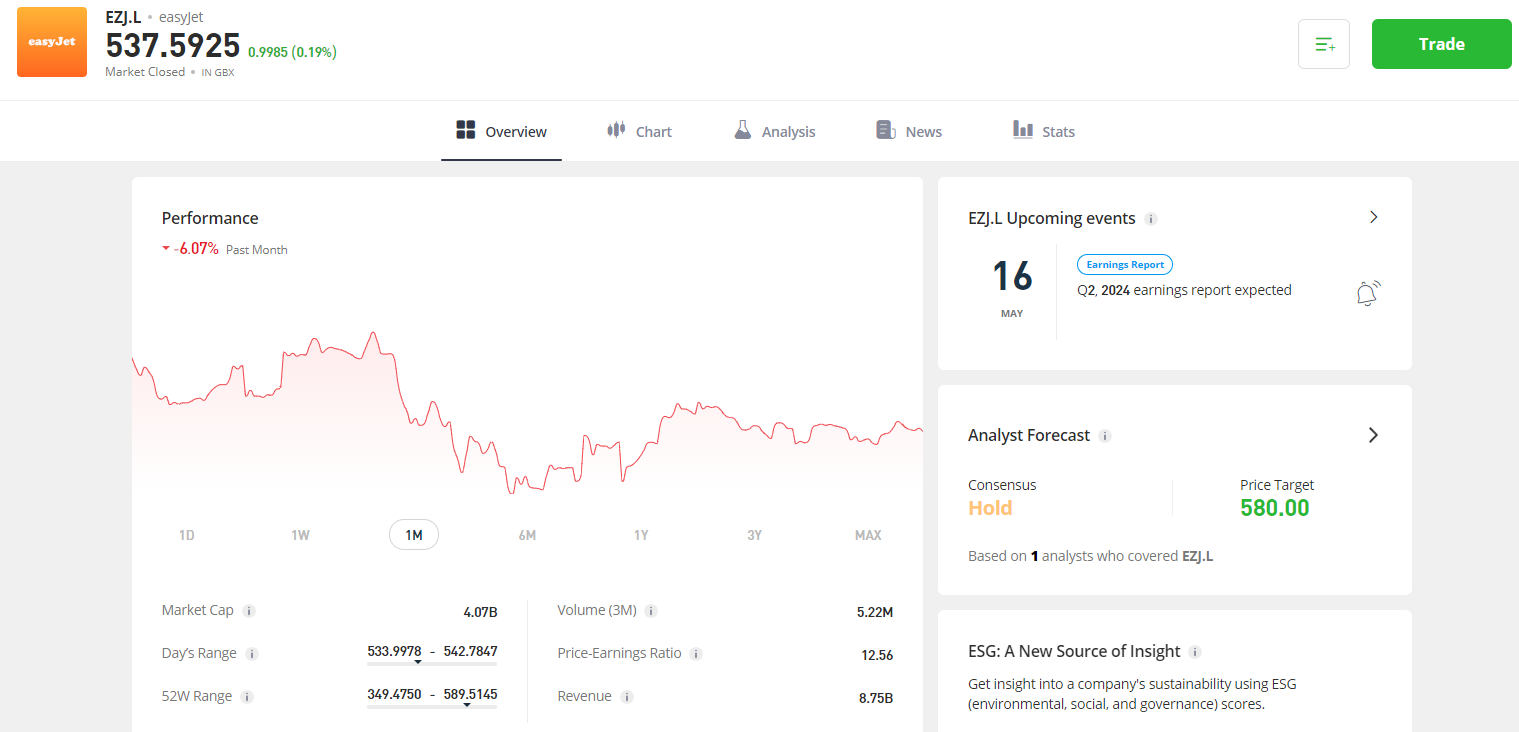
As with all airlines, easyJet has had a tough ride due to the pandemic, with its share price halving in the five years to April 2024. While from then on, things started to look up for the business, the stock has dropped 13% this year.
The slide occurred following a warning by the airline in the summer that a strike by French traffic controllers in June and rising jet fuel costs will result in a £25 million hit to full-year profit.
Otherwise, the company posted healthy financials for the fiscal third quarter ended 30 June.
In a trading update, easyJet said pre-tax profit in the quarter rose 21% year over year to £286 million. Revenue rose 10.9% to £2.92 billion. The airline expects similar revenue trends for the fourth quarter. For the coming quarter, it had 67% of its capacity sold, up 1 percentage point on a year earlier.
Sell-side analysts have a positive outlook on the stock. Out of 20 analysts covering the stock 12 recommends investors ‘buy’ the stock and 7 have a ‘hold’ rating, with one ‘sell’ recommendation. Their average 12-month price estimate is 626.25 pence, representing a 30% upside.
Given the recent drop in the share price, this could be an excellent time to get onboard with easyJet.
Your capital is at risk.
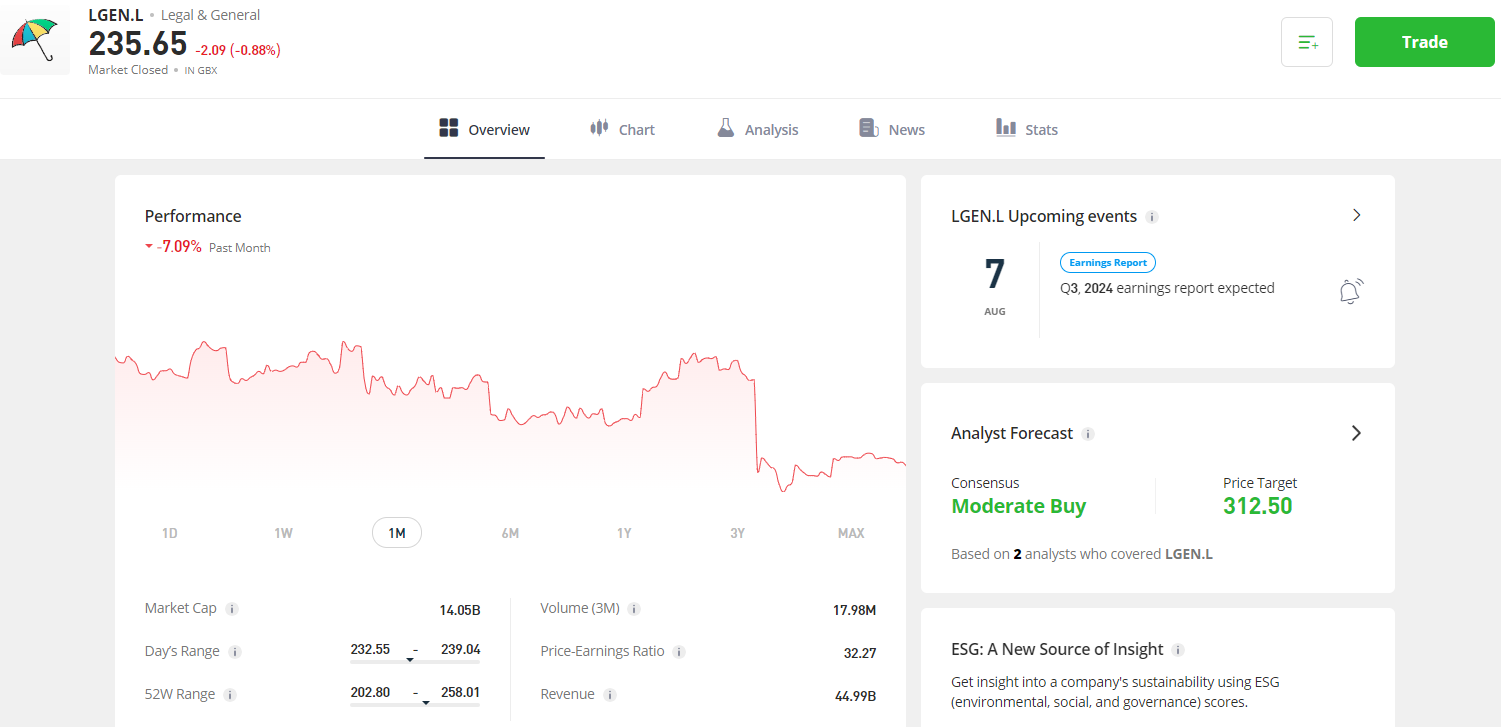
5. Legal & General (LGEN): Steady growth and high dividend yield
Another of the FTSE100’s most popular stocks, financial services firm Legal & General, could be poised to offer investors outstanding value in 2025 and beyond.
The global financial uncertainty of recent years has often proved troublesome for financial services firms, and LGEN has somewhat fallen into this spiral.
Despite enjoying steady share price growth of more than 14% so far this year, the stock has shed more than 3% in a single day on 6 August, dragged down by the reception of its first-half financial results.
Even as core operating profit rose 6% from the same period a year earlier to £859 million, topping analyst estimates, investors were disappointed that the solvency ratio, an indicator of a company’s ability to meet long-term obligations, fell to 217% from 223% a year earlier.
While Legal & General is undergoing an overhaul of its business under CEO Antonio Simoes, who is selling non-core businesses to focus on insurance and asset management, patient investors can find solace in its dividend and share repurchases.
“The outlook for our businesses is positive and we are firmly on track to achieve our financial targets,” Simoes said in a press statement, adding the insurance and asset management firm is on track to return more than £5 billion in dividends and share buybacks to shareholders over three years.
Legal & General has always been one of the leading forces when it comes to dividend payouts, with the rate increasing steadily since the 2008/9 financial crisis. As of 2025, the firm’s dividend yield is currently 8.3%. This set to rise to 9.8% by 2026.
The dividend outlook could make Legal & General one of the top UK dividend stocks to consider now.
Your capital is at risk.
6. Vodafone (VOD): Potentially set for growth after a poor run
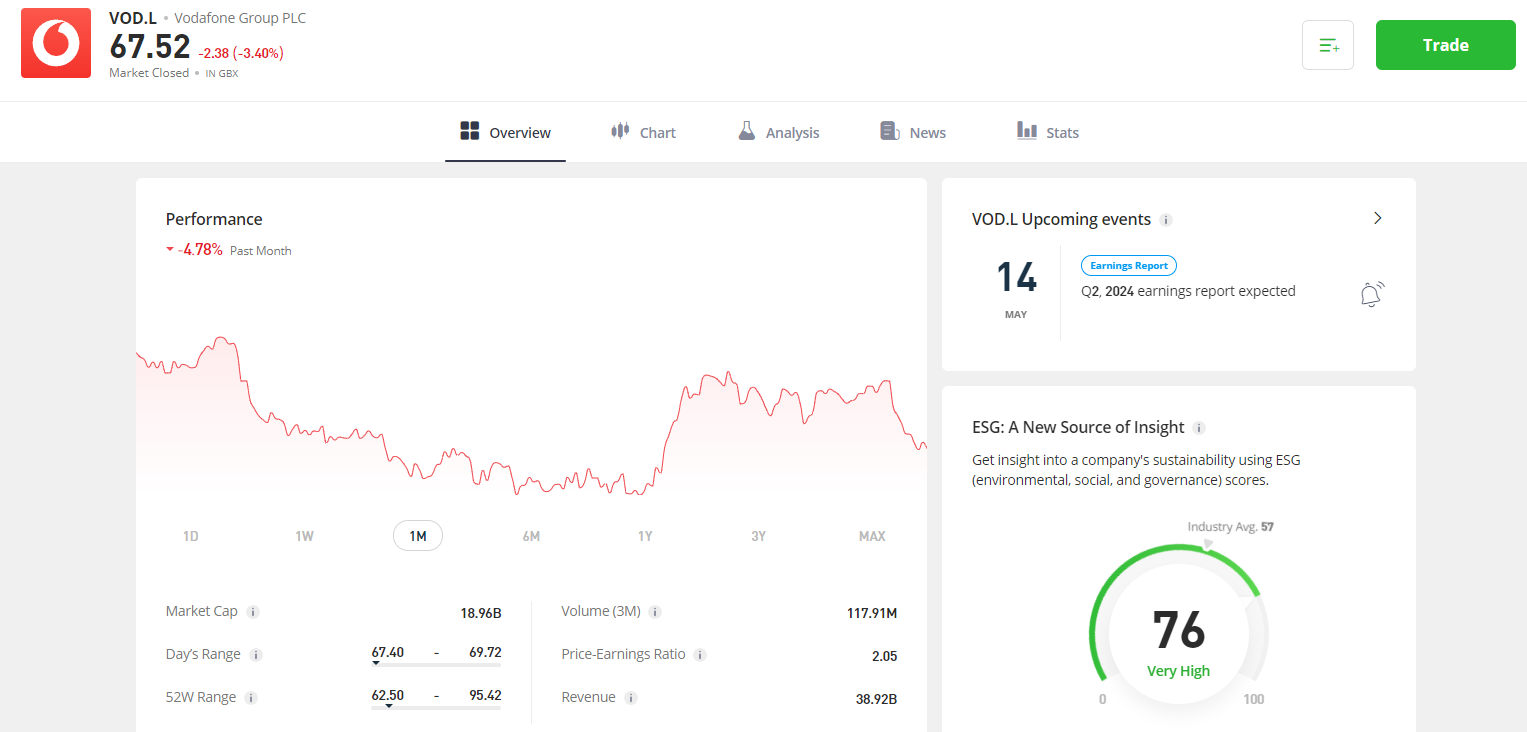
While the telecommunications giant’s value has shrunk by a fifth during the past five years, the share price is recovering. In fact, the stock has its first bullish run since 2022, having gained 26% since the start of this year.
CEO Margherita della Valle, who assumed the post in 2023 is overhauling the business. She closed down the firm’s struggling Italian and Spanish units, with total cash proceeds of around £10 billion.
As part of the transformation, Vodafone completed the merger of its UK business with rival Three UK in a £16.5 billion transaction in May, creating the largest mobile network in the country with more than 28 million customers.
The merger already began to boost revenue and profit in the first quarter of fiscal 2025 ended 30 June. Service revenue rose 5.5% to €7.86 billion, despite further declines in Germany caused by a cable TV law change. The drop in Germany, at 3.9%, narrowed from a 6% decline in the previous quarter.
Adjusted EBITDAal, its preferred profit measure, increased 5.1% on an organic basis, to €2.68 billion in the quarter. Management reiterated its full-year estimate for €11.3 billion to €11.6 billion adjusted EBITDAal.
The company halved its unsustainable dividend in the last fiscal year, and the dividend still yields a respectable 4.4%. The firm also launched a share buyback programme in the first quarter of up to €500 billion.
Taking these factors into account, the future could be bright for Vodafone stock, with a forward price-to-earnings ratio of just about 14, now could be a great opportunity for investors to get ahead of the curve.
Your capital is at risk.
7. Marks and Spencer Group (MKS): Continuing the turnaround even after cyberattack costing £300 million
It’s been a bumpy ride for Marks and Spencer shareholders over the past decade. The stock has enjoyed a series of impressive runs, but ultimately failed to establish sustained growth.
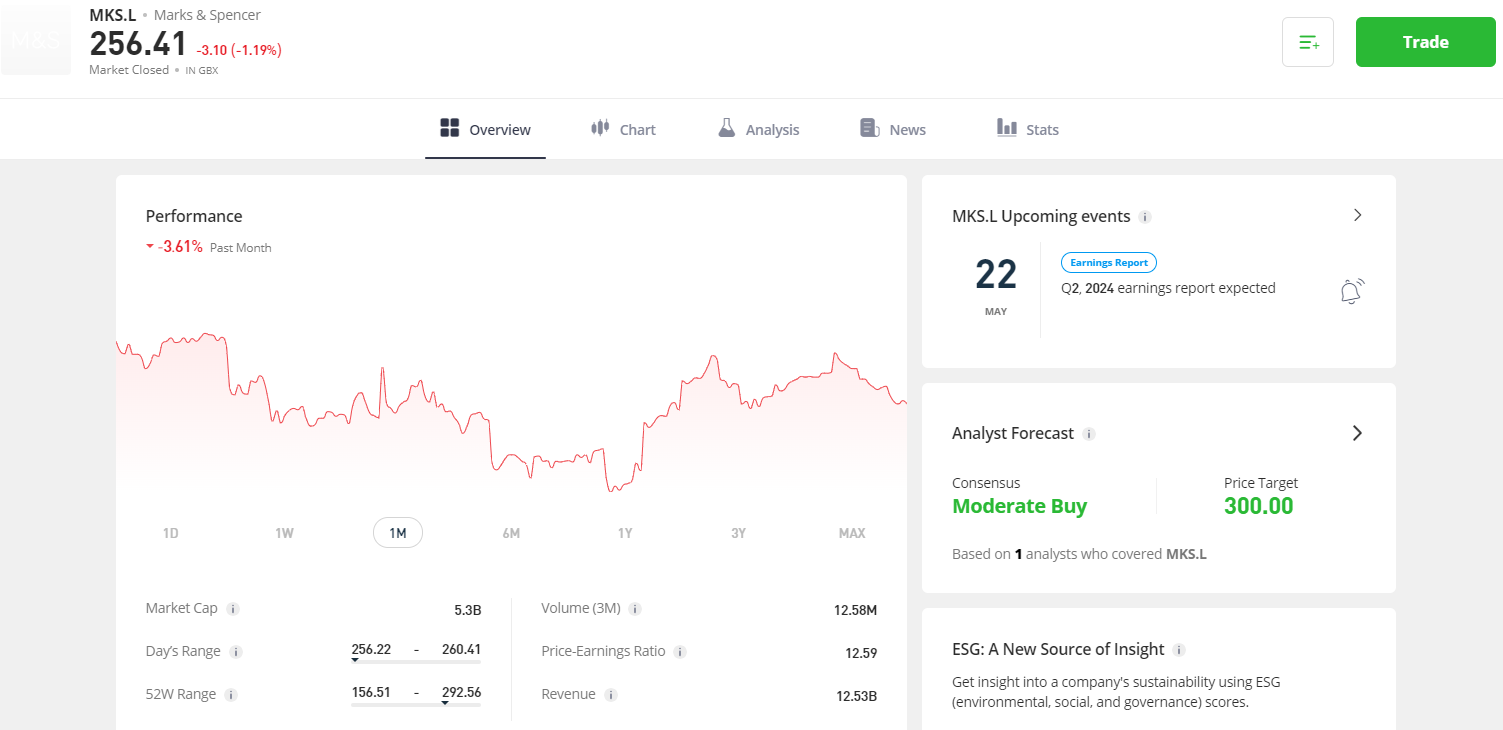
But after hitting close to an all-time low in October 2022, the retailer saw a subsequent run of good fortune, becoming one of the best-performing shares in UK trading.
Owing to strong sales momentum in its grocery and clothing divisions, the company has enjoyed a 277% uptick in value since.
However, even as the stock price hit five-year highs in April this year, the firm suffered a setback, a cyberattack over Easter that left some store shelves empty and halted online sales until well into the summer. The incident almost entirely wiped out its profit in the fiscal first half, which runs through September 27.
The company said it’s aiming to reduce the impact of the attack through cost management and insurance payouts. It has already received a £100 million payout from insurers related to the attack. M&S previously estimated the hack will cost it £300 million in total.
Results for the fiscal first half showed that statutory profit before tax declined 99% from a year earlier to just £3.4 million. Revenue rose 22.5% to £7.94 billion.
Profit before tax and adjusting items fell 55% from a year earlier to £184.1 million. Food sales climbed 7.8% to £4.53 billion and Fashion, Home & Beauty sales declined 16.4% to £1.7 billion.
Turnaround plan on track
Regardless of the cyber incident, the retailer is proceeding with implementing a turnaround plan that began in October 2022 to lure shoppers back amid heightened competition from online retailers and a discounting trend for supermarket food.
Marks & Spencer’s transformation plan targets a further 1% of the UK’s food and grocery market share by 2028, in addition to attaining food operating margins of more than 4%. Over the past year, its market share rose 27 basis points to 3.9%, and food margins were 5.4%, ahead of the target.
Even as profit shrank, shareholders were rewarded with a 20% increase in the interim dividend, to 1.2 pence per share.
Your capital is at risk.
| Stock | Ticker symbol | Market cap | Performance (YTD) |
|---|---|---|---|
| Rolls-Royce Holdings | RR | £95.43 billion | +93% |
| GSK | GSK | £72.04 billion | +30.3% |
| Barclays | BARC | £57.28 billion | +54.1% |
| easyJet | EZJ | £3.68 billion | -12.86% |
| Legal & General Group | LGEN | £13.77 billion | +4.87% |
| Vodafone Group | VOD | £20.67 billion | +25.26% |
| Marks and Spencer Group | MKS | £8.14 billion | +1.62% |
Your capital is at risk.
Best UK stocks to buy by investor type
Whether you’re a beginner, short-term, long-term, or expert investor, there is always a suitable entry point into the world of investing.
But choosing that entry point is easier said than done. In this section we will introduce some of the best stocks to buy in 2024 depending on what type of investor you are.
Best British stocks to buy for beginners
When you’re first starting out in the world of investing, it’s best to opt for more reliable, less volatile, and easier-to-understand stocks. Some useful categories to focus on are dividend-paying stocks, blue-chip stocks (well-known, financially stable market leaders), and growth stocks — all of which are commonly supported by leading UK online stock brokers.
Here are a few examples of UK stocks to watch that meet these parameters in 2024:
- Legal & General Group PLC: Mentioned in our list above, Legal & General is not only a stable and consistent market leader in financial services but is also famed for its generous dividend yields (currently sitting at 9.21%).
- Tesco PLC: While unlikely to make you a millionaire, Tesco is a classic blue-chip stock in that it’s a market-leading firm that consistently performs well. In the past year, for instance, the supermarket chain has added more than 35% to its value.
- Deliveroo PLC: Deliveroo is the definition of a growth stock. While it has no dividend yield, it’s likely to offer a significant return on investment due to its gradual emergence as a significant market player. In the past six months, its stock price has increased by more than a quarter.
Top UK stocks to buy for short-term gains
Put simply, short-term investment strategies are engineered to generate quick, substantial profit. However, picking the right stocks for this kind of strategy can be tricky. Here are some worthy contenders in 2024:
- London Stock Exchange Group PLC: This is one of the best British stocks to watch for short-term growth. It’s share prices is on a significant upward trend in 2024, and its partnership with AI and computing giant Microsoft could spell further promise for the near future.
- Beazley PLC: Insurance group Beazley has been making waves recently, with share prices up by more than 44% so far this year. The stock is also arguably undervalued, currently trading at just 4.82 times its earnings.
- STV Group: Digital media firm STV is another stock enjoying impressive growth of late, and showing the potential for further growth going forward. In addition to increasing its value by nearly a quarter so far this year, the firm is also on track to meet its full-year guidance for profit and revenue.
Top UK stocks to buy for long-term gains
Depending on your risk appetite and financial goals, you may feel more comfortable aiming for slow and steady growth. In this case, you can build wealth by investing just £100 a month.
Here are some stocks that should theoretically align with that kind of strategy:
- AstraZeneca PLC: Pharmaceutical giant AstraZeneca is the definition of a long-term, blue chip stock. Aside from helping to produce the first Covid-19 vaccine, the firm is a solid market leader, and likely to continue its domination for years to come.
- Shell: One of only two major oil firms on the FTSE 100, Shell is another market leader defined by consistent, sustainable growth. The firm also looks to be future-proofing its business by investing heavily in clean energy sources such as solar, wind and biofuels.
- Unilever: With such a strong grip on the UK consumer goods market, Unilever looks poised to maintain its dominance for the foreseeable future. Its brand portfolio includes Knorr, Lipton, Axe, Hellman’s, Dove, and many more. What’s more, things only seem to be improving for the firm, with its share price up 20% in the past year.
How to find the best UK stocks to buy now
The world of investment can be vast and daunting, and knowing how to find the right stocks for you is a big part of this. Here are some key considerations to make finding the best UK stocks more approachable.
Choose the right type of stock
This may sound obvious, but it’s critical that you choose a stock whose track record and prospects align with your personal ambitions and risk profile.
For instance, if you’re wanting to play it safe and see modest gains over a long period of time, a stable, market-leading company is likely to be your best best. Equally, if your strategy is fast and aggressive, a disruptive newcomer such as Deliveroo could be a smarter pick.
Examine the company’s financials
Financial performance is, unsurprisingly, a critical factor in making an investment decision. This encompasses both the company’s track record, and projections for its future.
You can find all the information you need on this by digesting a combination of previous financial reports, and analysts’ predictions for the company’s future.
Keep up with the news
A company’s prospects, and therefore its ROI potential, is largely dictated by wider market and macroeconomic factors.
To this end, it’s critical to stay abreast of a combination of economic news, sector-specific news, and company-specific news. This can allow you to stay ahead of the curve and make smart investment decisions ahead of time.
Our panel spend several hours researching each product, developing a deep understanding of its features, utility, and pros and cons.
While our panel is comprised mostly of seasoned financial experts, some have little to no expertise in the area. This provides us with a wide range of perspectives, ensuring our verdicts are objective.
Here are some basic share investing terms for beginners:
Shares are a unit of ownership in a company. People who buy shares become part-owners in that company, and can choose to sell those shares at any time.
Companies issue shares in order to raise capital for expenditure on areas such as operations and product development.
The exact nature of the shareholder’s position depends on the firm. For instance, some firms allow shareholders to have voting rights, and some allow shareholders to receive regular lump sum dividend payments.
There are generally two main types of company shares that exist. They are:
- Common shares: These typically give shareholders voting rights, and give shareholders the right to receive dividends. Common shareholders also reserve the right to claim a share of the company’s assets if it liquidates.
- Preferred shares: This is the less common type of share. It generally has priority over a common share when it comes to asset distribution and dividends. However, it may not have voting rights, and usually bears a fixed dividend rate.
There are a number of ways in which investors can purchase company shares. They are:
- Direct: Some companies distribute shares directly to the public
- Through a stockbroker: These are licensed professionals who help individuals buy and sell securities as a service.
- Through a brokerage: These are firms that offer investment services, most commonly through online trading platforms.
- Through a robo-advisor: These are automated investment platforms that make investment decisions based on algorithms.
You can profit from the stock market by trading contracts for difference (share CFDs), without owning the actual share.
What are share CFDs?
Share CFDs are financial derivative products that allow you to speculate on stock price movements without actually owning the underlying asset. Instead of buying or selling the actual stock, you enter into a contract with a broker to exchange the difference in the share’s price between the time the contract is opened and when it’s closed.
One of the key benefits is flexibility — you can profit from rising or falling markets. If you expect a stock to rise, you ‘buy’ the share CFD; if you think it will fall, you ‘sell’ it short. Another notable feature is leverage, which lets you control a larger position with a smaller deposit.
This same principle applies when trading, for instance, hydrogen stocks in the UK via CFDs, offering investors exposure to the growing hydrogen sector without needing to own the shares outright.
However, the main risk of trading CFDs is also tied to leverage. While it can increase your profit, it can also amplify losses, potentially exceeding your initial deposit.
Other risks include that the volatility of stock market prices can lead to rapid and substantial losses on your CFD positions. CFDs are meant to be traded over a short time horizon. If you hold your position after the market closes, you will incur an overnight financing fee.
A word of warning: CFDs are complex financial instruments and may not be suitable for traders with limited experience.
The difference between direct shares and share CFDs
The following table summarises the main differences between actual shares and share CFDs.
| Real shares | Share CFDs | |
| Ownership | Ownership rights | No ownership |
| Leverage | You pay the full value of the stock | Generally brokers provide leverage, which allows you to control a larger position than your deposit |
| Going long/short | Short selling (profiting from falling prices) is not typically available | You can bet on rising (long position) or falling prices (short position) |
| Dividends/Voting rights | Owning shares entitles you to vote at shareholder meeting; You will receive dividends when paid | No voting rights or dividends |
| Capital requirement | You need to cover the full price of the shares you are buying | You can start trading with a small initial deposit, due to leverage |
| Investor focus | Long term investment; wealth creation | Short term gain from price fluctuations |

How We Rate Stocks
We review each stock that is selected. Below are the key metrics we check before listing stocks on the website. For further details, you can also take a look at our stocks rating guide, featured on ValueWalk.
Balance sheet
Potential Growth
Competitiveness
Liquidity
FP Markets is currently the best platform for buying UK stocks. It’s a popular online trading broker that offers trading for more than 10,000 instruments, including UK stocks and ETFs.
Founded in 2005, the company has licenses from the top regulators, including ASIC and CySEC. The platform has a relatively competitive fee structure, with just a 0.1% commission per side on UK stocks and a minimum charge of 2 GBP.
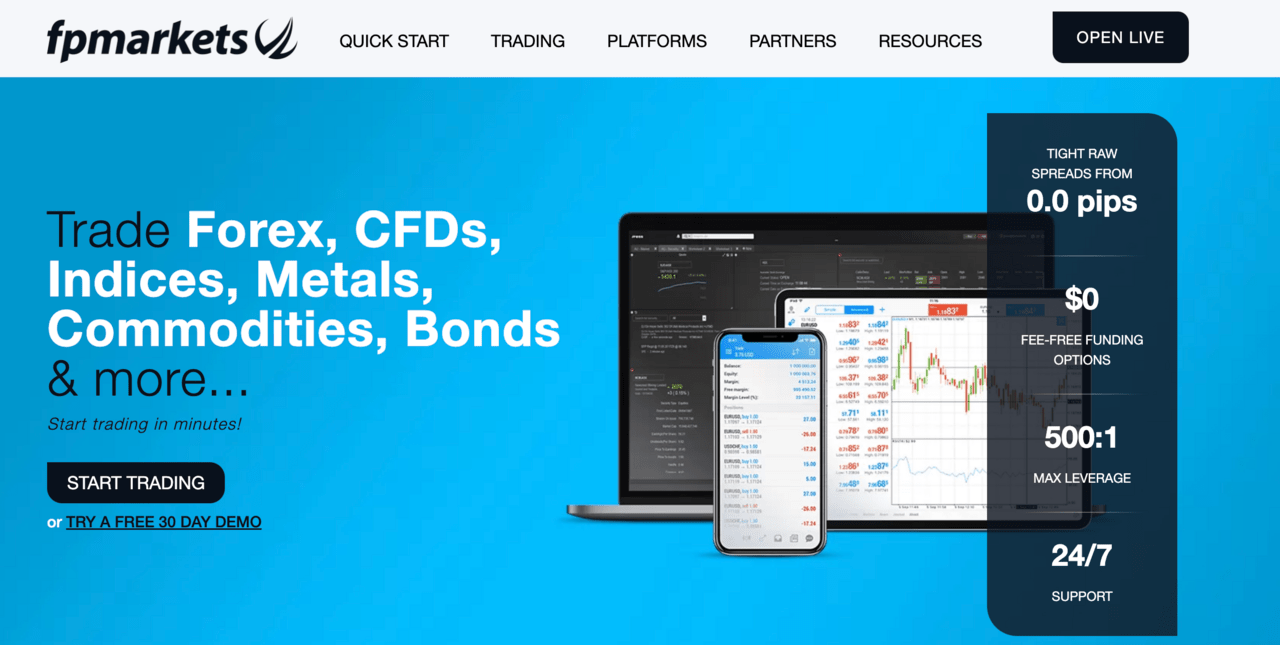
FP Markets also provides various platforms, including MetaTrader 4, MetaTrader 5, cTrader, Iress, and TradingView. You’ll find a good match on these platforms if you like algorithmic strategies, advanced charting, or social trading— features that appeal to those exploring, for instance UK penny stocks.
The broker offers free webinars, eBooks, and trading guides to help users stay updated and understand trading risks. You can also get 24/7 multilingual customer support with quick response times.
Best UK stocks FAQs
What are the safest stocks to invest in UK?
What is a hot UK stock right now?
Which stock is good to buy right now?
What are the top dividend stocks in the UK in 2025?
What to invest $1,000 in right now?
What stock has the highest buy rating right now?
Is the UK stock market good to invest in?
References
https://www.hl.co.uk/shares/stock-market-summary/ftse-100/top-volume
https://www.etoro.com/trading/markets/
https://uk.marketscreener.com/quote/stock/ROLLS-ROYCE-HOLDINGS-PLC-4004084/calendar/
https://www.investorschronicle.co.uk/content/ee55156c-642a-54e4-a25c-ee3516cd2d85
Disclaimers:
eToro is a multi-asset platform which offers both investing in stocks and cryptoassets, as well as trading CFDs.
Please note that CFDs are complex instruments and come with a high risk of losing money rapidly due to leverage. 51% of retail investor accounts lose money when trading CFDs with this provider. You should consider whether you understand how CFDs work, and whether you can afford to take the high risk of losing your money.
This communication is intended for information and educational purposes only and should not be considered investment advice or investment recommendation. Past performance is not an indication of future results.
Copy Trading does not amount to investment advice. The value of your investments may go up or down. Your capital is at risk.
Don’t invest unless you’re prepared to lose all the money you invest. This is a high-risk investment and you should not expect to be protected if something goes wrong. Take 2 mins to learn more
eToro USA LLC does not offer CFDs and makes no representation and assumes no liability as to the accuracy or completeness of the content of this publication, which has been prepared by our partner utilizing publicly available non-entity specific information about eToro.