


Decentralized Finance (DeFi) is a concept that has emerged in the cryptocurrency market. It is when traditional financial services are provided through smart contracts that anyone can engage with. DeFi uses blockchain technology to let anyone lend, borrow, trade, and earn interest—without needing approval from a central authority.
What is Decentralized Finance (DeFi)?
Decentralized Finance (DeFi) is a financial system that runs on blockchain technology, removing banks and other middlemen from transactions.
DeFi automates financial agreements using smart contracts and self-executing code. Users are unrestricted by their geographic locations. Anyone with an internet connection and a crypto wallet can use DeFi.
Individuals without bank accounts, often in distanced locations in Africa, can consider DeFi instead.
These services are facilitated by DeFi applications (called dApps), which handle financial operations and transactions within blockchains without an intermediary and even take out loans using their crypto as collateral.
How DeFi Works in Crypto
DeFi replaces banks and middlemen with smart contracts—self-executing code on a blockchain built and maintained by developers to automate financial transactions. Instead, users transact with each other.
You interact directly with decentralized systems instead of relying on institutions to approve loans, hold savings, or process payments.
These platforms let you lend, borrow, trade, earn interest, speculate on asset prices, and even insure against risks, all without needing permission from a bank or financial authority.
Everything happens on public blockchains, meaning transactions are transparent and accessible to anyone. You control your funds at all times, but that also means you’re responsible for security and risk.
What is a decentralized exchange (DEX) in crypto?
A decentralized exchange (DEX) allows you to trade cryptocurrencies without a middleman. Instead of a company holding your funds and processing trades, smart contracts handle everything on a blockchain.
DEXs use liquidity pools. These are pools of crypto that users deposit to enable trading. When you swap tokens, you’re not matching with another trader—you’re exchanging with the pool. This system ensures there’s always liquidity, meaning you can trade whenever you want.
In return for supplying crypto to these pools, users (called liquidity providers) earn a share of the trading fees.
Intent-based DEXs (gasless, MEV-aware execution)
“Intents” flip the flow: you sign what you want, and solver networks compete to fill it at the best price—often gasless for the user—with MEV protection via batch auctions. UniswapX and CoW Protocol lead here. It feels simpler than routing your own swaps and reduces surprise slippage.
Fees & scaling (2024–2025)
Rollups got dramatically cheaper after Ethereum’s 2024 EIP-4844 (“blobs”), so most activity belongs on L2s. Modular data availability (e.g., Celestia, EigenDA) pushes costs down further, and shared sequencers aim to improve fairness and liveness across L2s. For most users: start on a major L2, keep mainnet for big moves.
DeFi applications, protocols, and uses
There are thousands of DeFi apps you can start using today. Below are the most popular DeFi uses in today’s markets.
Staking
The simplest form of DeFi is staking. Your tokens are used to validate the network (cryptocurrencies that allow staking are Ethereum, Solana, and, most recently, Algorand) or locked in exchange for rewards, usually in the form of APY.
New in 2025: BTC can be economically staked (non-custodially) to secure PoS chains via protocols like Babylon. This creates a BTC-native yield lane with different risks than lending or wrapping. Treat it as advanced and size small until liquidity and slashing economics mature.
Lending protocols
Let’s say you buy Bitcoin. Rather than keeping it in your wallet, you can lend Bitcoin in DeFi protocols and earn interest on your digital holdings. If Bitcoin is too volatile for you, there are stablecoins, digital assets that are pegged to the US dollar (1 stablecoin is worth $1), and those assets can be used for lending in DeFi applications.
Liquidity pools
Providing liquidity to DEXs allows you to earn a share of the fees and often includes a passive yield in the form of APY/APR. There are many DEXs to choose from. For ETH, Uniswap is the most popular DEX. For BNB Smart Chain, PancakeSwap is in the lead.
Prediction markets
Prediction markets are becoming very popular in 2025. Platforms like Polymarket let users bet on real-world events with blockchain-verified transparency, allowing traders to profit from correctly predicting political, sports, and finance outcomes. Being a liquidity provider in a prediction market earns you a share of the fees for every buy and sell transaction.
Liquid staking and restaking
For advanced users, there are DeFi platforms that offer the ability to boost your earnings further. Liquid staking lets you earn staking rewards while keeping a liquid token you can deploy in DeFi.
Restaking extends that token to secure additional services (AVSs) for extra yield, but stacks protocol and depeg risk, so size positions conservatively. Learn more about liquid staking and restaking.
Liquid Restaking Tokens (LRTs): LRTs (e.g., eETH, ezETH, rsETH) wrap restaking into a liquid token you can hold, swap, or deploy in DeFi. They compound yield sources, but also compound risks: restaking protocol risk, AVS risk, and potential depegs. Understand unwinding mechanics and redemption paths before you chase APR.
DeFi vaults
If managing your DeFi investments is a struggle, DeFi vaults may be an optimal solution. Depositing your crypto into vaults that diversify DeFi strategies may be ‘easier’ to manage than doing all the work on your own.
Morpho Vaults are a great example. A vault can be focused on lending against liquid staking tokens (LSTs) where exposure is contained to specific LSTs collateral assets (as opposed to traditional lending platforms). Choose your vault based on your risk appetite and expected returns.
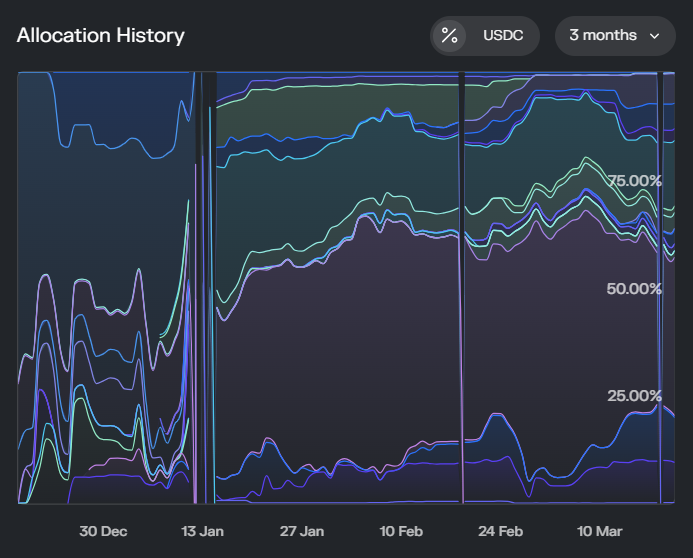
MEV Capital Usual USDC is an example. The vault has over $230M deposits (USDC) with a projected 17.67%. Bear in mind that there are performance fees (which could differ) from vault to vault.
Benefits of Decentralized Finance
1. With DeFi, you hold your funds in your own wallet. There’s no bank freezing your account, setting withdrawal limits, or blocking transactions—you’re in complete control.
2. Traditional banks require proof of identity, credit history, or residency. DeFi removes these barriers, allowing anyone with an internet connection and crypto wallet to access financial services – without waiting for approval or processing delays
3. All transactions are recorded on public blockchains. You can verify trades and loan agreements, reducing fraud and hidden fees. It also offers global reach, bypassing the hassles of currency exchange, banking hours, and international limitations.
4. Smart contracts allow complex financial operations—like automated loans, instant settlements, and dynamic interest rates—without human intervention, making transactions more efficient and cost-effective.
5. Lending doesn’t rely on traditional credit scores. Instead, users provide crypto as collateral, enabling anyone to access loans without proving income or creditworthiness.
Risks of Decentralized Finance
1. DeFi operates without legal safeguards. If a transaction goes wrong, there’s no customer support, refunds, or legal recourse. Scammers and anonymous parties can vanish with funds, making recovery nearly impossible.
2. Losing your private key means permanently losing access to your funds. DeFi transactions can’t be reversed, so sending crypto to the wrong address results in permanent loss with no recovery options.
3. Many DeFi platforms claim full transparency but rely on vulnerable code. Hacks, rug pulls, and misleading investment schemes have led to billions in losses, especially for users who fail to research projects properly.
How to start with DeFi
Getting started with DeFi is simple. You only need a crypto wallet, some funds, and access to a DeFi application. Here’s a step-by-step guide:
1. Set up a DeFi wallet
A DeFi wallet is a digital wallet that lets you store, send, and interact with decentralized apps (dApps). Unlike traditional wallets, you control the private keys, meaning no bank or company can access your funds.
Popular wallet types include browser extensions and mobile apps. When setting up, you’ll receive a recovery phrase. Write it down and keep it safe. If you lose it, you lose access to your funds.
Smart accounts (account abstraction)
Smart wallets now support passkey login, social recovery, batched actions, and sponsored gas (paymasters). On leading L2s, this lets you sign fewer transactions and sometimes pay no gas at all. Prefer audited, battle-tested stacks; enable 2FA/passkeys and set spending limits where available.
2. Add crypto to your wallet
To use DeFi, you’ll need cryptocurrency. Get crypto from an exchange and send it to your wallet—here are some of our best DeFi coins. Some wallets also let you swap tokens directly within the app. Always double-check addresses before sending funds, as transactions cannot be reversed.
3. Start using DeFi apps
Each platform has different rules, so always review the details before committing funds.
Is DeFi safe?
DeFi removes banks and middlemen, but that also means there’s no safety net. Security depends on smart contracts, which execute transactions automatically. If a contract has a flaw, hackers can exploit it.
One of the biggest DeFi hacks was the Ronin Bridge attack (2022), in which hackers stole over $610 million by exploiting a weak security setup. Another was the Poly Network hack (2021), in which $600 million was drained, though most funds were later returned.
Despite these risks, DeFi has security advantages.
Self-custody wallets mean no bank failures or account freezes. Blockchain transparency allows users to verify transactions, and several protocols now use insurance funds or third-party audits to enhance trust.
Cross-chain safety
Bridges remain a major risk. If you must move assets, use well-audited routers with active monitoring and rate limits, or institutional rails (e.g., CCIP integrations) where supported. Prefer native L2 exits over third-party shortcuts. Test with small amounts first; verify the destination token contract.
Live threat defenses
Protocols increasingly use real-time monitoring and pre-execution checks to stop exploits earlier.
Users still need basics: revoke stale approvals, avoid blind signing, pin known-good frontends, and prefer hardware wallets for size. Before interacting, scan contracts and check recent audits and incidents.
How much money do you need to start with DeFi?
There’s no fixed amount required to start using DeFi. Some platforms let you begin with as little as $1, while others require hundreds due to network fees and minimum deposit rules. On major L2s, typical swap fees now cost cents after 2024 upgrades; pick an L2 to stretch small starting balances.
Some DeFi strategies require more capital. For example, staking might need a minimum deposit, and yield farming often works better with larger amounts to offset fees. However, lending and borrowing platforms allow flexible deposits, making them accessible to smaller investors.
Starting small is a smart approach. It lets you learn without risking too much. If you only have $50-$100, focus on low-fee networks and simple strategies like lending or staking. If you have more, explore yield farming and liquidity pools.
DeFi is open to all budgets, but transaction costs and risks make it important to start with an amount you’re comfortable experimenting with.
Summary
DeFi is transforming the financial landscape by giving users complete control over their funds eliminating the need for traditional intermediaries. It opens up new opportunities to earn, invest, and interact with digital assets through trading, lending, staking, and prediction markets.
However, the space isn’t without challenges. Hacks and market volatility remain real risks; fees on leading L2s are now typically low, but always check live network costs before you transact. That said, informed users who take the time to research can minimize these risks and fully leverage the advantages DeFi offers including exploring the best DeFi 2.0 coins, which are designed to address the shortcomings of earlier protocols.
According to combined reports from Mordor Intelligence and Statista, the DeFi industry is projected to reach a valuation of $80 billion and attract between 40 and 50 million users by 2030 as developers work to enhance security and reduce costs. As DeFi expands, it could become a mainstream alternative to traditional banking.

How We Rate Cryptocurrency Wallets
We manually review the cryptocurrency wallets on our list. Below are the key metrics we check before cryptocurrency wallets on the website. For further details, you can also take a look at our crypto wallets rating guide, featured on ValueWalk.