


Launched in 2020, Arkham Intelligence is a blockchain analytics platform designed to unmask wallet owners and precisely trace on-chain activity. Its core feature sets it apart: linking real-world identities to blockchain addresses — a step most other tools avoid.
Branded as a provider of “on-chain intelligence,” Arkham offers powerful insights but raises serious concerns over user privacy and the platform is gaining traction among law enforcement agencies and regulators. Its tools have already been used to track down ransomware groups, uncover fraud networks, and investigate crypto hacks.
What is Arkham Intelligence?
Arkham Intelligence is a crypto analytics platform founded by Miguel Morel, a former crypto researcher and entrepreneur, that turns public blockchain data into readable insights. It maps crypto addresses to labeled entities, helping you see which exchanges, funds, or services interact with a wallet. Arkham Intel combines data across multiple chains and groups related wallets to simplify tracking. The aim is to make on-chain activity easier to understand for beginners and professionals.
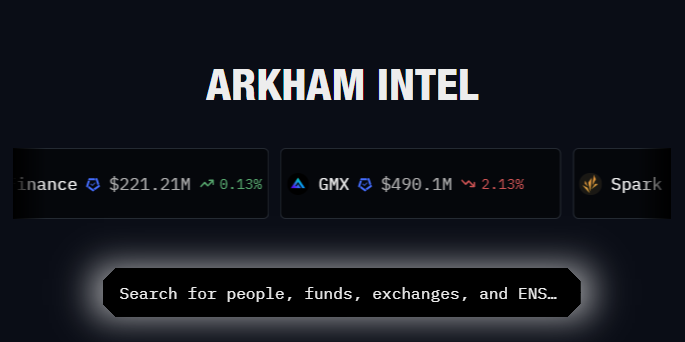
At a high level, the platform uses data labeling and automated analysis to organize wallets, balances, and transaction flows. You get straightforward dashboards with graphs, entity pages, and search so you can look up addresses or names. This makes it easier to spot large moves by investigating whale wallets, following funds, or reviewing a wallet’s history without decoding block explorers. In short, Arkham Intelligence is a user-friendly blockchain analytics layer that shows labeled activity and major movements at a glance.
What is Arkham Intelligence used for?
Arkham Intelligence helps you figure out who’s behind crypto activity on the blockchain. You can use it to track wallets linked to individuals, companies, trading firms, or even scammers. Arkham gives you that visibility if you’re trying to understand where funds are moving during major events, like crypto exchange hacks or large trades.
Traders use it to monitor whales or rivals, akin to social trading platforms that let you mirror others’ strategies. Researchers use it to spot suspicious behavior or follow money trails. Journalists use it to support crypto investigations with wallet-level evidence, etc. It’s also helpful for compliance teams and analysts who want to trace connections between wallets or verify the origin of funds.
Everything is built around making blockchain data human-readable. (You see names, not just wallet strings.) In summary, whether chasing trends or doing due diligence, Arkham makes blockchain intelligence feel more like reading a report than decoding raw data.
The Arkham Intel Exchange
The Arkham Intel Exchange is a marketplace where people buy and sell blockchain intelligence. Here’s how it works: someone posts a bounty asking for info about a wallet, like who owns it or how it’s connected to others. Anyone can respond with research. If the answer checks out, they get paid in crypto.
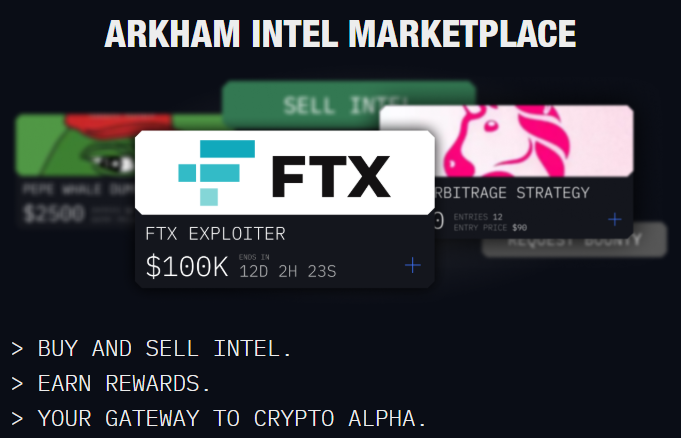
This flips the script. Instead of a closed investigation team, Arkham lets the public take part. You can earn by solving real blockchain cases. Each bounty has a deadline and payout amount, and Arkham verifies submissions before rewarding them. It’s all visible on the platform.
You can also sell your own intelligence without waiting for a bounty. If you’ve researched a wallet cluster or found wallet links that no one’s noticed yet, you can list them for sale. The Intel Exchange turns blockchain research into a competitive and rewarding space for anyone willing to dig.
Core features of the Arkham Intelligence platform
| Feature | Description |
| Insights | AI-driven, real-time summaries of on-chain and market events, whale movements, funding shifts, sentiment for actionable, precise trading signals |
| Intel-to-Earn | Core to Arkham’s value proposition, users get paid in ARKM to produce blockchain intelligence. This system turns research into a monetizable asset. |
| Arkham Filters | Enables efficient sorting of transactions by key metrics like time, token, value, and counterparty. Users can zero in on relevant blockchain activity without manual sifting. |
| Profiler | Provides real-time visibility into an entity’s blockchain behavior through specialized Units. It’s the command center for wallet-level intelligence and investigation. |
| Portfolio Unit | Offers a full-spectrum view of an entity’s financial footprint. Users can track current and historical holdings, analyze profit and loss over time, identify key counterparties, and monitor a live transaction feed |
| Visualizer | Transforms blockchain data into a network graph. Each node is an entity, and transaction links reveal relationships and flows. Users can apply filters to tailor the network |
| Bounties | Buyers post ARKM-backed requests for intelligence. Contributors stake ARKM to participate, get paid upon approval, and face penalties for low-quality submissions, keeping the system spam-resistant |
| Auctions | Sellers list intelligence with a minimum bid and price in the Arkham Intelligence marketplace. Verified by Arkham, these auctions offer structured and fair value exchange, with anti-spam mechanisms similar to bounties |
| DATA Program | Contributors submit raw intelligence (like entity labels or urgent cases) directly for ARKM rewards. Submissions are reviewed and priced based on predefined tiers—no bidding or competition needed. |
| Bitcoin clusters and AI prediction tab | Bitcoin clusters group addresses by likely owner to make tracking easier, and the AI Prediction tab proposes owners with confidence scores for you to verify. |
Arkham Insights
Arkham Insights delivers a clear market overview the moment a catalyst emerges. It taps into the world’s largest public on-chain database alongside exchange, macro, sentiment, and news sources.
AI monitors on-chain and off-chain feeds to identify whale movements, notable transactions, changes in open interest, funding rates, sentiment shifts, breaking headlines, and more.

An AI-generated insight summarizes each event, highlighting key metrics and explaining immediate impacts. It also flags hack-related incidents, noting the timing and shifts in funding rates or large transfers surrounding the breach.
You gain actionable intelligence instead of raw noise. And the feature presents insights in a user-friendly terminal designed for rapid decision-making. You can also spot patterns in perpetual data and act on whale flows before they trigger broader market moves, and clear summaries guide you through complex events.

This newly-launched feature provides you with precise, timely signals to trade with confidence and stay ahead of the crowd, along with alerts. Now, users can focus on the trends that truly matter.
Bitcoin clusters and AI prediction tab
Bitcoin clusters are groups of BTC addresses that likely belong to the same owner. The platform builds these groups by spotting patterns, such as addresses used together in a single spend or that move funds in lockstep. You see the cluster’s combined balance, recent transfers, and links to known services like exchanges. That view helps you follow large holders, track exchange wallets, and spot unusual activity without checking each address one by one.
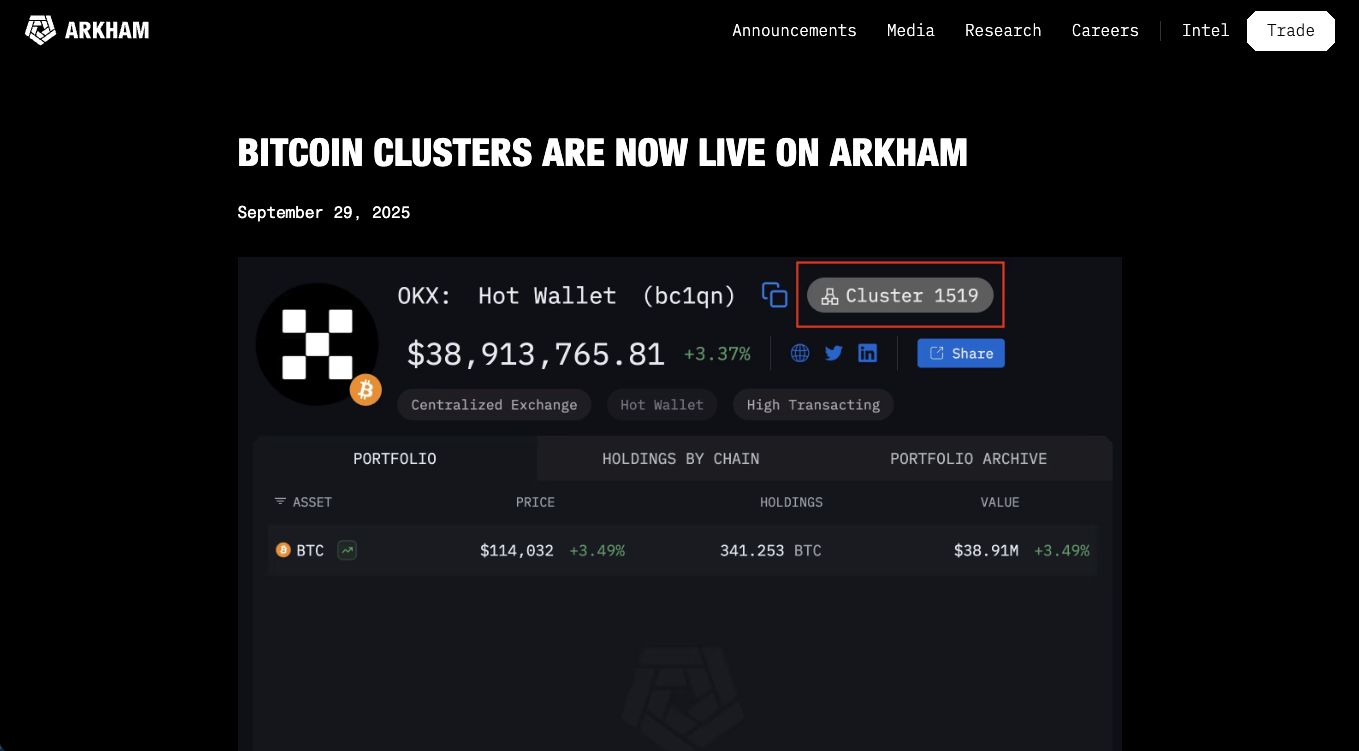
The AI prediction tab suggests possible labels for unlabeled wallets and clusters. It shows a proposed owner, a confidence score, and the reasons behind the guess so you can judge it yourself. You treat these as leads, not final answers, and compare them with on-chain evidence shown on the page. And when the data changes, the predictions can update, giving you a fresh starting point for further review.
Arkham Tracer
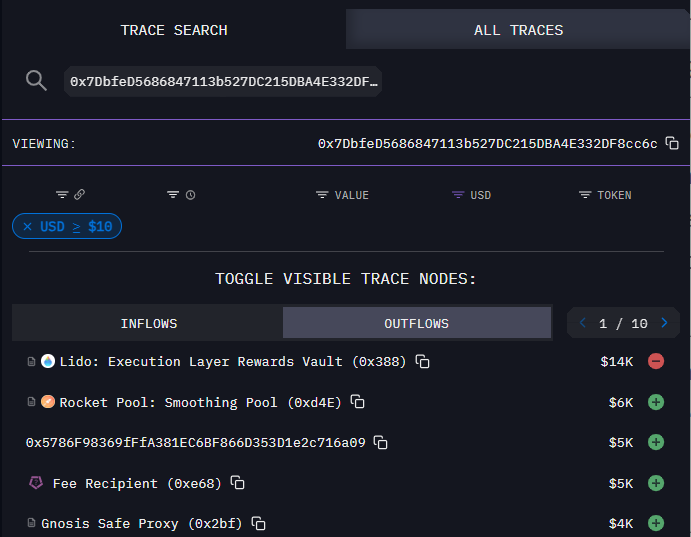
Another useful feature is the ‘tracer.’ This tool allows you to navigate the wallet address’s inflows and outflows easily. For the test, I picked a random wallet address from the latest transactions on Etherscan. These were the results from Arkham tracer:
The $ARKM Token
The $ARKM token is Arkham’s native currency for payments and rewards on the platform. You use ARKM to post bounties for wallet attribution and to pay for on-chain intelligence, and analysts earn ARKM when accepted submissions solve those requests. And most Intel Exchange deals settle in ARKM, so value circulates within one economy. This ERC-20 token still works like any other crypto asset, so you can move it to and from your own wallet without friction. That loop, pay with ARKM, deliver intel, receive ARKM, keeps incentives tight and the marketplace straightforward for beginners.
$ARKM rewards and discounts
ARKM rewards let you earn tokens for helpful contributions on Arkham, and ARKM discounts reduce what you pay to trade. You can receive ARKM for actions like submitting accepted intelligence or other community-building work, with eligible tasks changing over time. Paying your trading fees in ARKM gives you a 25% discount at checkout. And holding ARKM can unlock deeper reductions, up to 100%, measured by your minimum 30-day balance. You can then use earned ARKM to cover future fees or to post or claim bounties on the Intel Exchange, which keeps your costs down as you keep contributing.
How to use Arkham Intelligence
Even if you’re just getting into crypto and trying out the space, using the Arkham Intelligence platform is simple. All you’d need to get started is a wallet address or a transaction hash (a unique string identifying a specific crypto transfer). From here, you can have the research bit done, and Arkham will help you understand what’s happening behind the scenes. Arkham supports several blockchains, including Ethereum, BNB Chain, Bitcoin, Avalanche, and Polygon.
Step 1: Find an address or transaction ID
Get the wallet or transaction ID you want to analyze. You can copy it from a block explorer or a message someone sent you.
Step 2: Paste it into Arkham Intel
Go to intel.arkm.com and paste it into the search bar. Hit enter and wait a few seconds for the results to load.
Step 3: Explore the on-chain activity
Arkham will break down the wallet’s balance, past transactions, and token holdings. You’ll also see any labels, links to other wallets, and an activity timeline.
To access more features, register for free with your email address. You don’t need to create an account just to look around; signing up gives access to deeper features like alerts and wallet watchlists.
Whether you’re checking out a project team’s wallet, reviewing an NFT trader’s moves, or trying to spot red flags before buying into a token, you’ll get a clear picture fast.
Arkham doesn’t just show raw numbers. It organizes everything into charts, summaries, and visual links so you can quickly understand what’s happening.
Entities and influencers can be searched on Arkham Intel
Arkham allows users to search and track individuals, companies, institutions, and wallets across major blockchains, or track whales or review movements around major events (for instance, markets driven by voting or forecasts on Polymarket). Users can search by name, tag, or wallet address to uncover holdings, transactions, and connections.
As of March 2025, crypto influencers (under ‘Key Opinion Leader,’ KOL) are being indexed in addition to public figures like Donald Trump. Over 900 KOLs were discovered and tracked on Arakham Intel. Dingaling (known as Dinghua Xiao), who has over 200,000 followers on X, has his crypto portfolio open to the public on Arkham Intelligence.
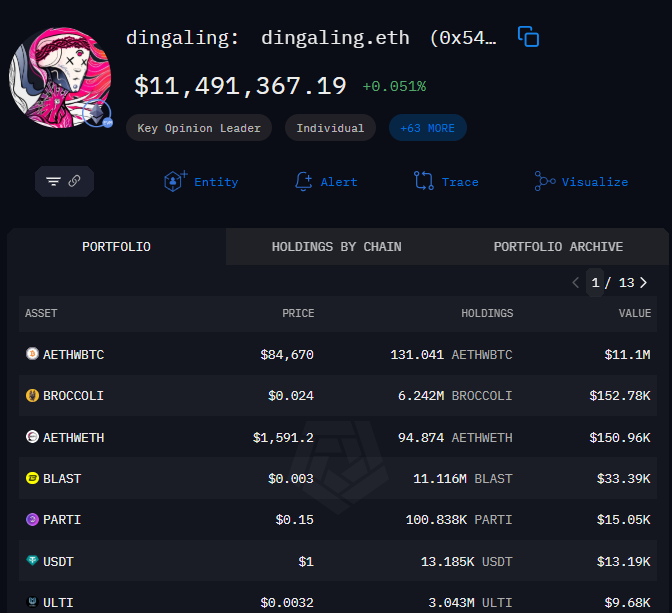
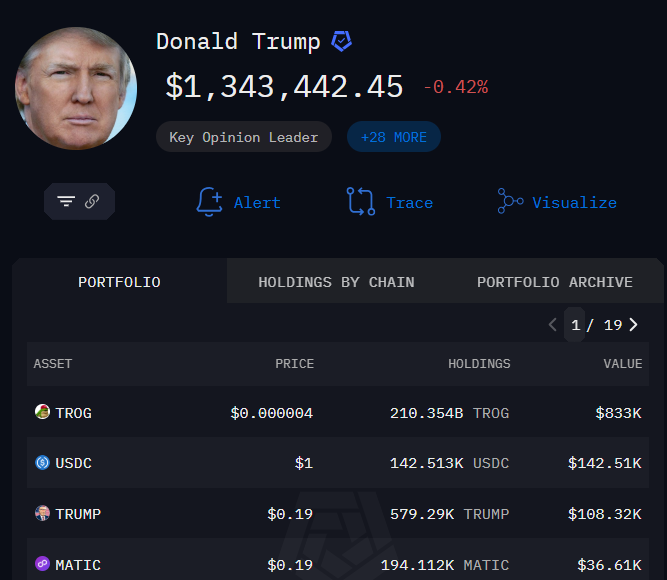
Besides the crypto holdings, current and historic transactions are documented and available to all. The tool now goes beyond anonymous wallets, turning blockchain data into searchable identities. For example, it uncovered $108 billion in BTC linked to Satoshi Nakamoto.
Using forensic tools, the platform traced the holdings to the creator’s earliest wallets, revealing the scale of the dormant fortune. If you’re tracking a hedge fund, a YouTuber, or a DAO treasury, Arkham makes on-chain behavior searchable and public.
Arkham Intelligence Telegram app
Arkham Telegram mini app was launched in 2025. Rather than being restricted to desktops, Telegram users can access the Intel exchange from the app. Alerts can be created, automated notifications can be sent, addresses can be tracked, and other features.
Arkham Intelligence Bounties explained
Arkham’s Intel Exchange is a decentralized marketplace where users can post bounties in ARKM tokens to request specific on-chain intelligence. Researchers compete to solve these bounties by submitting verified blockchain analyses. The first valid submission earns the reward, and the data remains exclusive to the buyer for 90 days.
A notable example occurred in February 2025, when Bybit offered a 50,000 ARKM bounty to identify the perpetrators of its $1.4 billion hack. On-chain analyst ZachXBT provided conclusive evidence linking the attack to North Korea’s Lazarus Group, including detailed analyses of test transactions, connected wallets, and forensic graphs. His findings were shared with Bybit to aid their investigation.
How to find and submit bounties on Arkham Intel
To find active bounties, browse the Arkham Intel Exchange under ‘More’ in the top menu.
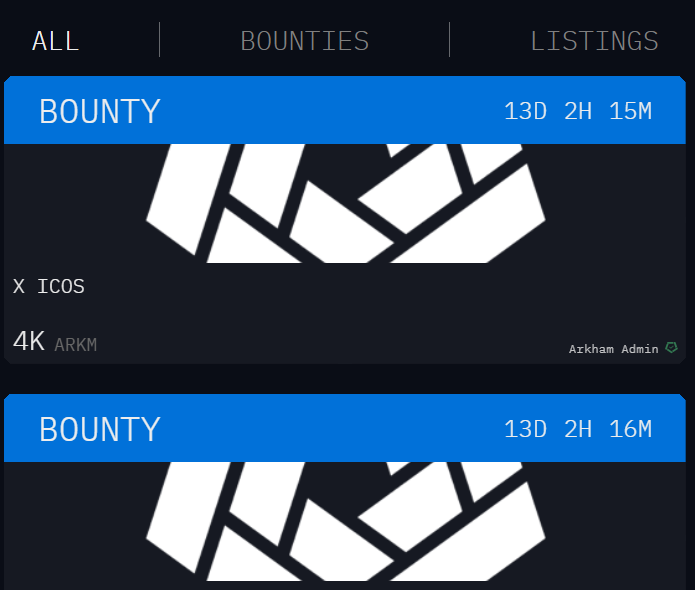
You’ll need an Arkham account and ARKM tokens to submit a bounty. Click “Post Bounty,” describe what intel you’re looking for, set your reward, and define your criteria.
Once your bounty goes live, researchers can begin submitting reports. If someone delivers a verified answer that meets your criteria, they get paid, and the bounty closes. You can also choose whether to make the findings public or keep them private.
How to claim the bounty
Once you’ve completed your investigation, claiming a bounty on Arkham is straightforward, as described in the Arkam Codex. Here’s how it works:
- You need a verified profile to submit bounty responses.
- Click on the bounty you’re solving to read the requirements and criteria in full.
- Upload your findings directly to the bounty page. Include wallet addresses, proof of connections, graphs, or relevant transaction data.
- The bounty creator will review all submissions and pick the first valid one that meets the criteria.
- If your report is selected, the ARKM reward is sent to your account automatically.
- Successful claims also boost your researcher profile.
How reliable is Arkham Intelligence?
Arkham Intelligence pulls data directly from public blockchains, then uses machine learning to group and label wallets. That means the raw data is mostly accurate, but labeling can depend on user submissions and AI predictions.
Some labels come from verified sources. Others are user-generated and marked as “community tags.” You can see the source of each label, so it’s clear what’s verified and what’s not. Some users have also raised reliability concerns, but the platform doesn’t guarantee 100% accuracy and provides some tools to verify the integrity of the information.
For instance, you can cross-reference wallet activity, follow transaction history, and see connected addresses. It’s reliable if you treat it as a starting point, not the final word. The more you engage with the data, the more valuable and trustworthy it becomes.
Summary
Arkham is funded by industry heavyweights like Founders Fund (Peter Thiel’s firm), Bedrock Capital, and Tim Draper — backing that signals confidence in its long-term potential. It’s also opened up a new frontier for blockchain forensics: anyone with the right skills can earn ARKM, its native token, by identifying wallet owners, exposing scams, or tracing stolen assets.
This “on-chain bounty hunter” model has created financial incentives for deep research. But the platform isn’t without its critics. When ARKM launched via Binance Launchpad in 2023, privacy advocates immediately dubbed it a “snitch-to-earn” system. Some Bitcoiners even called it a threat to pseudonymity. As Arkham grows, the tension between transparency and privacy in crypto only gets sharper.