


KuCoin’s new listings are a major draw for crypto traders, as the top exchange, home to over 41 million users, is known for dropping fresh tokens and sparking market hype. With massive trading volume and global reach, KuCoin has become the go-to platform for early adopters chasing the next big thing. This guide breaks down some must-watch KuCoin listings for 2025, giving you the insights you need to stay ahead and make informed trading moves.
Page summary
KuCoin regularly lists new cryptocurrencies, attracting traders seeking early market opportunities.
- The 2025 list highlights 9 promising new projects, including Bitcoin Hyper, Maxi Doge, PEPENODE, Little Pepe, Aster, Plasma, tokenbot, Somnia, and KGeN.
- Each listing is chosen for its real user traction, innovative tech (AI, cross-chain, hardware), and strong community or presale momentum. KuCoin’s approach prioritizes scalability, security, and active development, with a focus on supporting global growth markets.

 ETH
ETH- USDT
 Debit
Debit


- ETH
- BNB
- USDT
- +2


- ETH
- BNB
- USDT
- +1

- ETH
- USDT
- Debit

- ETH
- USDT
- SOL
- +1

Potential new listings on KuCoin in 2025
- Bitcoin Hyper (HYPER): Proposes a Bitcoin Layer-2 integrating the Solana Virtual Machine to enable faster transactions and smart-contract dApps.
- Maxi Doge (MAXI): Markets a meme token in presale, centered on max-leverage trading culture, degen ethos, and community branding.
- PEPENODE (PEPENODE): Offers virtual “mine-to-earn” nodes for meme coins, simulating rigs to earn rewards without physical hardware.
- Little Pepe ($LILPEPE): Runs a meme-themed Layer-2 EVM chain, native token powers ecosystem transactions while promising low fees and speed.
- Aster (ASTER): Operates a multi-chain DEX for spot and perpetuals, and is developing a privacy-focused Layer-1 with ZK trade verification.
- Plasma (XPL): Builds a stablecoin-first Layer-1 focused on instant, low-fee USD-denominated payments across remittances and merchant checkout.
- tokenbot (CLANKER): Provides an AI agent deploying ERC-20 tokens on Base via Farcaster mentions, auto-pairing liquidity, and enabling on-chain trading.
- Somnia (SOMI): Introduces an EVM-compatible Layer-1 for real-time apps, targeting sub-second finality and million-TPS performance claims in gaming and social.
- KGeN (KGEN): Builds VeriFi, a verified-distribution protocol, with a token supporting rewards, settlement, staking, and governance for real users.
- Show Full Guide
Evaluation of the top potential and new KuCoin listings
Catching hot crypto projects early can level up your portfolio. This next section outlines how to identify and assess new KuCoin listings, enabling you to make more informed decisions.
Bitcoin Hyper ($HYPER): Solana-style smart contracts and apps brought directly to the Bitcoin community
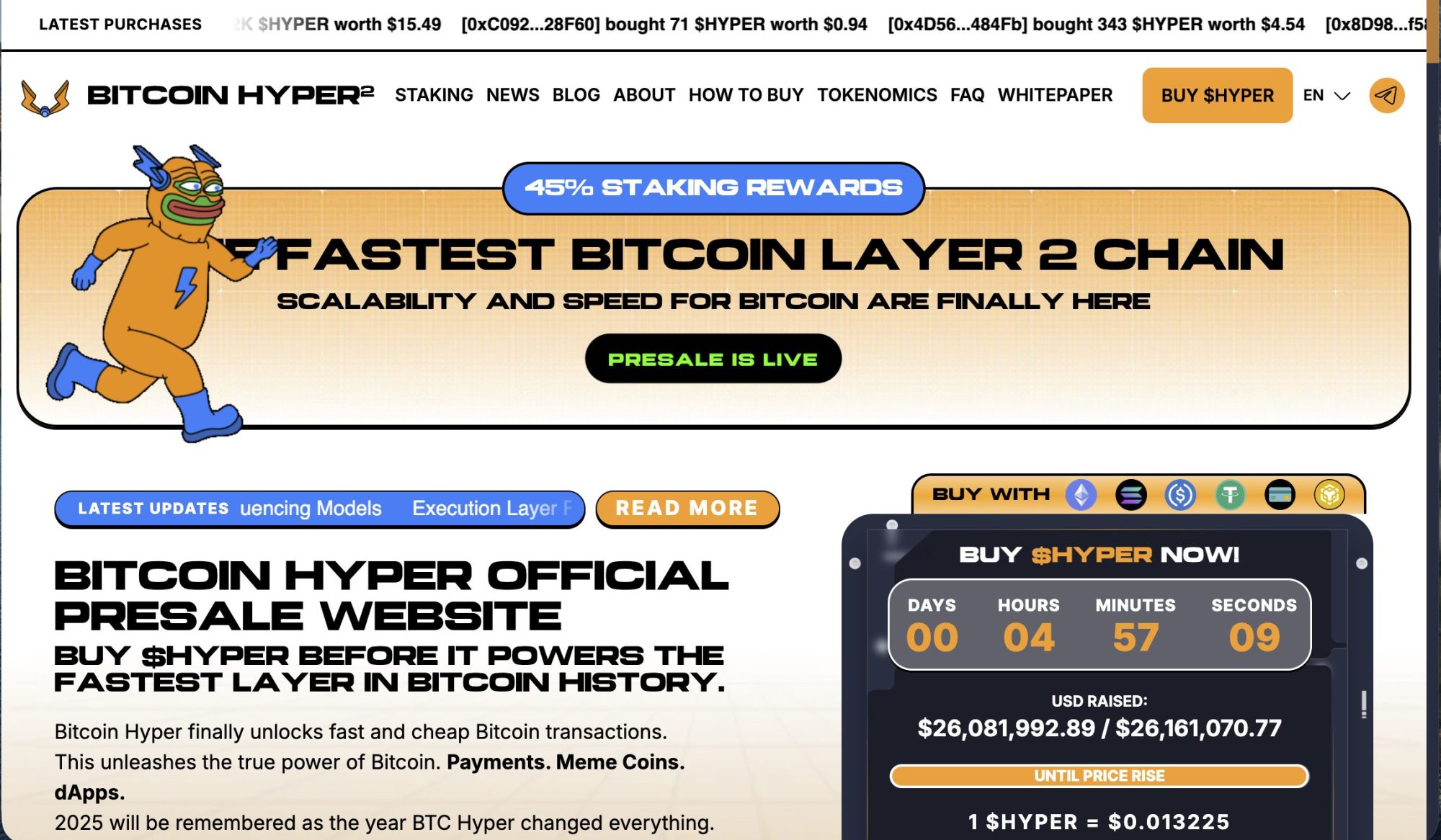
Bitcoin Hyper (HYPER) pitches itself as a Bitcoin Layer-2 that runs a Solana-style virtual machine and anchors to Bitcoin for settlement. That combo aims to bring fast finality, cheap fees, and smart-contract rails to BTC without changing Bitcoin itself. You get the Bitcoin narrative, plus programmability that feels familiar to Solana builders. And that’s why it’s on our list, because the project is tapping a hot “Bitcoin L2 + SVM” theme while still in presale.
The team says HYPER will run SVM programs natively on a Bitcoin-anchored rollup, opening the door to DeFi, payments, and app-level use cases on BTC. But we’re treating this as marketing until mainnet code and usage are public. You’ll also see a staking interface and presale flow with ETH/USDT/BNB on-ramps, which keeps the funnel simple for you. And coverage across crypto outlets shows growing attention around the presale.
On funding, reports cite rising totals: $7M in early August, ~$24M by mid-October, and ~$29M noted this week. You should take those as advertised figures, not on-chain receipts. Token trackers and explorers show multiple HYPER contract representations across ETH and SOL, with very low live holder counts right now; early distribution, if legitimate. And CoinCarp lists a 21B total supply with buckets for Treasury, Development, Marketing, Rewards, and a 10% “Listings” allocation.
We also looked for third-party checks: a SpyWolf token audit is published, and project pages exist at Coinsult and SolidProof; scope appears limited to token contracts rather than any L2. That’s useful but doesn’t validate rollup claims or performance. You’ll want to watch for public repos, testnets, and usage stats before assuming the tech lands as pitched.
Project features
- SVM-based execution environment claimed to run Solana programs on a Bitcoin-anchored rollup.
- Near-instant finality and low fees pitched for payments, DeFi, and apps on top of BTC.
- Presale + staking flow with wallet connect and ETH/USDT/BNB payments.
- Published token audit (SpyWolf) and project entries at Coinsult/SolidProof; token-level scope.
- Tokenomics posted by trackers (21B supply; listings bucket noted), subject to change.
Why $HYPER could get listed on KuCoin
~$29M raised in its presale shows real buyer interest that KuCoin could turn into trading volume and fees. And trackers like CoinCarp show a 21B supply with about 10% set aside for “Listings,” giving room for market-making and promo budgets if an exchange lists HYPER.
Pros
- Nearly zero-fee Bitcoin transactions
- Smart-contract support for Bitcoin holders
- Non-custodial bridge ensures user control
- Expands Bitcoin’s utility beyond payments
- Presale demand suggests early market interest
Cons
- Security depends on bridge infrastructure
- Relies on wrapped BTC, not native
- Competes with established Bitcoin scaling projects
Maxi Doge ($MAXI): Meme-driven ERC-20 with staking, contests, and presale-fueled early traction
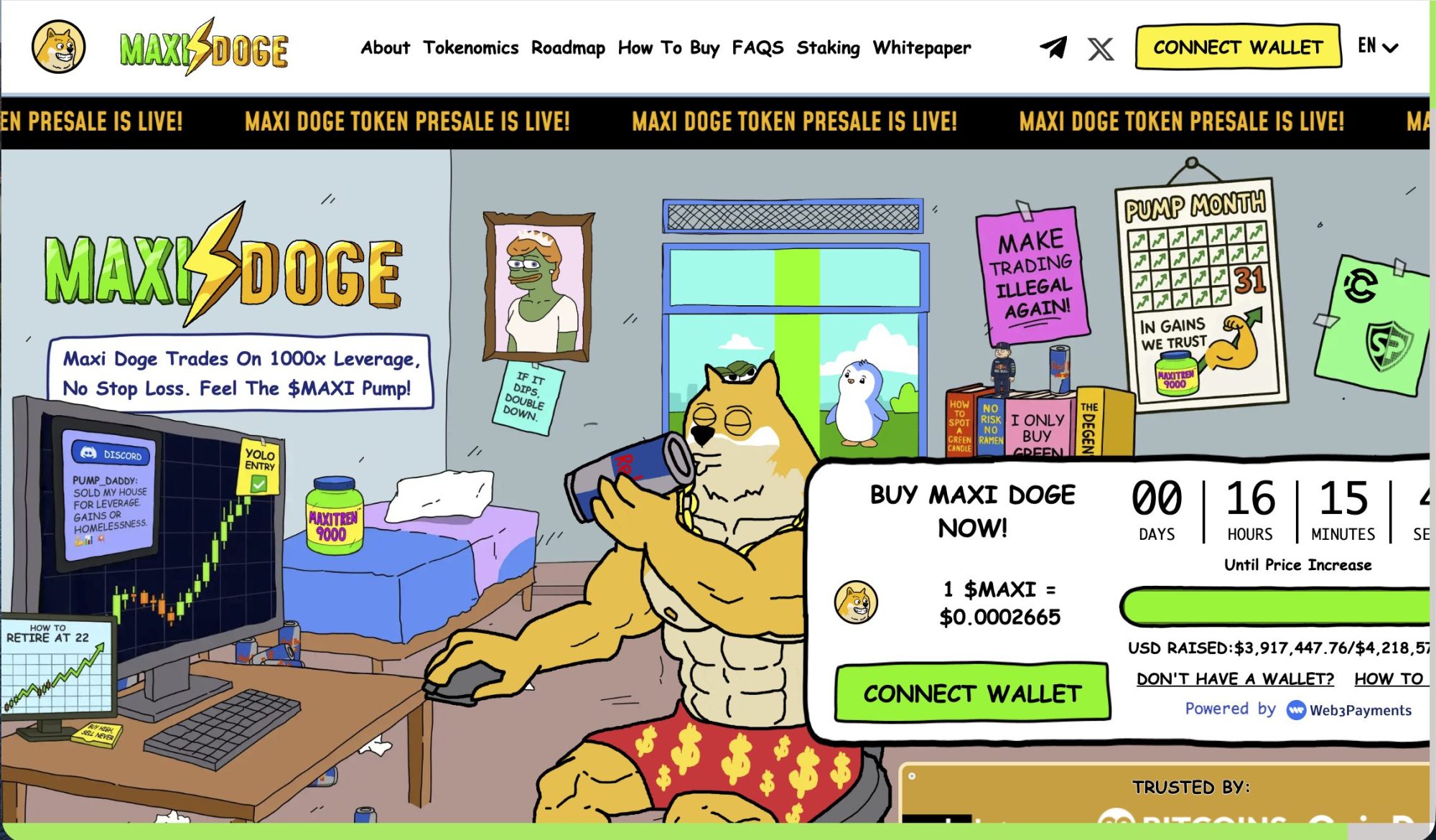
Maxi Doge ($MAXI) is an ERC-20 meme coin in presale with a fixed supply of 150.24 billion tokens, dual third-party audits, and a growing X/Telegram footprint; we’re watching it as a candidate for near-term exchange traction.
Maxi Doge pitches a simple idea: meme energy plus on-chain clarity. You get a fixed-cap ERC-20, public contract, and a whitepaper that keeps the scope tight. And there’s no owner minting or blacklist power noted in SolidProof’s TrustNet entry. But the team remains pseudonymous via “Maxi Doge Labs Ltd.” in Costa Rica, as stated in the paper.
The value story leans on activity you can actually use. Staking, trading contests, and partner events are described as the core utility, with Uniswap v3 planned right after presale. And tokenomics skew toward growth: 40% marketing and 25% “MAXI Fund,” with explicit slices for dev, liquidity, and staking.
Community reach is small but visible. The verified X account shows ~5K followers, and the Telegram portal lists ~2.7K subscribers at the time of writing. And the on-chain token tracker currently shows six holders, which fits a not-yet-distributed presale phase. But if you’re weighing early traction, you’ll likely care more about how fast those numbers move than their raw level today.
Project features
- ERC-20 with fixed 150.24B max supply; public contract and renounced-style privileges outlined in audit notes.
- Two audits referenced (SolidProof TrustNet; Coinsult via Trustblock) with no high/medium issues flagged.
- Tokenomics focused on growth: 40% marketing, 25% MAXI Fund, plus dev, liquidity, staking allocations.
- Staking and trading contests positioned as day-one utilities.
- 14-day refund window before exchange listing, per the disclaimer.
Why $MAXI could get listed on KuCoin
Presale shows roughly $4.2M raised so far, giving the team budget for liquidity, marketing, and a first CEX push; the whitepaper also says Uniswap v3 first, with CEX talks in progress. KuCoin has a record of listing meme coins that find early momentum (FLOKI, PEPE), and those pairs can drive sticky traffic for the venue.
Pros
- Clear meme angle that simplifies community storytelling
- Staking described, giving holders optional yield mechanics
- Fixed-supply messaging reduces fear of surprise minting
- Presale visibility can bootstrap early liquidity on launch
- Simple token page gives quick market snapshots
Cons
- Presale concentration risk until wider distribution occurs
- Meme dependence makes value sensitive to sentiment cycles
- Audits don’t cover business risks or future governance choices
- Multiple token addresses online create verification confusion for newcomers
PEPENODE ($PEPENODE): Meme coin meets virtual mining: buy nodes, collect rewards daily
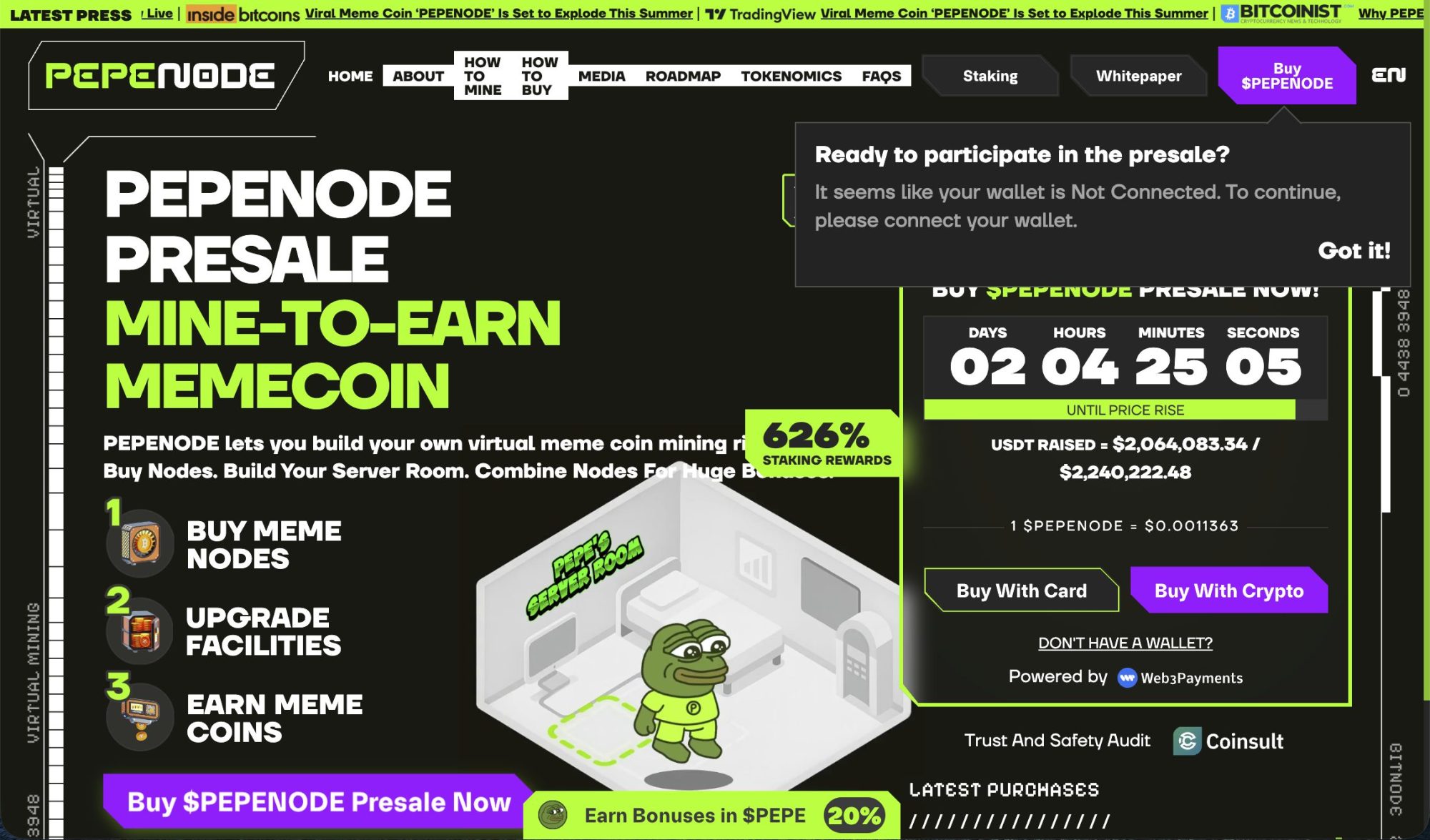
PEPENODE ($PEPENODE) wraps a meme coin into a “mine-to-earn” loop you can actually play. It’s an ERC-20 token on Ethereum with a presale that plugs straight into a virtual mining game. You buy nodes, build a server room, and stack rewards without hardware. And that mix of meme energy + gameplay is why it’s on this watchlist.
The core loop is simple: assemble Miner Nodes and Facilities, watch hashrate climb on a web dashboard, and claim emissions. Early tiers get stronger nodes, so timing matters and creates a race dynamic. Post-TGE, the full game unlocks with leaderboards and bonus mechanics. But you never touch real rigs, everything’s virtual and on-chain.
Utility sits beyond the house token. You can stake from presale (“buy & stake”) and, once live, the system pays out extra prizes in well-known meme coins like PEPE and even Fartcoin. That’s a clear hook for traders who already farm meme rotations. And it keeps people coming back daily instead of just holding.
On traction, the on-chain token shows a max supply of 420.69B and ~728 holders, while the whitepaper notes “over 210B minted” for the economy, so we track both data points openly. And the presale has crossed the $2M mark at ~$0.0011638 per token. What matters is whether this game loop can convert presale buzz into real usage
Project features
- ERC-20 on Ethereum; web app + mining dashboard; no hardware required.
- Virtual “nodes” and facility upgrades that boost simulated hashrate and rewards.
- “Buy & stake” during presale; staking boosts after TGE.
- Bonus payouts in other meme coins (e.g., PEPE) plus leaderboards.
- Public sale started at $0.001 with progressive pricing.
Why $PEPENODE could get listed on KuCoin
PEPENODE looks early, but the presale crossing $2 million tells us buyers are actually funding it. On-chain, the official Ethereum contract shows a 420.69B max supply and around 728 holders, so you’re not staring at a ghost token. Listing teams tend to focus on these basics: money raised, holder counts, early DEX activity, and the project’s aim to secure exchange listings around Q4 2025, which keeps KuCoin on the radar.
Pros
- No hardware; mining experience is virtual
- Simple dashboard shows hashrate and rewards
- Presale offers staking from day one
- Gamified upgrades can increase reward rate
- Potential bonus payouts in other memes
Cons
- Rewards depend on sustained user interest
- Unclear real utility beyond game loop
- Low current DEX volume suggests illiquidity
- Outcome tied to future listings success
Little Pepe ($LILPEPE): Memecoin turned utility token powering creator launches on Ethereum L2
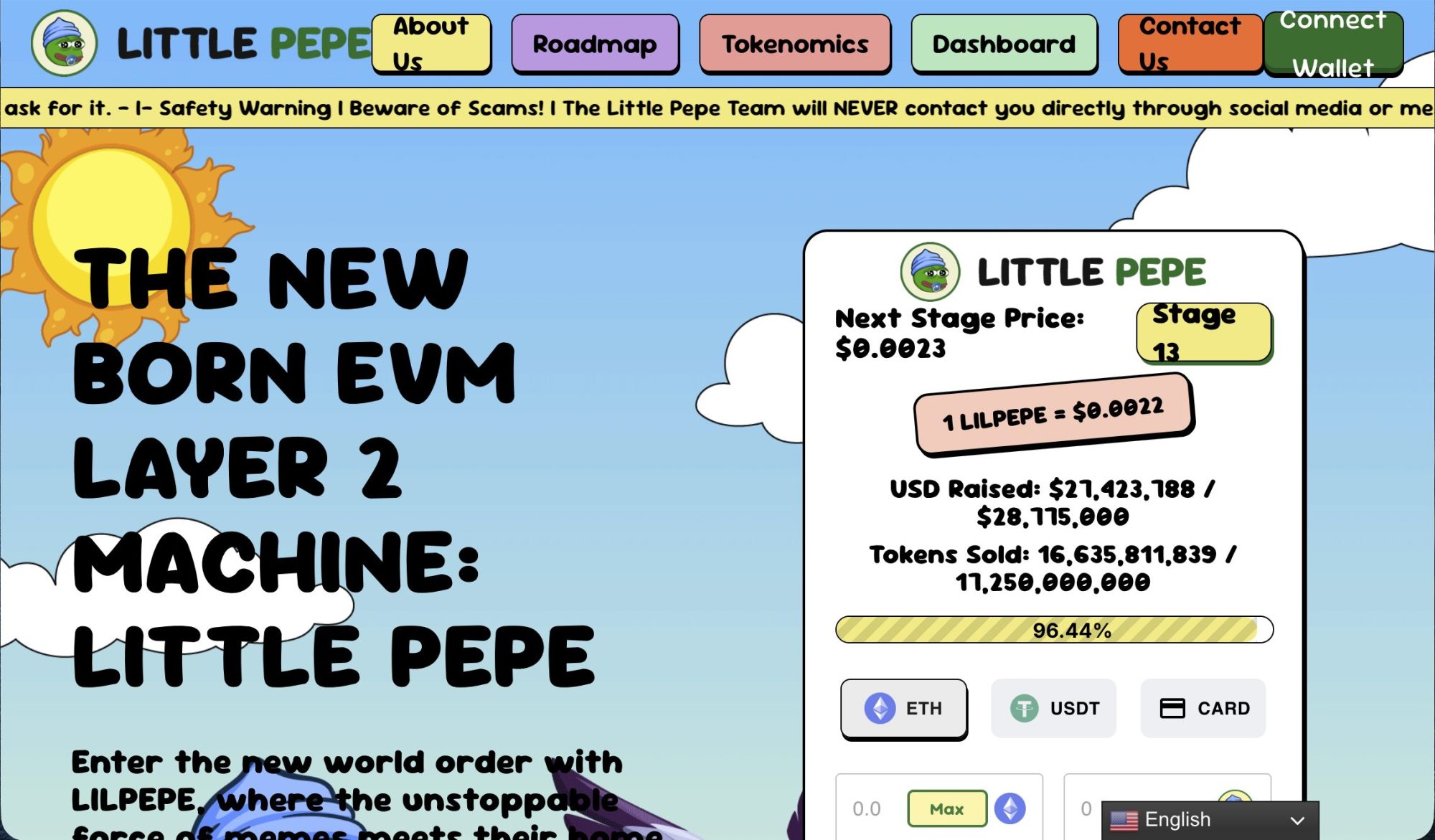
Little Pepe ($LILPEPE) frames itself as a meme-first project that’s building an Ethereum Layer-2 focused on low fees and speed, with $LILPEPE as the utility token at the center. And the team’s messaging leans hard into “L2 built for memes,” positioning Little Pepe as infrastructure rather than just another frog token. You’re getting a story about culture plus rails, which is why it’s on our watchlist for 2025.
Beyond branding, the roadmap promises a no-code meme launchpad (“Pepe’s Pump Pad”), staking, and anti-sniper protections that aim to make fairer token launches. But these elements are mostly described in promo and partner content, not in a public repo or live testnet we can verify. And that means we treat them as forward-looking claims, not shipped product.
What we can verify today: $LILPEPE completed a CertiK audit dated July 21, 2025, with no critical, major, or medium issues reported; minor and informational findings were acknowledged. And CertiK’s page shows formal verification on 32/32 properties, while KYC is not verified. You and I both know an audit isn’t a guarantee of behavior, but exchanges do look for this kind of baseline diligence.
Traction claims mainly center on a multi-stage presale with ~$27M raised at ~$0.0022 in “Stage 13,” plus aggressive giveaways (a $777k promo and a separate Mega Giveaway in ETH). But on-chain secondary activity looks thin, and that gap between presale hype and live liquidity is the key thing to watch; could a meme-centric L2 actually pull real users and builders, or does interest stall post-TGE.
Project features
- Markets itself as an Ethereum L2 “for memes,” with $LILPEPE as the utility token.
- CertiK audit completed and found no critical/major/medium issues; minor/informational acknowledged; KYC not verified.
- Plans for a no-code launchpad (Pepe’s Pump Pad), staking, and anti-bot protections.
- CoinGecko currently shows minimal DEX trading volume, suggesting most activity is still presale-side
Why $LILPEPE could get listed on KuCoin
With the presale raising ~$27M raised and >90% of tokens sold in later stages, the momentum signals strong headline demand KuCoin often screens for. And a completed CertiK audit gives a compliance-style checkbox many CEX teams want before green-lighting a meme asset. But the on-chain ERC-20 contract for “Little Pepe (LILPEPE)” shows ~1,551 holders, while CoinGecko reports ~$90 24-hour DEX volume; numbers that highlight the need for real post-TGE liquidity if KuCoin is to see meaningful fee throughput.
Pros
- Large presale war chest supports listings, liquidity, and marketing
- Clear, meme-forward brand that’s easy to rally behind
- Community giveaways can attract retail attention quickly
- Staking promise encourages longer holding behavior
- Launchpad vision could seed early ecosystem projects
Cons
- L2 claims still unproven without public testnet or mainnet
- On-chain liquidity and trading remain very limited today
- Giveaway-heavy growth can fade after token generation
- Competitive meme market dilutes attention and builders
Newly listed coins on KuCoin to watch in 2025
Check out KuCoin’s newest features to stay on top. These recently listed coins might make a big impact in the crypto market this year.
Aster (ASTER): Perps and spot DEX with yield collateral and pro tools
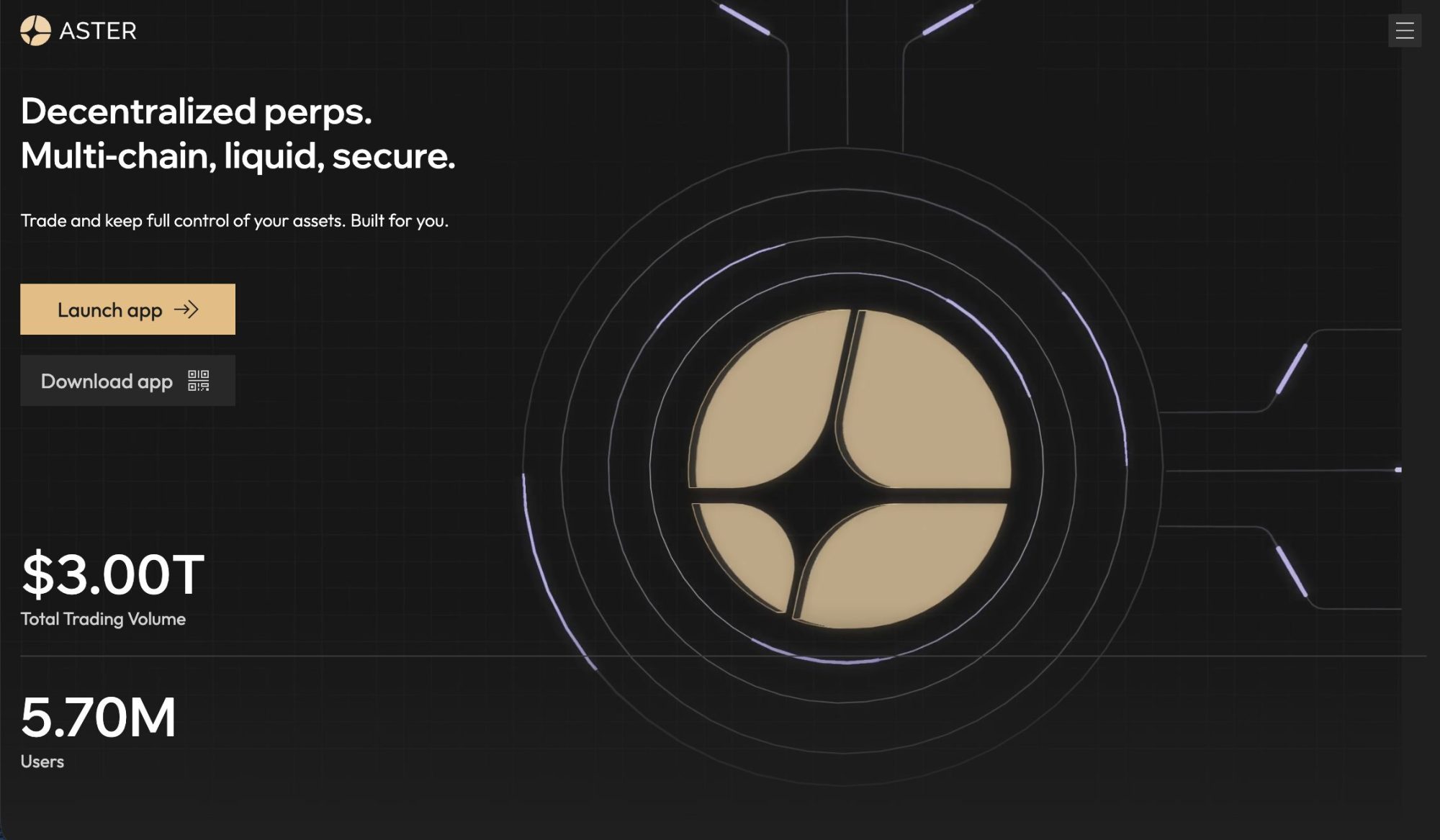
Aster is built for on-chain traders who want both order-book perps and simple one-click leverage. It runs across major chains and supports its markets with an L1 stack called Aster Chain. And the project leverages capital efficiency by letting you post yield-bearing collateral rather than idle margin. That mix of speed, liquidity, and flexible collateral is the core pitch of the ASTER ecosystem.
The token powers governance, discounts, and program incentives designed to keep liquidity sticky. And you can toggle between three trading modes: Spot (order book), Perpetual (pro order book), and a fully on-chain “1001x” mode for the degens who crave huge leverage. Price data sources include Pyth, Chainlink, and the Binance Oracle to reduce bad ticks during periods of volatility.
That stack makes Aster feel familiar to CEX users while keeping settlement on-chain. Where’s the traction coming from right now. Coin trackers show Aster near the top 50–60 by market cap, with ~$1.1B+ daily volume flowing through ASTER pairs across CEXs/DEXs.
On BNB Chain, the ASTER contract shows ~182K unique holders, with a max supply of 8B and ~2.02B in circulation. Those are the kind of numbers that create listing gravity. And APX holders have a migration path into ASTER, which pulled an existing user base into the new ticker. You get scale from day one, not just speculation. But it’s the sustained volumes and broad exchange coverage that make the case stronger than any campaign.
Project features
- Three trading modes: Spot, Pro perps, and fully on-chain “1001x” perps
- Yield-bearing collateral (asBNB) and a native yield stablecoin (USDF) for capital-efficient margin
- Multichain footprint with MEV-resistant execution and hidden orders in Pro mode
- Governance, fee discounts, and staking/buyback mechanics tied to ASTER
- Oracle blend (Pyth, Chainlink, Binance Oracle) for resilient pricing feeds
What is the hype about Aster as KuCoin new listings?
As of publication, ASTER’s market cap is ~$2.15B with ~2.02B tokens circulating; 24-hour volume hovers around ~$1.1B across markets. Holder count on BNB Chain alone is ~182K, signaling a wide retail base that KuCoin can convert into active traders. And there’s a dedicated “liquidity & listings” allocation (4.5% of supply), which helps bootstrap order books on new venues. Put simply, the scale, velocity, and ready-to-deploy listing bucket map cleanly to KuCoin’s appetite for high-turnover assets.
Pros
- Capital-efficient margin using yield-bearing collateral like asBNB and USDF
- Perpetuals and spot in one platform reduce switching friction
- Hidden orders and advanced tooling help active traders execute better
- Multichain access with BNB focus broadens user reach quickly
- Large BNB Chain holder base you can market into immediately
Cons
- Reliance on external oracles introduces latency and dependency risks
- Multichain bridges and routing expand the attack surface
- Category crowded by entrenched perps DEX competitors
- Sustaining deep liquidity requires ongoing incentives and market makers
- Regulatory uncertainty around derivatives trading may limit listings
Plasma (XPL): Stablecoin-first Layer-1 with gasless USDT, EVM, and Bitcoin bridge support

Plasma is a Layer-1 built for stablecoin payments, not general-purpose compute, and that focus shows. You get zero-fee USDT transfers, EVM compatibility, and a trust-minimized Bitcoin bridge that keeps settlement fast. It’s a clean rails-first design: move dollars first, do everything else second. And that’s why it’s on our list, the chain targets the $250B-plus stablecoin economy head-on.
You don’t need to hold gas in XPL to send USDT, which lowers friction for new users and payments apps. The network uses a PoS design with sub-second finality (PlasmaBFT) so transfers settle quickly and feel instant. And because it’s EVM-compatible, you and I can port familiar tooling without learning a new stack.
The Bitcoin bridge adds reach for liquidity and on-chain dollars without forcing a detour through wrapped custodial assets. Adoption has come fast. Binance listed XPL with multiple spot pairs and added it to HODLer Airdrops; Kraken turned trading on the same day; Robinhood followed in October. KuCoin did a world-premiere listing and then lit up margin and futures, which tends to pull in active flow early.
That exchange footprint matters when you’re building payments liquidity across regions. That larger day-one float plus CEX coverage brought real turnover out of the gate. We’ve seen 24-hour reported volumes in the hundreds of millions and a mid-nine-figure market cap as of today. And for you that means price discovery and order book depth are already live, not hypothetical.
Project features
- Zero-fee USDT transfers and support for stablecoin gas to cut onboarding costs.
- EVM-compatible smart contracts plus custom gas token support for app flexibility.
- Sub-second finality via PlasmaBFT for payment-grade throughput.
- Trust-minimized Bitcoin bridge to tap BTC-side liquidity.
- 10B total supply; ~1.8B circulating at listing (~18%).
What is the hype about XPL as KuCoin new listings?
KuCoin listed XPL in Sept, 2025 and it showed scale on day one, about $484.0M market cap and ~$623.1M in 24-hour volume today, with 1.8B circulating and KuCoin added margin and futures to deepen liquidity. The raise history is real ($74M across rounds), and even the BSC-bridged token shows >21,000 holders, a small but visible proxy for distribution outside the native chain. Put together, that’s sustained volume for KuCoin, on-ramp demand for payments users, and more activity for its derivatives book.
Pros
- Gasless USDT transfers for basic payments via protocol paymaster
- EVM compatibility lets you reuse familiar tooling and contracts
- Custom gas tokens reduce onboarding friction for new users
- Bitcoin bridge taps BTC liquidity inside smart contracts
- Fast finality through PlasmaBFT improves payment experience
- Exchange listings on KuCoin and Binance expand access
Cons
- Zero-fee limited to simple transfers; dApps still need XPL
- DEX market share under one percent recently
- Chain fee revenue currently very small by comparison
tokenbot (CLANKER): Tag, deploy, and trade new Base tokens from Farcaster directly
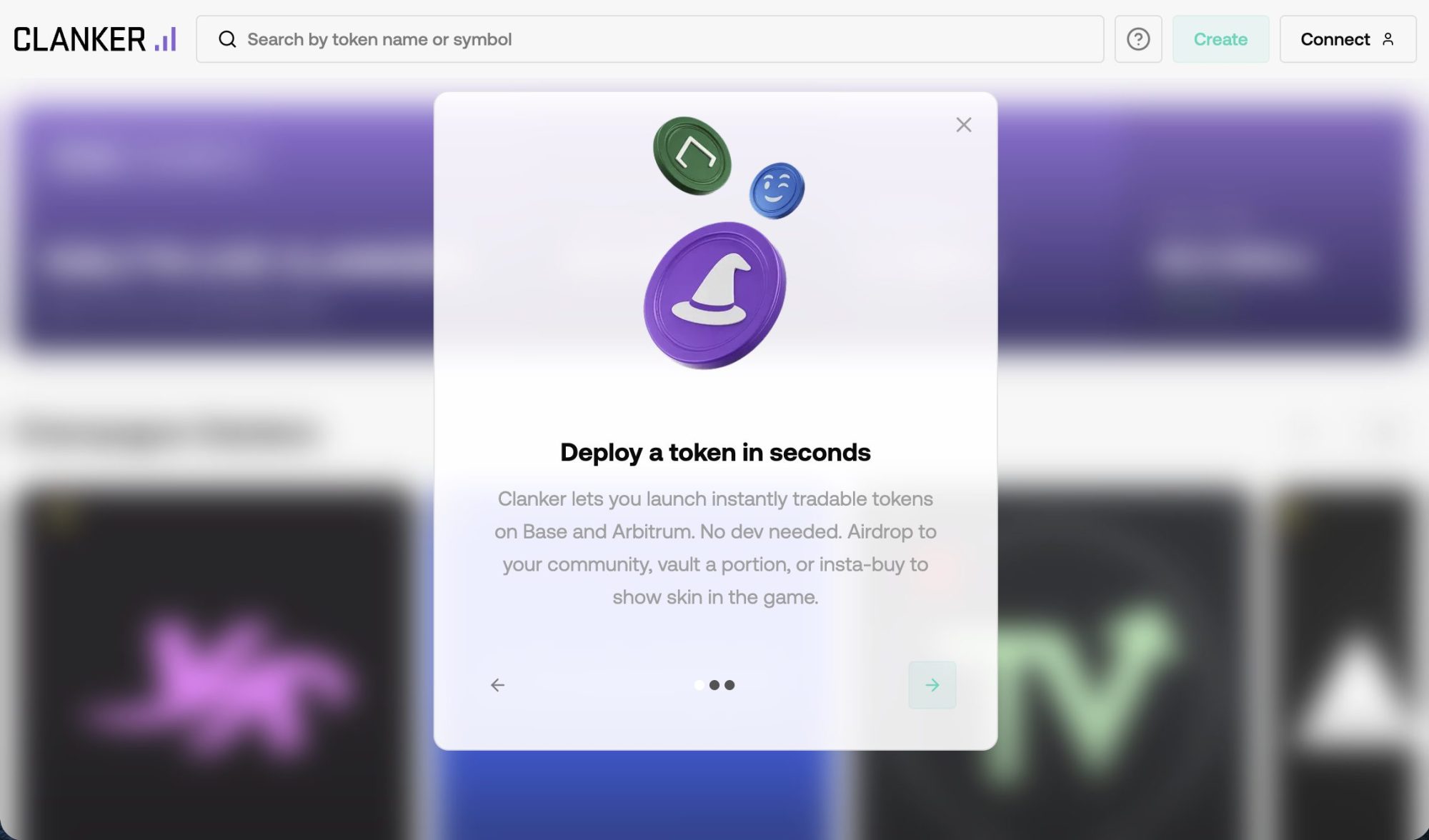
CLANKER sits at the center of Clanker, an autonomous token-deployment agent running on Base and wired into Farcaster. You tag @clanker on Farcaster, it deploys an ERC-20 and wires up trading; no devs, no fuss. That utility gives the token a clear anchor. And with the KuCoin listing in place, more users can reach it with one click.
The platform’s own dashboard tells you how busy this engine has become. It shows 530,692 “live clankers,” an ecosystem market cap near $221.8M, and lifetime volume around $4.7B, with creator fees topping $46.9M. Those are site-reported metrics, but they hint at strong activity through the pipes CLANKER touches. And they help explain why liquidity shows up fast.
Momentum also picked up after Farcaster moved to acquire Clanker and fold it deeper into its app. Coverage around the deal outlined plans to integrate the tokenbot and use protocol fees to buy/hold CLANKER while sunsetting older tokens, mechanics that can reinforce demand around the core asset. And that headline alone lit a fire under volumes and price during late October.
But most important for you: it pulled CLANKER from a niche tool into a mainstream SocialFi primitive. Zoom out, and the footprint is already broad. CLANKER trades across major CEXs (KuCoin, Coinbase Exchange, Bitget, LBank) while Base on-chain markets provide depth. And with 24-hour volume hovering around $60–57M across trackers, there’s enough turnover for market makers and retail alike.
Project features
- Utility-tied asset sitting where social + AI + Base activity converge.
- Tokenbot utility: deploy tokens by tagging @clanker on Farcaster; real usage funnels attention and fees to the ecosystem
What is the hype about CLANKER as KuCoin new listings?
KuCoin listed CLANKER/USDT in April, 2025 and the numbers show why the fit made sense. With ~488k on-chain holders, and ~$60.7M in 24-hour volume, CLANKER brings both breadth and turnover to KuCoin’s order books. And because it’s tied to a token-creation agent on Base that keeps spinning up activity, KuCoin captures that flow when users want a CEX route. For KuCoin, that means new users, sticky volumes, and pairs that market makers can keep tight.
Pros
- You create a token from a simple Farcaster tag
- On-chain process gives transparent history and open access
- Creator fees match incentives across launches and holders
- Base network keeps transactions cheap during bursts
- Multiple venues can expand reach beyond purely on-chain audiences
- Growing Farcaster usage can funnel discoverable demand
Cons
- High-velocity launches can attract short-term, speculative flows
- You still need post-launch marketing and community work
- Smart-contract risk exists despite audits or reputation
- Fees and slippage may spike during heavy demand
Somnia (SOMI): EVM Layer 1 for real-time gaming, social, and metaverse

Somnia (SOMI) is interesting because its an EVM-compatible Layer-1 built for real-time apps across gaming, social, metaverse, and DeFi. It targets consumer-grade throughput while keeping Ethereum tooling familiar for builders.
Under the hood, Somnia compiles frequently called contracts to optimized machine code while leaving the rest on standard EVM paths. MultiStream consensus separates validator data chains from a consensus chain so transactions can be processed in parallel.
IceDB focuses on nanosecond-level reads/writes and snapshotting to keep state access predictable under load. The team reports tests above 1M TPS and highlighted more than 10B testnet transactions before mainnet.
For users, the pitch is clear: fast, low-cost on-chain actions behind the games and social features you actually touch. For builders, there’s familiar EVM tooling plus a DPoS model that requires 5M SOMI to run a validator, with delegated staking for everyone else. $SOMI powers fees, staking, and over time governance within the network. And supply is capped at 1B, with 160.2M in circulation today.
Project features
- VM Layer-1 with compiled hot contracts, MultiStream consensus, and IceDB for state performance.
- Fixed 1B max supply; ~160.2M circulating at launch and today.
- Validator staking requirement: 5M SOMI; delegated staking supported.
- Reported throughput: 1M+ TPS in testing; 10B+ testnet transactions pre-mainnet.
- Ecosystem funding signals: $151.5M private sale + up to $270M ecosystem support from partners.
What is the hype about SOMI as KuCoin new listings?
Somnia is already listed on KuCoin, with SOMI/USDT spot trading live since September 2, 2025 following a Pre-Market period. At writing, SOMI’s market cap sits near $55.3M on a 160.2M circulating supply, with ~$33.1M in 24-hour volume, solid liquidity for a new L1. Binance’s HODLer Airdrops (30M SOMI) and a Kraken listing on October 15, 2025 broaden exchange coverage and depth.
Pros
- BEVM compatible, so onboarding builders stays simple
- Real time focus fits games and social apps
- Low fees aim to reduce user churn
- Parallel execution promises smoother peak periods
- Familiar tooling cuts migration costs for teams
Cons
- New chain risk around sustained demand
- Competition from larger chains remains tough
- Fewer proven apps at this stage
- Liquidity may swing with exchange support
KGeN ($KGEN): Verified distribution protocol linking apps with real, human users worldwide
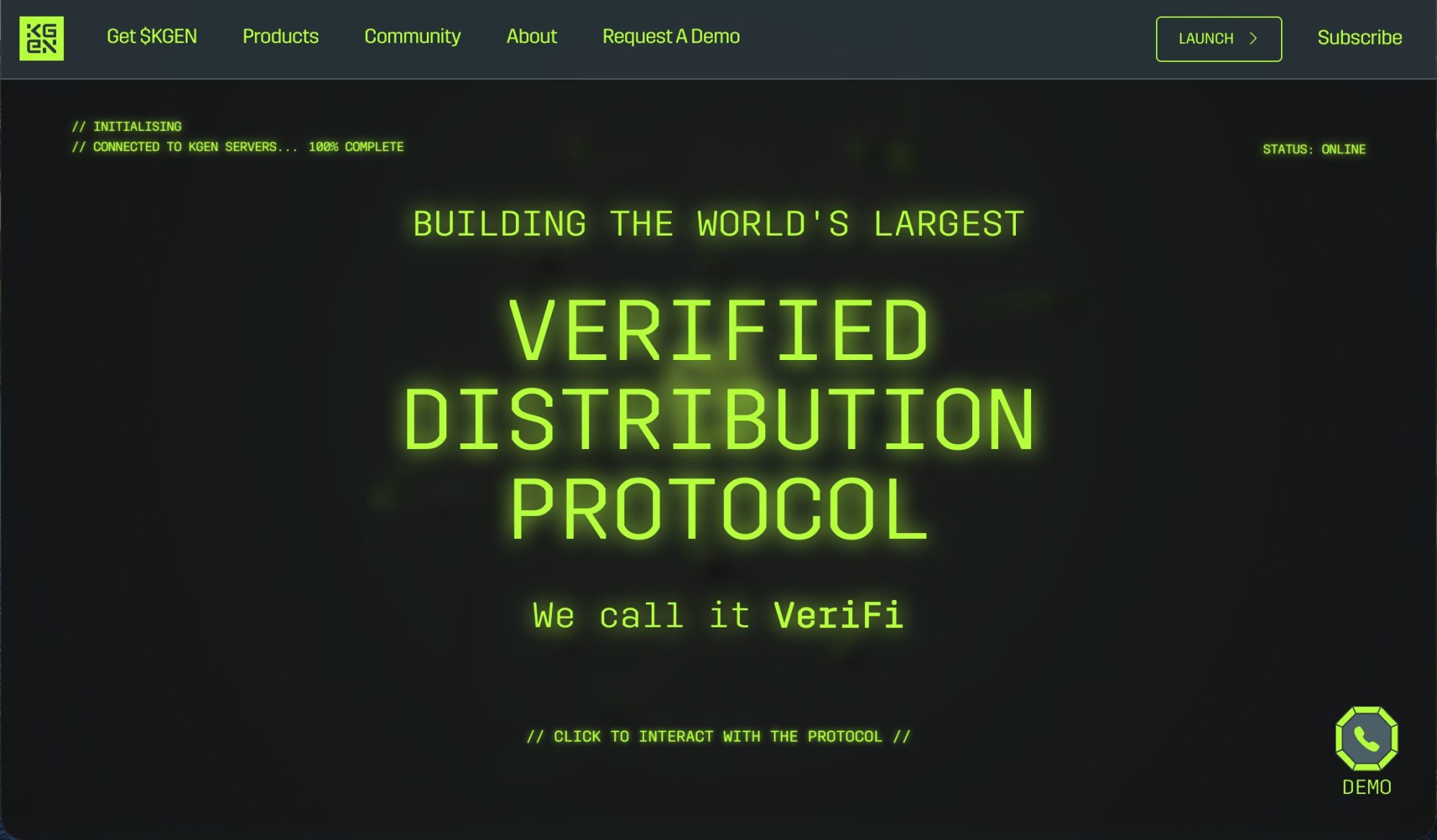
KGeN is building what it calls the world’s largest verified distribution protocol, VeriFi. It targets a simple problem: apps need real users, not bots. The network routes growth for AI, DeFi, gaming, and consumer apps through a POGE identity framework and decentralized micro-communities across 60+ countries. And that’s exactly why it’s on our 2025 watchlist.
You get a dual-token design and a clear on-ramp. KGEN is the utility token (max supply 1B) and rKGEN was the pre-TGE rewards token that converts 1:1 to KGEN. Staking is live for holders, with the team walking users through the process at launch. But the bigger idea is continuity: earn rKGEN for contribution, convert to KGEN, then stake to secure the protocol’s growth loop.
Scale matters here, and KGeN shows it. As of publication, the project cited 38M+ users, 6.6M monthly actives, 200+ revenue partners, and $48.3M in annualized revenue. That’s distribution you can measure, not just promise.
And it’s backed by capital: KGeN raised $13.5M led by Prosus Ventures, Jump Crypto, and Accel in October 2025. For you as a trader or researcher, liquidity and footprint are already visible and multiple trackers record a mid-October ATH and multi-million-dollar daily volumes since listing.
Project features
- VeriFi: verified distribution built on identity + reputation (POGE) to route real users to apps.
- Dual-token path: rKGEN → KGEN 1:1; on-platform staking available.
- Multi-chain presence and public explorers (Aptos, BNB Smart Chain).
- Global reach through decentralized micro-communities across 60+ countries.
- Documented user and revenue scale from 2025 disclosures.
What is the hype about KGEN as KuCoin’s new listings?
KGEN was listed on KuCoin in October 2025, accompanied by an 85,000 KGEN campaign. As of November 2025, it has a market cap of ~$54.1M on a ~198.7M circulating supply, with ~$12.2M in 24-hour volume, showing sustained activity post-listing. On-chain, the BSC contract shows ~142k holder addresses, signaling broad retail distribution across at least one chain which is useful context for liquidity partners and market makers.
Pros
- Verified distribution focus reduces bot traffic
- You get clear contributor reward pathways
- And apps can target real user acquisition
- Multi-vertical reach across AI, DeFi, consumer
- Staking and token utility support engagement
- Community micro-hubs enable local market testing
Cons
- Identity frameworks can raise privacy questions
- Token incentives may crowd out intrinsic motivation
- And sybil resistance claims need independent validation
- Market cycles could compress token liquidity
Comparison of new KuCoin listings
| Project | Ticker on KuCoin | Chain | Max supply | KuCoin listing status |
| Bitcoin Hyper | HYPER | BNB Chain | 21B | Presale |
| Maxi Doge | MAXI | Ethereum | 420B | Presale |
| PEPENODE | PEPENODE | Ethereum | 210B | Presale |
Little Pepe | LILPEPE | Ethereum | 100M | Presale |
| Aster | ASTER | BNB Chain | 10B | Listed |
| Plasma | XPL | Plasma blockchain | 10B | Listed |
| tokenbot | CLANKER | Base blockchain | 1M | Listed |
| Somnia | SOMI | Somnia blockchain | 1B | Listed |
| KGeN | KGEN | Aptos/BNB Chain | 1B | Listed |
How token prices change after a KuCoin listing
Increased exposure and demand
Exchange listings expose a token to a wider audience of potential buyers, often leading to increased demand and potentially driving the price up. For instance, Coinbase listings have on average lead to a 91% increase in the first five days of trading. Similar effects are observed with other major exchanges. Binance too. The Optimism (OP) token exemplifies this; its price skyrocketed over 300% shortly after its Binance debut.
Improved liquidity
Besides KuCoin offers, listings enhance a token’s liquidity, making buying and selling easier. This can attract more investors who prefer assets with readily available buyers and sellers.
Short-term volatility
Listings can trigger short-term price volatility. Speculative trading often intensifies around listing events, causing price swings. This volatility can be both positive and negative.
Delisting risk(s)
Delisting from a major exchange can significantly impact a token’s price. When a token loses access to a large trading pool, its liquidity can dry up, leading to price drops. This highlights the importance of project fundamentals and long-term viability.
Market validation and credibility
Being listed as one of Kucoin new listings suggests a level of legitimacy for the token and the project behind it. This can inspire confidence in investors, potentially leading to price appreciation.
Remember:
- Listing effects aren’t guaranteed.
- The project’s underlying value plays a major role in long-term price performance.
- Thorough research is crucial before investing in newly listed tokens.
How are cryptocurrencies listed on KuCoin?
KuCoin lists tokens through a public application and built-in anti-fraud checks that you can verify yourself. Here’s a simplified process:
- On KuCoin.com’s footer, click Token Listing, then open the application form.
- Submit project details, documents, and an NDA; KuCoin’s research/audit team reviews.
- After a preliminary pass, an account manager will contact you (or in this case, the project) to guide them through the workflow.
- Create an 8-digit anti-phishing code; any staff who reaches out must quote it back.
- Check sender domains: @kucoin.com, @corp.kucoin.com, @flsdex.com. Kucoin will only contact you via emails containing one of these domain.s
- Before any transfer, please verify your emails, social media accounts, and KuCoin business wallet addresses in the Official Verification Center.
Use these checks every time. It’s simple: confirm the channel, verify the code, confirm the address, then proceed with your listing.
Should you buy cryptocurrencies before they are officially listed on KuCoin?
Buying before a KuCoin listing sits in speculative pre-listing markets where price discovery is unstable. You usually see access via DEX pairs or smaller centralized venues with thinner order books. Spreads widen, slippage rises, and visibility into circulating supply can be limited; usually, rumors also often drive abrupt moves both up and down.
Observers will typically track contract authenticity, tokenomics, and vesting calendars, liquidity locks, and any security audits. They can also monitor holder concentration, early investor unlocks, market-making arrangements, and real user traction versus paid promotion. But listing events can produce a short-lived surge followed by profit-taking, though outcomes vary widely. What you get is event-driven flow where narratives, timing, and market conditions dictate the path. You can get a feel of the platform by reading the entire KuCoin review.

How We Rate Cryptocurrencies
We review each cryptocurrency we select. Below are the key metrics we check before listing the cryptocurrency on the website. For further details, you can also take a look at our cryptocurrencies rating guide, featured on ValueWalk.
Security
Popularity and potential
Liquidity
Tokenomics
Social media activity
FAQs
Why are listings good news for the token?
Is KuCoin a safe crypto exchange?
What are the best tokens on KuCoin?
Is it risky to trade newly listed coins?
Which coins are listed on KuCoin?
Can I trust KuCoin?
Can you use KuCoin in the US?
References
- KuCoin and Founders Face US Prosecution over Alleged AML Violations | Finance Magnates
- KuCoin Debuts Crypto Payment Acceptance Tool for Merchants | PYMNTS
- KuCoin 2024 H1 Report: Achieving Milestones with Over 34 Million Users and Leading with Compliance | PR Newswire
- KuCoin, Execs Charged With Bank Secrecy Act and Unlicensed Money Transmission Offenses | Investopedia
- US charges KuCoin crypto exchange with anti-money laundering failures | Reuters