


The crypto fear and greed index is one of the simplest ways to understand how investors are feeling about the crypto market at any given time.
By tracking shifts in market sentiment, it turns the emotional side of the crypto market into a single score.
In this guide, I’ll explain what the index is, how it works, and how traders use it to shape smarter crypto investment decisions.
What is the crypto fear and greed index?
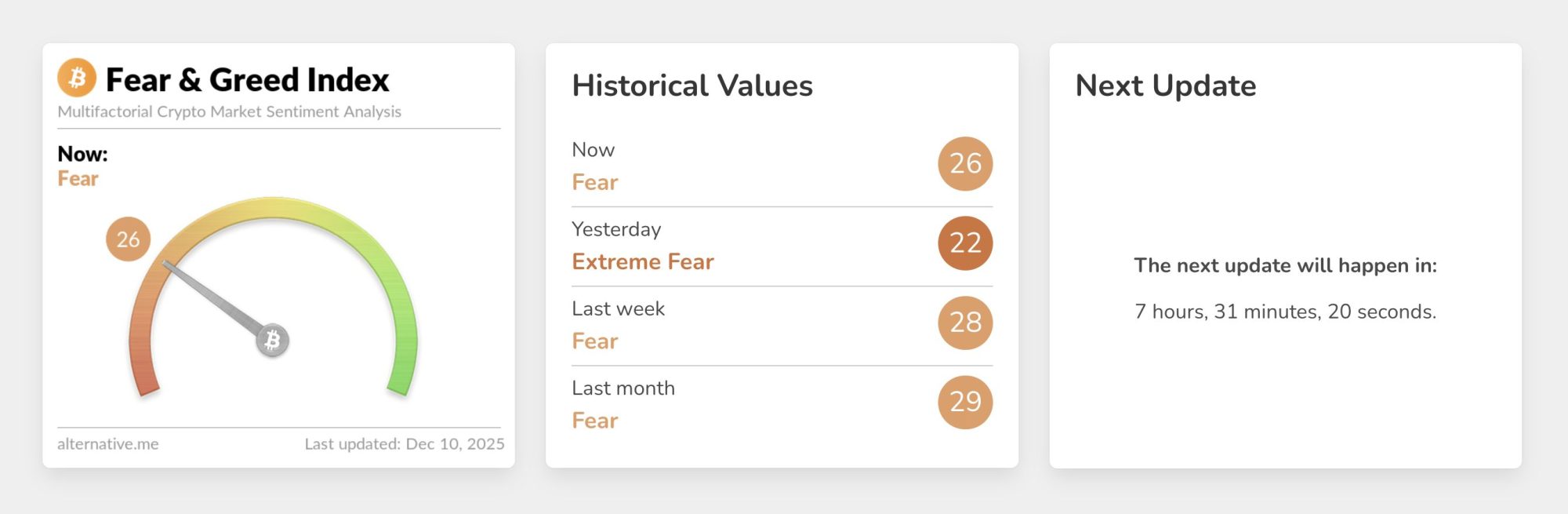
Put simply, the crypto fear and greed index is a daily gauge of market sentiment in the crypto market.
It turns signals like market momentum, market volume, and search trends into a single score from 0 to 100. Low readings flag extreme fear. High readings point to extreme greed.
I use it to quickly read about Bitcoin sentiment and broader market trends. Then I pair it with other analytical tools, such as the Relative Strength Index (RSI) and other momentum indicators, before making decisions.
How is the crypto fear and greed index calculated?
To build the crypto fear and greed index, providers combine several indicators that reflect how the crypto market is behaving.
Each factor is given a weight, and together they form the final score that shifts daily with real-time data and can be compared against historical data.
Volatility (25%)
The index tracks how sharply the Bitcoin price moves compared with 30 and 90-day average values. A sudden spike in swings often reflects a more fearful market.
Market momentum and volume (25%)
This part measures market momentum and current volume against their corresponding average values. Strong buying volumes in a positive market are often taken as a sign of rising confidence.
Social activity (15%)
On X (formerly Twitter), the index looks at Bitcoin hashtags, the number of posts, and the level of engagement. A sudden spike in conversations or how many interactions those posts get often shows rising excitement or concern.
Reddit discussions are also tracked through basic Reddit sentiment analysis. By scanning the tone of crypto threads, the index can capture what everyday traders are feeling.
When activity rises across both platforms, it often signals FOMO (fear of missing out) and can point to greedy market behavior.
Surveys (15%)
Earlier versions of the index included weekly crypto polls on a large public polling platform, giving insight into how thousands of crypto investors saw the market. While less common today, this remains one of the possible inputs.
Bitcoin dominance (10%)
Another factor is Bitcoin dominance, which measures Bitcoin’s share of the total crypto market cap.
If Bitcoin gains ground, it can suggest investors are playing it safe and thus a reduction in speculative altcoin investments. If Bitcoin dominance shrinks, it may mean traders are more willing to take risks with risky altcoins.
Google Trends (10%)
Finally, the index pulls Google Trends data to track Bitcoin-related search queries. For example, a surge in searches such as Bitcoin price manipulation can signal growing uncertainty. Rising search volume in optimistic terms may point to a more confident market mood.
Different providers may calculate the index in their own way, but the idea stays the same: all these signals are pulled together into one score that gives a snapshot of market sentiment and helps guide smarter investment decisions.
Crypto fear and greed index scale explained
Before you try to trade on sentiment, it helps to know how the index score breaks into zones. The numbers from 0 to 100 are not random. Each bracket tells you something slightly different about how traders feel and how stretched that emotion might be.
Most providers follow a scale close to this:
0 to 24 – Extreme fear
The market is in panic mode. Forced liquidations, margin calls, and headlines full of doom are common. Long-term investors often see this zone as a place to start looking for value, provided the price holds around key support levels.
25 to 49 – Fear
Sentiment is still negative, but the worst selling pressure can be behind us. You usually see cautious positioning, lower risk appetite, and traders waiting for clearer signs before they commit fresh capital.
50 – Neutral
At the midpoint, buyers and sellers are more balanced. The market is still reacting to news and macro events, but there is less emotional overshoot on each move. Many traders use this area to reset and recheck their bias.
51 to 75 – Greed
Confidence returns and risk-taking increases. Breakouts attract more attention, people talk about new highs, and altcoins start to move. This zone can still offer upside, although it pays to be more selective with entries and position size.
76 to 100 – Extreme greed
Euphoria dominates. Price moves can become parabolic, pullbacks are shallow, and social feeds turn into a stream of bold predictions. In this zone, experienced traders usually think more about protecting gains, tightening stops, or scaling out than about chasing the next leg higher.
Pros and cons of the crypto fear and greed index
Pros
- Clear snapshot at a glance: The fear and greed index condenses many signals into one read, making it easier to measure fear or euphoria, especially at extreme index ranges.
- Helps control emotions at decisive moments: Deep fear often aligns with capitulation and hot greed with exhaustion, which can help plan entries or trims instead of letting own emotions drive trades.
- Quick support for more in-depth work: It saves time gathering data before you dive into price action, volume, and on-chain metrics, so decisions start with a clean sentiment check.
Cons:
- Differences in standards between suppliers: Inputs and weights vary, so the greed calculated on one site may not match another, and coverage can skew toward Bitcoin while missing moves in large alt coins.
- Can lag in fast markets: Sharp news shocks can flip sentiment quickly, which is especially risky when using a href=”https://www.valuewalk.com/cryptocurrency/best-crypto-leverage-trading-platforms/”>crypto leverage trading platforms. This could pull many investors into chasing an irrational reaction before the reading updates.
- Oversimplifies a complex market: One number cannot capture full crypto market behavior, sector rotation, or shifts in market cap share, so context is still essential.
How did the crypto fear and greed index start?
The idea of the fear and greed index began in traditional investing. Analysts tracked fear and greed in stocks to map the market’s emotional momentum, explain price swings, and spot potential turning points. That thinking went mainstream with popular stock “greed index” tools and the Buffett mindset of being cautious when others chase gains.
In 2018, Alternative.me brought the concept to crypto. Their crypto fear and greed index adapted those signals to the Bitcoin market, using data like volatility, momentum, dominance, social activity, and search trends.
Since then, others have built their own versions. Notably, CoinMarketCap and Binance publish a fear and greed index for crypto. Some focus on Bitcoin, others try to reflect the whole crypto market, and a few offer separate indices for major altcoins.
The inputs are similar, but the weights and presentation vary. They all relate to broader shifts that have the potential to shape the future of crypto in the next five years.
How reliable is the crypto fear and greed index?
More than a trading signal, the fear and greed index can be considered a reliable indicator of crowd sentiment.
Overall, the index does a good job at the extremes: extreme fear often lines up with panic and forced selling, while extreme greed tends to show up near overheated rallies. Those moments can flag a possible buying opportunity, but it’s always good to still look for confirmation and consider different ways to invest in crypto depending on market conditions.
Readings can lag behind rapid movements during periods of high market volatility, and a headline can turn the cryptocurrency market upside down in a matter of minutes while the data catches up.
Also, methodologies differ by provider, so the fear and greed index you see on one site may not match another index on the same day.
How to use the crypto fear and greed index for trading: Step-by-step guide
The fear and greed index can be turned into a practical trading tool if you follow a clear process. Here’s a simple framework traders often use:
Start with today’s reading
Begin by checking where the score lands. A reading close to 20 or below often reflects extreme fear, while values above 80 suggest extreme greed.
Traders pay the most attention to these zones, since they can signal points where market sentiment is stretched.
Compare with recent trends
Don’t look at today in isolation. Compare it with the last 7–30 days to see if fear or greed is building momentum.A sharp move from neutral to fearful in just a few days can be more meaningful than a steady escalation that’s been building for weeks.
Create rules for action
Many traders treat extreme fear as a potential buying opportunity since it often reflects panic selling. Extreme greed can be a warning that the market is overheated, so timing the best time to buy crypto works best when sentiment and price action agree.
Writing down and sticking to certain rules in advance will help you to avoid impulsive choices. For example: “If the index is under 20 and Bitcoin holds key support, I will add gradually”.
Cross-check with price action
Never rely solely on the index. Compare it with the coin price, chart structure, and major levels.If the index shows fear while Bitcoin sits on a long-term support, the signal is stronger than if it’s breaking down without any clear floor.
Weigh momentum and participation
Sentiment becomes more powerful when backed by current volatility and high buying volumes. If the index points to extreme greed but volume is drying up, the move may be losing steam.
On the other hand, fear combined with a volume spike might suggest capitulation, which often sets the stage for a bounce.
Add context from outside signals
The index doesn’t capture everything, which is why some traders also look at crypto auto trading platforms to reduce emotional bias. Watching more risky alt coins can help. If they’re rallying while the index still shows greed, the market may be near exhaustion.
A quick look at X (Twitter) analysis or search trends can also show if panic or hype is being fueled by headlines rather than lasting fundamentals.
Plan and execute carefully
Once you have the full picture, decide how to act. This includes setting entry points, stop losses, and profit targets on trusted crypto exchanges. A common approach is scaling in slowly when fear is high and trimming during greedy rallies. This helps spread risk and avoids all-or-nothing bets.
When used this way, the fear and greed index becomes less of a curiosity and more of a tool you can adapt into your own system. Over time, combining it with your other signals can help turn raw market emotion into something you can actually trade with confidence.
Practical tips for using the crypto fear and greed index
Once the index is familiar, it becomes most useful when it supports decisions rather than drives them. Used this way, it can help bring structure to moments when emotions usually take over, especially for those exploring ways to make money with crypto.
- Focus mainly on the extremes: The index tends to be most informative at the edges. Readings in extreme fear or extreme greed often reflect emotional crowd behavior, so they are worth a closer look, especially when price is testing important technical levels.
- Use it as part of a broader decision process: The index works best alongside a few simple checks, such as trend direction, nearby support or resistance, and current volume. When sentiment and price structure tell a similar story, the signal carries more weight than sentiment alone.
- Pay attention to consistency, not single readings: A single daily number rarely tells the full story. Changes over several days often matter more, as building fear or growing greed can signal shifting momentum across the market.
- Let sentiment influence risk, not just timing: Sentiment is not only about finding entries. High greed can be a reminder to reduce exposure or tighten risk, while deep fear often calls for patience and smaller, more deliberate positioning rather than rushed decisions.
- Always read it in context: The index becomes more meaningful when viewed alongside price action. Extreme fear during stabilization can suggest exhaustion, while the same reading during a sharp breakdown may simply reflect ongoing pressure.
Final thoughts
The fear and greed index is not a magic crystal ball but a useful lens for understanding how emotions drive the market.
When readings swing to Bitcoin fear or peak in extreme optimism, they often highlight turning points that many traders overlook.
On its own, it cannot weigh all the different factors that shape price, but when paired with charts, news, and shifts in market capitalization, it can help turn panic into a buying opportunity and euphoria into a moment of caution.
Use it consistently, review results, and it becomes less about reacting to the latest fear and more about building discipline in your strategy.
FAQs
What does “extreme fear” mean in crypto?
What does “extreme greed” mean in crypto?
Where can I check the current crypto fear and greed index?
Does the crypto fear and greed index predict Bitcoin or crypto prices?
Is the crypto fear and greed index better for short-term or long-term trading?
When should I pay attention to fear or greed signals?
References
- How Useful is the Crypto Fear and Greed Index When Making Cryptocurrency Investment Decisions | Jackie Johnson via SSRN | 2023
- It’s fear, not greed, that drives the stock market | Financial Times | 2025
- Google Trends: Understanding the data | Google | 2025
- Bitcoin price prediction based on fear & greed index | Qichuan Huang via SHS Web of Conferences | 2023
- The differential influence of social media sentiment on cryptocurrency returns and volatility during COVID-19 | PMC | 2022
- Does investor sentiment on social media provide robust information for Bitcoin returns predictability? | ScienceDirect | 2021
- Riding the Waves of Crypto Sentiment: Examining the Dynamics between Returns and Sentiment in the Cryptocurrency Market | Peter Albrecht, David Maňoušek, Daniel Pastorek via SSRN | 2023