



Investors seeking to maximize their returns can do so by using leverage. These trading platforms allow investors to amplify their gains by borrowing funds to trade with larger positions. However, looking through as many options can take time and effort. This article explores the top crypto leverage trading platforms. Explore their features, benefits, and risks, enabling you to make informed decisions and capitalize on market opportunities.
- Show Full Guide
11 best crypto leverage trading platforms
Are you finding crypto leverage trading difficult to navigate? We’ve got you covered. This will cover 11 of the best crypto leverage trading platforms, helping you make better trades and potentially increase your profits.
- PrimeXBT: Trade crypto futures and CFDs with up to 200x leverage from your account.
- Margex: Access BTC, ETH, and SOL perpetuals with up to 100x leverage using margin.
- MEXC: Run perpetual futures with up to 500x leverage, then manage risk with TP/SL.
- BloFin: Open USDT-M perpetuals with up to 150x leverage, and set stops fast today.
- CEX.IO: Use margin trading with up to 20x leverage on major pairs like BTC/USDT.
- Coinbase: Get regulated BTC and ETH futures 24/7 on Coinbase Advanced, with built-in controls.
- Kraken: Choose derivatives with up to 50x leverage, and manage margin with clear fees.
- OKX: Automate futures trades with up to 125x leverage using bots on OKX today.
- Binance: Scale futures positions with up to 125x leverage, and hedge faster with liquidity.
- KuCoin: Adjust perpetuals with up to 125x leverage, and tune limits as you scale.
- BitMart: Explore crypto futures with up to 125x leverage across 300+ contracts for diversification.
A trader’s guide: Our 11 favorite crypto leverage trading platforms
The cryptocurrency market is known for its volatility, but what if you could amplify your gains (and losses)? Leverage trading allows you to do just that.
Here, we explore the top 11 crypto leverage trading platforms for 2026, helping you choose the one that fits your trading style. We’ve tagged each of the top exchanges based on unique qualities, so you can find the platform that best suits your trading style and preferences.
1. PrimeXBT: Best leverage trading platform in 2026
How it started: PrimeXBT was founded in 2018. Over one million users across 150 countries currently trade on PrimeXBT. Given the low fees on leveraged products and over 150 various assets to trade, PrimeXBT is poised to become one of the leading trading platforms.
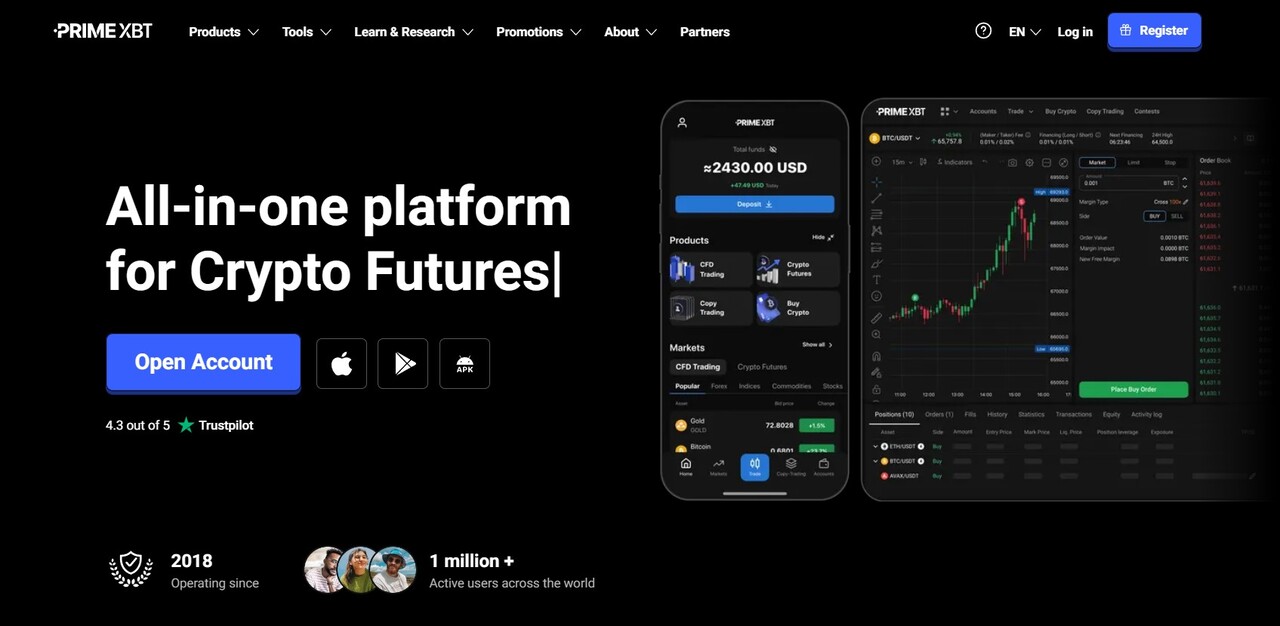
PrimeXBT unique features
- Multiple assets: PrimeXBT offers CFDs, forex, cryptocurrencies and crypto futures to its users.
- High leverage: Traders looking to maximize their returns will find up to 200x leverage on PrimeXBT crypto futures contracts.
Crypto leverage trading on PrimeXBT
PrimeXBT offers up to 200x leverage, which is one of the highest leverages you can get on crypto futures. Additionally, PrimeXBT utilizes deep liquidity and a proprietary order book to enable traders to make informed decisions and experience fast trade execution.
Those who don’t want to use 200x leverage can adjust it to a number that better suits their trading needs. Additionally, PrimeXBT offers expert trading tools and can be integrated into TradingView. This allows the use of advanced trading charts and technical indicators.
PrimeXBT continues to court high-beta traders with frequent leverage-band updates on BTC and ETH and aggressive commodity leverage for small-notional positions. You get multi-asset coverage in one terminal and regular risk guides that explain liquidation math and sizing.
What are PrimeXBT trading fees?
PrimeXBT has straightforward and affordable fees of 0.01% for the maker and 0.02% for the taker. This means that if you place a market order, you would pay the taker fee while placing limit orders charge the maker fee.
| Fees | 0.01% maker / 0.02% taker (crypto futures; tiered, “from”) |
| Max leverage | Up to 200× in some markets |
| Contract types | Perpetual CFDs (linear) |
| Margin modes | Cross & isolated (platform adjusts to avoid liquidation) |
| Accepted collateral & haircuts | BTC, ETH, USDT, USDC (platform-supported margins); haircuts not publicly listed |
| Max position size | Varies by instrument; shown per market in UI. |
| Risk tiers | Per-symbol risk/position limits in UI. |
Pros
- Flexible cross and isolated margin
- High leverage on multiple markets
- Simple, fast derivatives UI
- Quick collateral conversion for margin
- Clear maintenance-margin thresholds
Cons:
- CFD-style model; transparency varies
- Limited instrument breadth (no options)
- Liquidity trails top-tier venues
2. Margex: Best low-fee leverage trading platform
How it started: Founded in 2020, Margex is a newcomer in the industry. But thanks to its offering, including copy trading features, staking, and more, Margex has over 500,000 registered users from across the world.
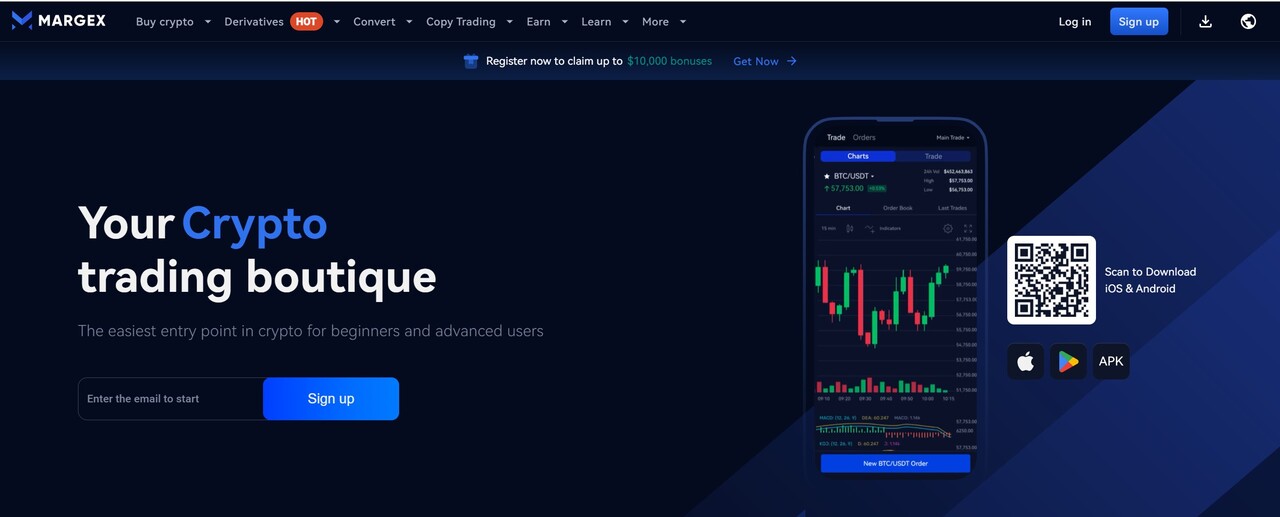
Margex unique features
- Leverage: Trade with up to 100x leverage on crypto futures. You can always lower the leverage – or even try with a demo account to get familiarized with the platform.
- Staking: Those who want to diversify from trading with leverage can use the staking feature and passively grow their assets. On top of that, there are copy trading features for a more aggressive approach to passive income.
Crypto leverage trading on Margex
Margex offers up to 100× on perpetuals with clean execution and both cross and isolated margin in one account. This means you control $100,000 with a $1,000 investment. And because wallets are multicollateral, you can deposit one asset and trade many, while platform docs spell out risk and liquidation step-by-step. Thankfully, traders can adjust their leverage to a number that works best for their financial situation.
What are Margex trading fees?
Margex uses the same maker/taker fee structure that most crypto trading platforms use. However, Margex’s fees are on the higher end with makers paying 0.019% and takers 0.06%. There are also funding (financing) fees if you use margin. The fees vary depending on the asset you trade and the fee is incurred every 8 hours.
| Fees | 0.019% maker / 0.060% taker (perpetual swaps; flat) |
| Max leverage | Up to 100× |
| Contract types | Perpetual swaps (linear) |
| Margin modes | Isolated & Cross |
| Accepted collateral & haircuts | Multi-collateral wallets (BTC, ETH, USDT, USDC, etc.); haircuts not listed |
| Max position size | Per-symbol caps via risk limits in UI. |
| Risk tiers | Pair-specific risk tiers in terminal. |
Pros
- Clean perps interface for beginners
- Cross and isolated margin support
- Multi-collateral margin wallet
- Tiered risk limits per pair
- Consistent 8-hour funding cycles
Cons:
- No dated futures or options
- Fewer listed contracts overall
3. MEXC: Top platform offering 100x leverage or more
How it started: MEXC was founded in 2018. Serving over 10 million users from more than 170 countries, this is one of the biggest crypto exchanges. That’s not surprising given the low fees, high liquidity, fast transaction speeds and many useful features.
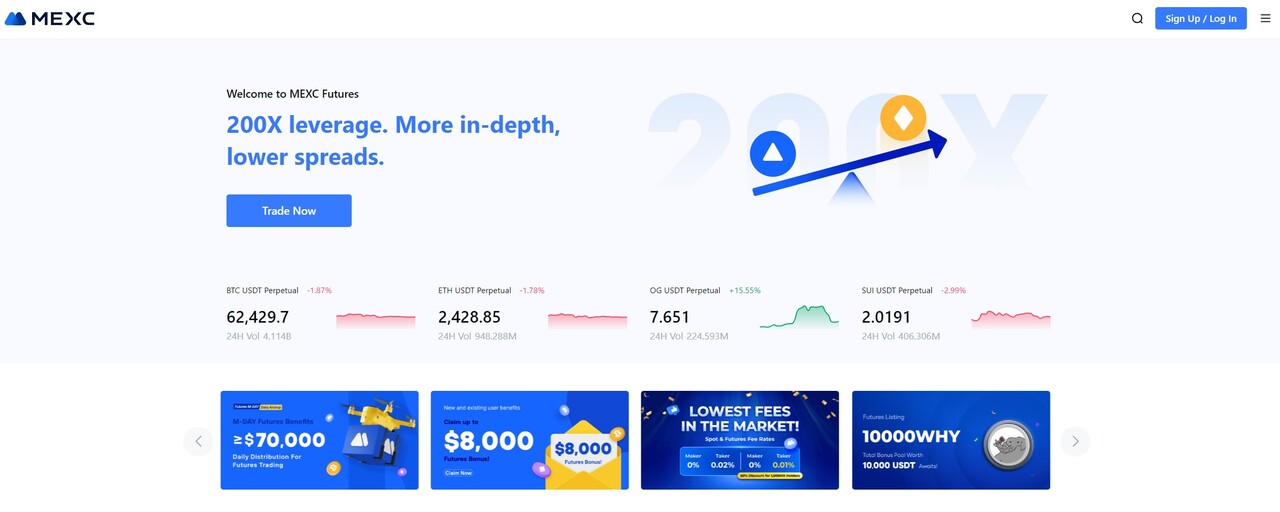
MEXC unique features
- High leverage: Traders looking to maximize their rewards can use up to 200x leverage on crypto futures. Users can choose between perpetual futures with USDT as a collateral or a crypto coin as a collateral.
- Industry-leading liquidity: MEXC boasts op liquidity on over 90% of its pairs, ensuring fast execution and stability during volatile market conditions.
Crypto leverage trading on MEXC
MEXC leans into high-leverage trading with up to 500× on selected USDT-M contracts and frequent 0-fee futures campaigns on named pairs. Liquidity is broad across hundreds of perps, but fee and leverage terms can vary by region and pair, check the live promo and pair pages.
In an isolated margin, a certain amount of margin will be added to the position, and if the margin drops below the maintenance level, your position will be liquidated. You can add or reduce the margin for the position at any time. In cross margin, your margin is shared across all positions. In case liquidation happens, traders could lose the margin and all positions can be settled.
What are MEXC trading fees?
MEXC offers some of the lowest fees in the industry. Both spot and futures trading comes with a 0% fee for the market maker and a 0.02% fee for the market taker. This means that if you consistently place limit orders, you won’t pay any fees.
Despite that, there are still funding rates you have to pay if you use margin. Similar to other trading platforms, the fee is calculated every 8 hours, while the fee itself depends on the asset you trade.
| Fees | 0.00% maker / 0.02% taker (USDT-M perps; MX token gives an extra –20% taker) |
| Max leverage | Up to 500× (pairs vary) |
| Contract types | USDT-M & Coin-M perps; delivery futures; (no listed vanilla options) |
| Margin modes | Cross, Isolated, Portfolio/Multi-asset margin |
| Accepted collateral & haircuts | Multi-asset collateral (discounts apply by asset) |
| Max position size | Risk limit tiers per symbol. |
| Risk tiers | Tiered risk limits (auto-adjust leverage/notional). |
Pros
- Very wide perps coverage
- High leverage caps on majors
- Portfolio/unified margin available
- Competitive taker fees on futures
- Partial liquidation and risk tiers
Cons:
- Funding volatility on long-tail pairs
- ADL risk on illiquid markets
4. BloFin: Best platform for beginners in leverage trading
How it started: BloFin was founded in 2019 with the focus on leveraged trading and crypto futures. This is a minimal-KYC exchange, meaning you don’t have to submit ID documents to start trading. Moreover, BloFin offers generous welcome bonus for new investors.
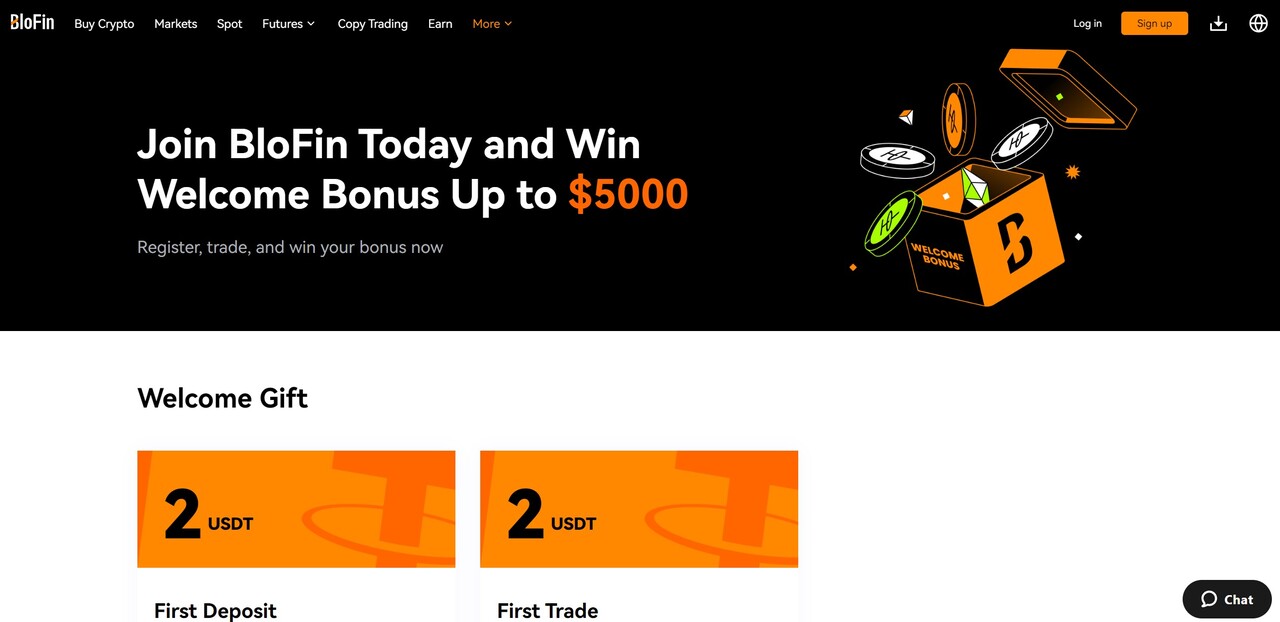
BloFin unique features
- Generous welcome bonus: Earn up to $5,000 after you meet the required criteria, including depositing funds and trading.
- Asset security and transparency: BloFin is focused on asset security, which is why it has partnered with Fireblocks for asset custody. The company claims to hold a 1:1 reserve of all customer assets.
Crypto leverage trading on BloFin
BloFin upgraded leverage on BTC and ETH perps to 150× and continues to emphasize institutional-grade custody/workflows. It’s a smaller venue than the mega-exchanges, yet the fee schedule and risk controls target active futures users, which allows users to maximize their return. Users can select a variety of features on popular cryptocurrencies, but also on more obscure tokens
What are BloFin trading fees?
BloFin offers competitive fees for market makers of 0.02%. The taker fee is on the higher end at 0.06%. This means, you could save money on fees by placing limit orders.
| Fees | 0.02% maker / 0.06% taker (futures; VIP tiers reduce further) |
| Max leverage | Varies by contract; leverage & margin tiers updated |
| Contract types | Perpetual swaps (linear) |
| Margin modes | Cross/Isolated; Unified Trading Account (multi-currency) |
| Accepted collateral & haircuts | Multi-currency collateral, USD-valued; haircuts/discounts implied by UTA |
| Max position size | Per-symbol tier caps |
| Risk tiers | Published tier updates |
Pros
- Unified account, multi-currency margin
- Competitive fee structure for perps
- Fast listings of new contracts
- Straightforward API for futures
Cons:
- Thinner books than tier-1 venues
- Limited product set; no options
- Insurance/ADL disclosures less detailed
5. CEX.IO: Best forex leverage broker for 2026
How it started: CEX.IO launched in 2013 as a Bitcoin cloud mining provider. By 2014, it became the first exchange to allow BTC purchases with credit cards. Over the years, CEX.IO expanded globally, serving 30+ U.S. states and securing 30+ regulatory licenses. It has processed $7.5 billion in customer deposits since 2019.
CEX.IO unique features
CEX.IO offers a comprehensive suite of services for traders and businesses. It supports spot trading with deep liquidity, advanced charts, and stop orders. Margin trading allows users to leverage up to 10x, with various order types and analytics tools. The trading API enables automated trading solutions for crypto.
For everyday users, CEX.IO provides a crypto debit card, an instant buy feature, and a multi-functional wallet. Staking rewards generate passive income, while the CeDeFi Swap integrates Web3 functionality. Businesses can access institutional-grade trading through CEX.IO Prime.
Crypto leverage trading on CEX.IO
CEX.IO’s standalone Margin Trading now advertises up to 20× with isolated and cross sub-accounts and fresh pair pages. But several live pages reference 10×, so practical caps may depend on the asset, account, and region, confirm in-app before sizing.
You get access to professional trading tools, aggregated liquidity, and risk management features like margin calls. CEX.IO sends alerts when your margin level drops to 75% and 50%. If it falls to 25%, the platform liquidates your position automatically to prevent deeper losses. Security, regulatory compliance, and 24/7 support give CEX.IO a more structured feel for leverage trading.
And now, CEX.IO has expanded for UK customers too. UK-based users can spot trade over 100 cryptocurrencies, including Bitcoin, major altcoins, and even meme coins like Dogecoin and PEPE. While margin is restricted, it’s a move that puts UK users on the same level as CEX.IO’s European Union customers — with full access to the same features and trading options.
What are CEX.IO trading fees?
CEX.IO charges fees for opening and closing margin positions, similar to spot trading fees. Interest on borrowed funds accrues hourly as a rollover fee. Your account level and trading pair determine specific rates. Before trading with leverage, check CEX.IO’s fee schedule. Understanding rollover costs and margin call levels is crucial to managing your risk.
| Fees | No native perps/futures. Their separate CEX.IO Broker (CFDs) currently advertises 0% |
| Max leverage | Up to 20× on margin trading (not perps) |
| Contract types | Margin on spot; CFDs via CEX.IO Broker; no native perps/options listed on main exchange |
| Margin modes | Isolated-style per position on margin |
| Accepted collateral & haircuts | Collateral per margin account (asset-based); haircuts not disclosed |
| Max position size | Per-pair limits in trading UI. |
| Risk tiers | N/A for perps (no native derivatives). |
6. Coinbase: Best leverage platform for small accounts
How it started: Coinbase was founded in 2012 by Brian Armstrong and Fred Ehrsam. By trading volume, It is the largest US crypto exchange. With over 100 million users, it boasts a global presence and a remote-first work model.
Coinbase unique features
- Coinbase Earn: Learn and Earn Crypto: Coinbase encourages new investors with its “earn while you learn” program. Users watch videos and take quizzes about cryptocurrencies while earning rewards. It’s a great introductory way not only to build knowledge but also to earn interest on your crypto through passive engagement.
- Coinbase (custodial exchange) + Coinbase Wallet (self-custody): The default wallet for trades on Coinbase. Private keys are stored on the exchange, reducing security. Coinbase dApp Wallet caters to Ethereum-based ERC-20 tokens. The third choice is Coinbase Wallet, a self-custody wallet stores crypto assets and NFTs, offering users more control over their holdings. (It’s a Separate app; no Coinbase account is required.)
Coinbase Wallet teamed up with Blockaid to enhance security measures and safeguard users from fraudulent activities. By integrating Blockaid technology, Coinbase successfully prevented over $75 million of funds from being stolen. The security tool analyzed 114 million transactions and DApp connections to stop nearly 800,000 wallet connections to harmful decentralized apps.
Crypto leverage trading on Coinbase
While leverage trading was introduced a bit late to the market compared to its platform, its offerings are nothing to frown upon with its Deribit acquisition (Aug 14, 2025), making options a core part of the Coinbase’s derivatives story.
Coinbase now offers CFTC-regulated “perpetual-style” futures to U.S. traders with up to 10× leverage, plus international perps for eligible non-U.S. users. And it’s pushing more risk education, position sizing, liquidation avoidance, and funding mechanics, directly in product. These limits are reviewed frequently, taking into account the exchange’s order book depth, volumes, and insurance fund balances.
What are Coinbase trading fees?
Coinbase fees are not displayed upfront. They depend on payment methods, order size, and market conditions. Expect fees to range from $0.99 to $2.99, with an added spread of 0.5%. While Coinbase offers a user-friendly platform, its fees can be high compared to competitors. Consider exploring the Advanced Trade option for a more transparent fee structure.
| Fees | 0.00% maker / 0.03% taker promo for perps; some eligible markets show 0.00%/0.00% |
| Max leverage | U.S. “perpetual-style” futures up to 10× , (b) Coinbase International Exchange perps up to 50× |
| Contract types | Perpetual futures (USDC-settled by default) |
| Margin modes | Isolated by default; cross with Multi-Asset Collateral (BTC/ETH) for some accounts |
| Accepted collateral & haircuts | USDC by default; optional BTC/ETH collateral; (USDC integration with Nodal Clear for U.S. futures proposed) |
| Max position size | Per-product and tier; see trading rules |
| Risk tiers | Base IM % → position-weighted IM; tiers per product |
Pros
- Conservative leverage reduces blow-ups
- Clear margin rules and liquidations
- Strong compliance reputation
- Spot-margin suits cautious traders
- Simple onboarding to leveraged trading
Cons:
- No native perps or options
- Lower leverage than offshore venues
- Limited advanced risk tools (ADL/IF)
7. Kraken (Kraken Futures / Kraken Pro): Safest platform for high-leverage trading
How it started: Founded in 2013 by Jesse Powell, Kraken is a global cryptocurrency exchange catering to casual and professional investors. They focus on secure trading with low fees for high-volume trades. The exchange acquired Coin Meester B.V. (BCM), a well-known crypto broker in the Netherlands. The acquisition allows Kraken to increase its presence in European markets.
Kraken unique features
- Kraken instant buy: Ideal for beginners, allowing quick and easy crypto purchases with fast verification.
- Kraken Pro: An advanced interface for experienced traders. It’s highly customizable and offers spot, margin, and staking features in one place.
Based on security audits by CER.live, a trusted platform, Kraken is ranked second for cryptocurrency exchange security. Kraken increased spot-margin leverage on five majors to 10× and broadened its derivatives slate with 24/7 FX perpetuals. Futures still go up to 50× with clear margin schedules and multi-collateral support in Kraken Pro.
What are Kraken trading fees?
Kraken offers two interfaces. Kraken Instant Buy charges a flat fee (0.9% for stablecoins, 1.5% for others) for simple purchases. For lower costs, use Kraken Pro, with maker/taker fees starting at 0.16% and 0.26%, respectively.
| Fees | Maker 0.02% / Taker 0.05% (Futures) |
| Max leverage | Up to 50× on perps/futures |
| Contract types | Perpetual & fixed-maturity futures (linear; USD-settled) |
| Margin modes | Single/multi-collateral; haircuts on non-USD collateral |
| Accepted collateral & haircuts | Cash FX 0% haircut; ADA/DAI/DOT 10% haircut examples |
| Max position size | Listed per instrument (e.g., “Max Position (Base)” in specs) |
| Risk tiers | Per-product tiering |
Pros
- Perps and dated futures available
- Regulated venue with robust controls
- Partial liquidation style risk engine
- Clear contract specs and limits
Cons:
- Max leverage below 100× peers
- Fewer listings than OKX/Binance
- No vanilla options market
8. OKX: Platform with the most advanced risk management tools
How it started: OKX founded in 2017 by Star Xu, has grown into a global exchange with 50 million users and partnerships like Manchester City and the Australian Olympic Team. Now it’s making moves in the U.S. The company also set up a regional headquarters in the US, launching a new exchange and a Web3 wallet that supports over 130 blockchains, offering token swaps and NFT access.

OKX unique features
- Self-Trade Protection (STP): Traders who execute algorithms for trading will love this feature. STP prevents you from unintentional self-trades. API traders will benefit from STP the most.
- Trading Bots Marketplace 2.0: Crypto trading bots developers can upload their systems to the bots marketplace and enjoy a revenue share from the profits earned by the automated system.
The OKX is a one-stop shop for crypto enthusiasts. Trade spot markets, simple and complex options, or delve into derivatives like margin, futures, and perpetual swaps. Explore the NFT marketplace, build trading bots, or participate in block trades. OKX stands out with staking/mining-alternatives language (ETC/other PoW, or staking ETH). Tutorials guide users through the mining process, making it easier to earn crypto.
This OKX review shows how the platform uses leverage trading to offer more than just basic spot trading. You can use your cryptocurrency holdings to access perpetual futures and margin accounts. OKX retains up to 125× on perps and continues to formalize risk controls like partial liquidation thresholds and ADL. Teams gain a group-RFQ workflow at the API level while retail gets clearer explainers on the margin level and liquidation triggers.
What are OKX trading fees?
OKX keeps costs low. Spot trading fees start at 0.08% for limit orders and 0.1% for market orders. Futures fees are even lower, at 0.02% and 0.05% respectively. Hold OKB tokens or trade BTC and ETH for further fee reductions. Deposits are free, and OKX only charges network fees for withdrawals.
| Fees | Maker 0.020% / Taker 0.050% (futures/perps, retail tier) |
| Max leverage | Up to 125× (pair/tier dependent) |
| Contract types | Perps; weekly/bi-weekly/monthly/quarterly futures; vanilla options; linear & inverse |
| Margin modes | Cross, Isolated, Portfolio/Unified margin |
| Accepted collateral & haircuts | Broad list with discount rates (haircuts) published |
| Max position size | Risk limit tiers per symbol |
| Risk tiers | Tiered margins with auto-tier migration |
Pros
- Deep liquidity across perps/futures
- Portfolio/Unified margin with haircuts
- Broad set: perps, delivery, options
- Transparent insurance fund mechanics
Cons:
- System complexity for new traders
- ADL still possible in tail events
9. Binance: Fastest execution leverage trading platform
How it started: Founded in 2017 by Changpeng Zhao, a veteran of high-frequency trading systems, Binance has become the world’s largest crypto exchange by daily trading volume (excluding the US). The platform caters to global users interested in altcoins, offering over 600 crypto-to-crypto trading pairs and NFT purchases.
Binance unique features
- Biggest crypto exchange: Binance enjoys the largest trading volumes among all centralized exchanges. Tokens that are listed on Binance benefit from strong liquidity, trust, and an uptick in price upon listing.
- SAFU: Binance utilizes a Secure Asset Fund for Users (SAFU), allocating 10% of trading fees to protect user funds. However, with over 350 cryptocurrencies available globally, only 150 are accessible in the US.
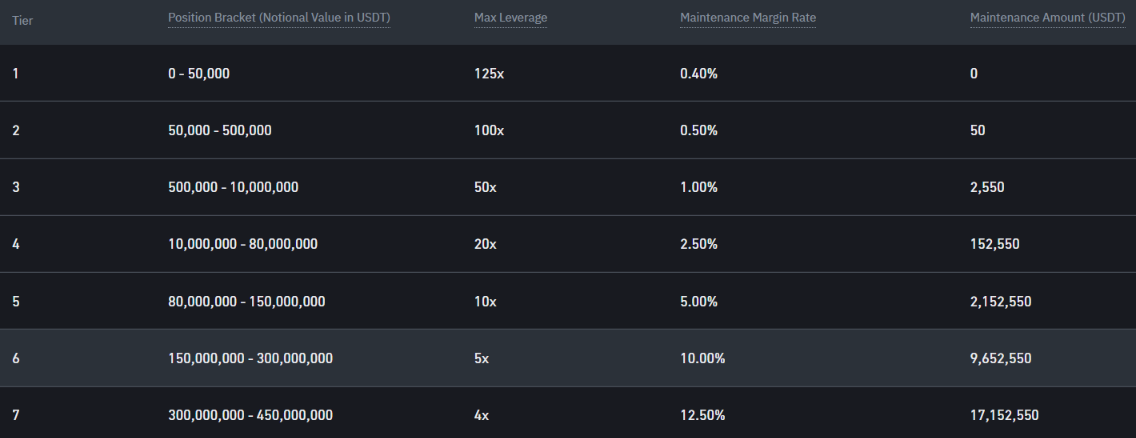
Binance allows leveraged trading on over 600 cryptocurrencies, with perpetual futures and options available. The platform keeps 125× max on flagship perps but actively tunes leverage tiers, haircuts, and funding cadence. The higher your balance, the lower the exchange’s leverage will offer. Portfolio Margin/PM Pro supports broad collateral, and new contracts sometimes open in pre-market at 5× before graduating to standard tiers. Binance faces regulatory scrutiny in several countries, so be aware of potential restrictions.
What are Binance trading fees?
Crypto trading fees range from 0.05% to 0.1%, but card purchases incur higher fees (1%-3%). Current base spot fee language (often shown as 0.10% before discounts) and keep futures fee tiers separate (VIP0 commonly cited as 0.02%/0.04%)
| Fees | USDT-M VIP0: 0.02%/0.04%; COIN-M differs |
| Max leverage | Up to 125× (BTC/major) |
| Contract types | USDT-M & COIN-M perps; COIN-M delivery (quarterly); European options; linear & inverse |
| Margin modes | Cross, Isolated, Portfolio/Multi-assets |
| Accepted collateral & haircuts | Multi-assets mode with haircuts (e.g., BTC/ETH/BNB −5%) |
| Max position size | Risk limit tiers per symbol |
| Risk tiers | Tiered notional → IM/MM scaling |
Pros
- Deepest books on BTC/ETH perps
- Perps, delivery futures, and options
- Portfolio margin and risk tiers
- Competitive fees with VIP tiers
Cons:
- Access varies by jurisdiction
- Complexity across many product lines
10. KuCoin: Best mobile app for leverage trading
How it started: Kucoin was founded in 2017. It has emerged as a top destination for altcoin trading. The exchange, led by CEO Johnny Lyu, offers a massive library of over 200 cryptocurrencies available for leverage.

KuCoin unique features
- P2P and staking support: The exchange supports both staking and peer-to-peer (P2P) trading, which is uncommon among major exchanges.
- Account-bound tokens: KuCoin Account-Bound Tokens (KABT) allow verified user credentials to unlock exclusive benefits within the KuCoin ecosystem, providing a revolutionary step for on-chain identity in the Web3 ecosystem.
Holders can earn passive income through KuCoin’s soft staking program and share a portion of daily exchange profits. Additionally, users receive daily cryptocurrency dividends by holding KuCoin Shares (KCS). KuCoin has increased its leverage options for Bitcoin and Tether trades, with users able to amplify gains (and losses) with up to 125x leverage. Margin trading ratios vary by coin, with some reaching 50x.
KuCoin Futures frequently rotates contracts and adjusts limits, recently delisting LEVERUSDT perps, so leverage availability is pair-specific and time-sensitive. Traders should check each contract’s latest tiers before sizing.
What are KuCoin trading fees?
Fees are competitive. Kucoin uses a maker-taker structure, with a low 0.1% maker fee and a 0.1% taker fee with no account minimum. Holding KCS grants an additional 20% discount.
| Fees | Futures VIP0: Maker 0.02% / Taker 0.06%. |
| Max leverage | Up to 125× (pair/tier dependent) |
| Contract types | USDT-M & Coin-M perps; (delivery futures limited) |
| Margin modes | Cross, Isolated, Portfolio |
| Accepted collateral & haircuts | Multi-collateral with discounts listed |
| Max position size | Risk limits per contract. |
| Risk tiers | Tiered notional → margin scaling. |
Pros
- Wide perps catalog including alts
- High leverage caps on select pairs
- Portfolio margin and cross/isolated
- Tiered risk limits by notional
- Frequent listings, active derivatives flow
Cons:
- Depth trails Binance/OKX on majors
- ADL more likely on small caps
- Collateral haircuts can be steep
11. BitMart: Best low-KYC leverage trading platform in 2026
How it started: BitMart was founded in 2017 by Sheldon Xia, a figure involved in blockchain initiatives. BitMart is a centralized exchange (CEX) that serves over 9 million users globally. Headquartered in the Cayman Islands, it offers various services beyond trading, including staking, lending, and derivatives.
BitMart unique features
Besides standard trading options, BitMart distinguishes itself with features like BitMart Earn. It allows users to earn passive income on their crypto holdings through various savings products.
- Flexible Savings: Earn interest on deposited crypto with the ability to withdraw funds anytime.
- Fixed Savings: Earn a higher interest rate by locking in your crypto for a predetermined period.
BitMart added futures risk tools like guaranteed TP/SL and slippage caps, and it keeps updating leverage tiers on individual pairs. The exchange touts engine upgrades and a new CEO focus on AI-assisted trading analytics. Max stated leverage remains up to 125×.
For experienced users, BitMart caters to margin and futures trading. Since 2020, the platform has offered futures markets with leverage up to 100x on certain assets. In May 2024, BitMart added the Euro to its P2P marketplace, hoping to draw more European traders.
What are BitMart trading fees?
BitMart employs a tiered maker-taker fee structure with fees starting at 0.25% and decreasing based on 30-day trading volume and holdings of the platform’s token, BMX. Futures trading offers significantly lower fees, with maker fees at 0.04% and taker fees at 0.06%. There are no deposit fees, but withdrawal fees vary by coin.
| Fees | 0.02% maker / 0.06% taker for futures |
| Max leverage | Up to 125×; cross & isolated supported |
| Contract types | USDT-M & Coin-M perps (linear/inverse) |
| Margin modes | Cross & Isolated |
| Accepted collateral & haircuts | USDT for USDⓈ-M; coin collateral for Coin-M (per product docs) |
| Max position size | Risk limits per contract |
| Risk tiers | Displayed in “Market information & risk limit” |
Pros
- Straightforward futures UI
- Cross and isolated margin modes
- Standard 8-hour funding cadence
- Insurance fund and ADL documented
- Up to 125× on select contracts
Cons:
- Thinner liquidity, higher impact cost
- Smaller contract universe
- Fewer advanced margin features
Pros and cons of crypto leverage trading
Crypto leverage trading offers the potential for amplified gains, but it also comes with significant risks. Before diving in, understand both sides of the coin.
| Leveraging pros | Leveraging cons |
|---|---|
| Amplify profits: Leverage magnifies potential returns by controlling a larger position with a smaller investment. | Flexibility: Leverage offers greater control over trading strategies by enabling long and short positions. |
| Short selling: Leverage allows traders to profit from falling crypto prices by opening short positions. | Liquidation risk: If the market moves against you, your position could be liquidated to cover losses, wiping out your initial investment. |
| Increased capital efficiency: Traders can maximize the use of their capital by controlling more assets with less upfront cost. | Volatility: The inherently volatile nature of cryptocurrencies can exacerbate losses when using leverage. |
| Flexibility: Leverage offers greater control over trading strategies by enabling long and short positions. | Margin calls: Unexpected price swings can trigger margin calls, forcing you to deposit additional funds to maintain your position. |
| Potential for faster gains: Leverage can accelerate profit accumulation when market movements align with your predictions. | Psychological pressure: The potential for magnified losses can lead to emotional trading decisions and cloud your judgment. |
How to choose the right leverage trading platform for you?
Choosing the right leverage trading platform is crucial for minimizing risks and maximizing potential profits. Here’s how to approach it:
- Regulation and trustworthiness
Ensure the platform is regulated by a recognized financial authority (e.g., SEC, FCA). This provides a level of safety and recourse if things go wrong. Research user reviews and ratings to gauge its reputation. - Leverage options
Check the leverage ratios offered. Different platforms provide varying amounts of leverage (e.g., 2x, 5x, 50x). Higher leverage can amplify both gains and losses, so choose what aligns with your risk tolerance. - Fees and costs
Understand the fees associated with leverage trading. Look for hidden charges like overnight fees, margin call penalties, and withdrawal fees. A platform with clear, low fees is usually better for long-term traders. - Available Assets and Markets
Ensure the platform offers the assets you want to trade, such as crypto, forex, stocks, or commodities. A diverse selection means you can expand your portfolio without switching platforms. - Risk management tools
Look for features like stop-loss orders, margin calls, and automated trading. These help manage risk by limiting potential losses when the market moves against you. - Liquidity and execution speed
Check for low slippage and quick order execution. Higher liquidity ensures you can enter and exit trades without significant price shifts, especially important when using leverage. Alternatively, some traders also use peer-to-peer (P2P) crypto exchanges to access different liquidity pools and local payment options - Demo account (availability)
A demo account allows you to practice leverage trading without risking real money. Test different platforms to find the one that suits your strategy and preferences before going live.
By evaluating these factors, you can find a leverage trading platform that suits your trading style, risk appetite, and goals.
FAQs
What is leverage trading in crypto?
Is leverage trading safe for beginners?
What’s the minimum deposit to start leverage trading?
How do funding rates affect leverage trading profits?
Can I earn passive income while leverage trading?
How to manage risk when trading with high leverage?
How does AI-based trading impact leverage trading strategies?
What’s the safest leverage level for beginners?
What hidden fees should I watch out for on leverage platforms?
Can leverage trading bots outperform manual trading in 2026?
What are the best offshore crypto leverage trading platforms in 2026?
Can I leverage trade crypto anonymously in 2026?
Which platforms allow leverage trading on tokenized stocks or forex pairs?
Are there leverage trading platforms that accept US customers without VPNs?
References:
- Crypto whale who made millions on leverage trading is a convicted fraudster | CoinDesk
- Leveraged tokens explained: A comprehensive guide for crypto traders | KuCoin
- Leverage. Overview of risks and benefits in 2025 | MEXC Blog
- 3 ways futures traders can use leverage and avoid liquidation losses | CoinTelegraph
- Beyond the allure: Lower leverage in forex trading | Forbes
- Leveraged ETFs explained: A comprehensive guide for investors | Forbes
- Crypto exchanges turn to derivatives to lure cautious investors | Financial Times